Australian government bureau reports that wind and sun will be the cheapest energy technologies
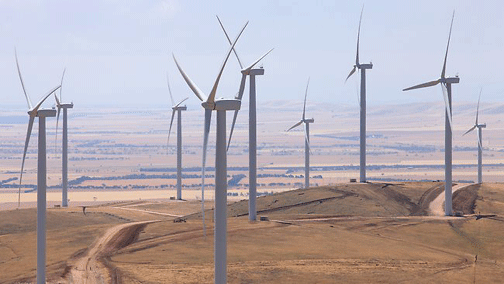 The turning point for renewables has arrived http://www.abc.net.au/environment/articles/2012/08/13/3565263.htm ANDREW BRAYABC 13 AUG 2012 Wind is predicted to be the cheapest form of energy by 2020.
THE BUREAU OF RESOURCE AND ENERGY ECONOMICS provides the Federal Government with all it wants to know about energy. Under the leadership of Energy Minister, Martin Ferguson, it is the last word on energy thinking in Canberra. In its Draft Energy White Paper last year it painted a rosy future for coal, gas and oil, with only a bit part for renewables.
Their message has been simple – when you want real energy, dig it out of the ground.
But recently it did something no one had ever imagined. It covered its latest report (pdf), , the Australian Energy Technology Assessment (AETA), not with pictures of massive coal loaders but with pictures of solar panels.
It was a declaration by this most conservative of government bureaucracies that renewable energy will become Australia’s energy source of choice, not because it is clean, safe and popular – all of which are true – but because it is cheap. The report slashes previous estimates of the cost of a whole range of renewables technologies and in some cases doubles the predicted cost of coal-fired generation.
By the end of this decade, it estimates that onshore wind will be the cheapest source of energy we have. At an average cost of $90 per megawatt-hour (MWh) and in some cases as cheap as $60/MWh it will be cheaper than coal and cheaper than gas.
By 2030, the cheapest option will be solar PV, which could cost as little as $50/MWh, followed closely by wind and landfill gas.
Many renewable industry figures say that even these numbers understate the falling price of renewables with the solar thermal industry, in particular, questioning why their estimate of $252/MWh in a recent report was rejected in favour of a much higher estimate for the same technology.
Meanwhile, the story for coal and gas goes in completely the other direction with carbon pricing and rising fuel costs dramatically driving up prices. Carbon capture and storage (CCS), should it ever eventuate, will only make fossil-fuel-powered energy more expensive again. The cheapest brown coal option in 2020 is $129/MWh, though if you’re one of those that thinks there’ll be no carbon price, you could get it for around $90/MWh. The cheapest brown coal plant with CCS isn’t expected to appear for over a decade, when it comes in above $150/MWh.
Gas no longer appears as the cheap, low-emissions saviour many have claimed. In 2020 it is predicted to be more expensive than wind and some bioenergy technologies. By 2030 the cheapest gas plants will be twice as expensive as the cheapest solar PV plants.
These projections turn energy thinking in Australia on its head and show that the longer we delay a transition to renewable energy, the more it will cost us.
Together with massive global spending on renewables, Australia’s Renewable Energy Target (RET) is working just as it was designed to do and is bringing down the cost of locally built renewables. This is bringing with it thousands of jobs, the majority in regional areas.
Expanding the RET beyond the current 20 per cent by 2020 target is the best way for us to ensure Australia shares in the fruits of this global investment boom and the jobs and cheap, clean power it offers.
There is also a message here that state governments who stake their energy future on coal and gas do so at their peril. We can expect power consumers to look dimly on governments that opt for expensive fossil-fuel powered options when wind, solar and bioenergy would provide cheaper power.
In Victoria, these figures provide further evidence of the damage Ted Baillieu’s anti-wind laws are doing to our economy. Not a single new application for a wind farm has been lodged since Baillieu came to power nearly two years ago. Unless these laws are changed, Victoria will have no industry to build new wind farms just as the price power from wind becomes the lowest in the country.
Victoria’s current dependence on brown coal is nothing but a recipe for higher power prices into the future.
As the BREE report notes, “The results indicate that Australia’s energy future is likely to be very different to the present.”
The good news is that if we choose to continue to drive renewable energy it will not only be cleaner and safer but also cheaper.
No comments yet.
1 This month

of the week – Australians for War Powers Reform (AWPR)
To see nuclear-related stories in greater depth and intensity
 Antinuclear
Leave a comment