A great week for hypocrisy, uranium lobby, Jay Weatherill, and the Assange case
 It’s been a great week for hypocrisy, especially in Australia. The uranium industry, facing the continuing dizzying fall in prices, and investment, and the backdown of several projects in Australia – nevertheless comes up with a load of propaganda about its coming great future. ( Google “uranium” and you’ll see loads of this). Today we learn that ‘community education’ is about to happen – so uranium mining will become popular. And Paladin Energy’s Matthew Keane agrees, ( never mind that Paladin lost $39 over the 9 months to March 12).
South Australia’s Premier Jay Weatherill deserves a medal for hypocrisy. Today he’s saying that uranium sales are beneficial to the world, cutting carbon emissions. And says Weatherill, (THE AUSTRALIAN, 16/08/12) “”we should join others in the world in respecting India’s reasons for not signing the Nuclear Non-Proliferation Treaty, and in respecting India as an international citizen.” Meanwhile India is going gung ho testing nuclear missiles, and launching nuclear attack submarines.
But – let’s give the top medal to Bob Carr, Julia Gillard‘s government, and all who sail in it. Not a peep out of them, as UK is about to raid the ecuador Embassy, to make sure that Australian citizen Julian Assange can be delivered unto the USA – to be made an example of – a la the atrocious treatment of Bradley Manning?
On the world scene – Japan is very quiet on the health effects of Fukushima radiation. Nuclear lobby writers are out in force – attempting to discredit ionising radiation “low levl” as a cause of cancers and genetic malformations. Indeed they’re still pushing the “hormesis” idea – (“low level” radiation is good for you) meanwhile scientific findings on butterflies in Japan reveal the harmful effects of low level radiation, that are passed down through generations.
In USA the mainstream media are putting a calm face on the decision by the Nuclear Regulatory Commission to halt licensing of nuclear reactors, because – well, a court has ruled that there’s no confidence in the NRC’s Waste Confidence Rule. That rule has allowed nuclear reactors to be licensed, even though nobody knows what to do with the radioactive wastes. There is also a calm face on the USA’s current extreme heat wave, which is causing one nuclear reactor after another to slow down , or shut down – due to problems of hot cooling water.
UK police raiding Ecuador Embassy to capture Julian Assange?
 Ecuador to announce Assange asylum, Britain threat to raid embassy
  http://www.news.com.au/technology/ecuador-to-announce-assange-asylum-britain-threat-to-raid-embassy/story-e6frfro0-1226451411725#ixzz23kTVyVq3 Charles Miranda, wires From: News Limited Network August 16, 2012 Reports suggest British police have been seen
entering the Ecuadorian embassy.
The Press Association had earlier reported officers arriving outside the Ecuadorian Embassy, close to the Harrods store in Knightsbridge, London.
EARLIER BRITAIN is threatening to raid the Ecuadorian embassy to arrest Wikileaks’ founder Julian Assange.
Ecuador’s foreign minister, Ricardo Patino, told a news conference that the South American nation had received a written and verbal threat on Wednesday from Britain that “it could assault our embassy” if Assange was not handed over.\
Patino also said that Ecuador “has made a decision” on Mr Assange’s asylum bid and will announce it on Thursday at 7am local time (10pm AEST).
“Ecuador rejects in the most emphatic terms the explicit threat of the British official communication,” he told a press conference in Quito. He said such a threat was “improper of a democratic, civilised and rule abiding country”.
“If the measure announced in the British official communication is enacted, it will be interpreted by Ecuador as an unacceptable, unfriendly and hostile act and as an attempt against our sovereignty. It would force us to respond,” he said.
“We are not a British colony.” He said the threat was delivered to Ecuador’s foreign ministry and
ambassador in London.
The letter said: “You need to be aware that there is a legal base in the UK, the Diplomatic and Consular Premises Act 1987, that would allow us to take actions in order to arrest Mr Assange in the current premises of the Embassy.
“We sincerely hope that we do not reach that point, but if you are not capable of resolving this matter of Mr Assange’s presence in your premises, this is an open option for us.”
Red light for yellowcake in NSW: New campaign targets Premier’s uranium ambitions.
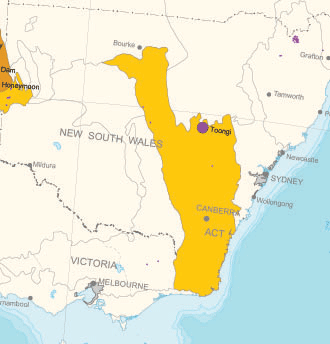 The NSW Uranium Free Charter and list of endorsing organisations is online at: http://nccnsw.org.au/uranium.
A community Charter opposing plans for development of a uranium mining industry in NSW will be launched at a public event in Sydney tonight, Thursday August 16.
The NSW Uranium Free Charter (attached and online at http://nccnsw.org.au/uranium) is an initiative of environment, trade union, public health and other groups concerned about the potential human and environmental impacts of uranium exploration and mining currently being promoted by the state government.
“The O’Farrell government has never taken its uranium plans to the people. This issue was not raised before the last state election and the government has no mandate to mine”, said Pepe Clarke from the Nature Conservation Council NSW. “In the shadow of Fukushima we should not be opening the back door to this dirty and dangerous trade”.
The Charter details concerns over the impact of uranium mining and the wider nuclear industry and calls for a shared energy future that is renewable – not radioactive. The document will be launched at the AMWU’s Tom Mann Theatre at 6pm tonight as part of a broadly endorsed public meeting. Continue reading
Environment and health groups call for end to Angela Pamela uranium uncertainty
Less than 2 weeks out from the election residents of Central Australia are left with the threat that either party could proceed with approval for a uranium mine at Angela Pamela, putting at risk the health of residents, our underground water supplies and the local environment.
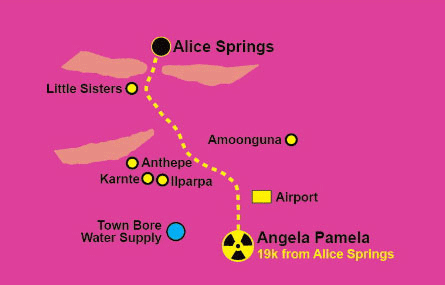

 The Arid Lands Environment Centre (ALEC) and the Public Health Association of Australia NT Branch (PHAA-NT) are calling on all parties and candidates to grant certainty to the Alice Springs community by committing to the enacting the Special Reserved Land status for Angela Pamela, thus protecting the site from any future mining activity.
In December 2011 the ALEC and PHAA-NT independently wrote to Minister Kon Vatskalis on behalf of Alice Springs residents concerned with the proposed development of a uranium mine within the Water Control District of Alice Springs. The letter requested the Minister to follow through on pre-election commitments to protect the deposit from mining.
Both groups specifically called upon the Minister to use powers granted under the Mineral Titles Act (2010) to act in the interest of the community and essential environmental services by granting the site a Special Reserved Land Order under Section 112 of the Act. The move would require the Minister to request a surrender of the current exploration license, giving certainty to the people of Alice Springs that any future government would be required to undertake a 30 day community consultation period before the Special Reserved status could be lifted.
ALEC Coordinator, Jimmy Cocking stated ‘The current uncertainty around the possibility of a uranium mine at Angela Pamela hinders our progress as a ‘world class’ solar city, a water smart town and reduces the desire for locally grown produce.’
On the eve of entering caretaker government status Minister Vatskalis responded by dodging the question of why in two years the government has taken no action to formally protect the Angela Pamela deposit, and instead reiterated NT Labor’s non-binding policy position to oppose a uranium mine at the site.
PHAA NT Branch Secretary Clive Rosewarne stated “This election we are looking for candidates to make a genuine and binding commitment to ensure the Angela Pamela deposit stays in the ground, and that means making the Minister genuinely respond to community pressure by invoking the Special Reserved Land provision of the Act”.
For further information/comment: Jimmy Cocking, Arid Lands Environment Centre (ALEC) 0423 511 931 Clive Rosewarne, Public Health Association Australia (NT Branch) 0487 282 303
In the shadow of Fukushima, Government blindly pushes repeat of nuclear agreement
 15 August 2012. Greens Senator Scott Ludlam, recently returned from Fukushima, today urged the Australian Government to consider the reality before locking Australia into a nuclear treaty for another five years.
“The Fifth Agreement to Extend the 1987 Regional Cooperative Agreement for Research, Development and Training related to Nuclear Science and Technology should not simply be rolled over for a further five year period,” Senator Ludlam said in a Dissenting Report on the deal.
“The Committee’s report perfunctorily dismisses the concerns and arguments provided in submissions and contrasts poorly with its past considered and detailed engagement on nuclear issues. It notes there ‘may have been an opportunity missed to upgrade the agreement rather than simply rolling it over’ but then goes on to recommend that the agreement be simply rolled over. It’s a negligent outcome.
“While the nuclear industry’s optimism may have a therapeutic function, it is not grounded in reality. This is an industry deeply shaken by the global financial crisis, the ongoing Fukushima disaster with its cover-ups and duplicity, and fierce competition from renewable technologies which continue to outpace nuclear.
Senator Ludlam said nuclear power was in terminal condition, as documented in the recently released World Nuclear Industry Status Report available at www.worldnuclearreport.org.
Need for patient scientific tracking of diseases and deaths from Fukushima radioactivity
[in the 12 months after Fukushima] an excess of 38,700 Japanese deaths, with no obvious cause.
Nobody should yet race to conclusions that 38,700 Japanese died from Fukushima exposure in the first year after the disaster.
The final element needed before conclusions are made is patience; vital statistics must continue to be tracked, and compared with radiation exposures to the Japanese people.
[In 2009] A team of Russian researchers, led by Dr. Alexey Yablokov, published results of 5,000 reports and articles
on Chernobyl – many in Russian languages never before made public. Yahlokov’s team concluded that near Chernobyl, increases in disease sand deaths were observed for nearly every human organ system.
 Let the Counting Begin Fukushima’s Nuclear Casualties http://www.counterpunch.org/2012/08/15/fukushimas-nuclear-casualties/ by JOSEPH MANGANO, 15 Aug 12 It’s been nearly 18 months since the disastrous nuclear meltdown at Fukushima. There have been many reports on the huge amounts of radioactivity escaping into the air and water, unusually high levels in air, water, and soil – along with atypically high levels of toxic chemicals in food – that actually “passed” government inspection and wasn’t banned like some other food.
Conspicuously absent are reports on effects of radiation exposure on the health of the Japanese people. Have any health officials publicly announced post-March 2011 numbers on fetal deaths, infant deaths, premature births, birth defects, cancer, or other health conditions? The answer so far is an emphatic “no.”
The prolonged silence doesn’t mean data doesn’t exist. Japanese health officials have been busy with their usual duties of collecting and posting statistics on the Internet for public inspection. It’s just that they aren’t calling the public’s attention to these numbers.
Thus, it is the public who must find the information and figure out what it means. After locating web sites, translating from Japanese, adding data for each of 12 months, and making some calculations, mortality trends in Japan after Fukushima are emerging. Continue reading
Australia’s uranium industry gearing up for a propaganda pitch
Both in Australia, and internationally, the nuclear industry is gearing up for a last ditch battle to “educate” the world’s 
public – C.M.
one of the issues that really dogged the industry across Australia for a number of years; there wasn’t great community engagement in terms of education about the industry but that’s now changing.”
 Uranium miners push ahead despite turbulence ABC News, By Kathryn Diss Aug 15, 2012…....Development hurdles
Uranium prices haven’t regained much lost ground which the industry says is hindering the development of new projects in WA and overseas.
Prices are sitting at about $50 a pound, almost half what they were before the disaster.
Mr Keane says the current price isn’t high enough to incentivise companies to bring the next wave of projects online.
“Since Fukushima, there has been a continual deferral of mega projects, such as Cameco’s Kintyre project and BHP’s Yeelirrie mine in WA,” he said.
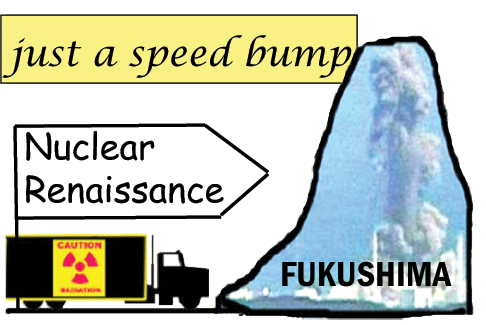 “Effectively big companies, which have assets in other commodities, are standing back and seeing what plays out from Fukushima.”…. Mr Khaliqi says the figures clearly show the disaster only damaged the industry’s image in the short-term….. one of the issues that really dogged the industry across Australia for a number of years; there wasn’t great community engagement in terms of education about the industry but that’s now changing.”
Paladin Energy’s Matthew Keane also believes change is occurring.
Global warming really affecting USA’s nuclear reactors

 Extreme Heat, Drought Show Vulnerability of Nuclear Power Plants Reactor shutdown in Connecticut is latest sign that nuclear energy would face challenges from climate change. By Robert Krier, InsideClimate News, 15 Aug 12, Will 2012 go down as the year that left the idea of nuclear energy expansion in the hot, dry dust?
Nuclear energy might be an important weapon in the battle against climate change, some scientists have argued, because it doesn’t emit greenhouse gases. But separate of all the other issues with nuclear, that big plus would be moot if the plants couldn’t operate, or became too inefficient, because of global warming. In June, InsideClimate News reported on the findings of Dennis Lettenmaier, a researcher at the University of Washington. His study found that nuclear and other power plants will see a 4 to 16 percent drop in production between 2031 and 2060 due to climate change-induced drought and heat.
The U.S. is getting plenty of both this year. Just Sunday, the Millstone nuclear plant in Waterford, Conn., had to shut down one of its two reactors because seawater was too warm to cool it. It was the first time in the plant’s 37-year history that the water pulled from the Long Island Sound was too warm to use.
So the question becomes, is the future already here?
Heat records have been falling by the thousands since spring, and on Aug. 9 theU.S. Drought Monitor map showed that 62.46 percent of the nation is under moderate to exceptional drought conditions. That’s down slightly from the peak of 63.86 percent last month, the highest percentage since the Drought Mitigation Center began producing the map in 2000. But the percentage of the country that is experiencing extreme to exceptional drought continued to rise and is now at 24.14 percent, almost a fourth of the country.
Much of the drought and unusual heat has been in areas that rely in part on nuclear plants: the upper Midwest, the Southeast and parts of New England.
When all of the nation’s 104 nuclear plants are fully operational, they supply about 20 percent of the energy generated in the United States. Those plants need water to operate, and in most cases, they need fresh water. There’s not a lot of fresh water to go around in much of the nation this summer, and that is putting nuclear energy to the test.
It’s also raising questions about how freshwater supplies should be managed in a world further taxed by climate change. Inevitably, there will be increased competition for water from a growing population, agriculture and the energy sector.
(Plants that use saltwater for cooling generally don’t have the same issues, because they never have a shortage of water. But the shutdown at Millstone shows they can still be vulnerable to heat waves.)
About 40 percent of the nation’s fresh water use goes toward energy generation, with nuclear energy considered a very water-intensive energy source….. http://insideclimatenews.org/news/20120815/nuclear-power-plants-energy-nrc-drought-weather-heat-water?utm_source=feedburner&utm_medium=feed&utm_campaign=Feed:%20solveclimate/blog%20(InsideClimate%20News)
Victor Harbor, South Australia, – the nation’s champion solar city
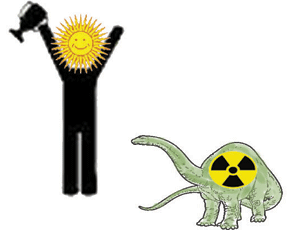 South Australia’s Victor Harbor A Solar Stronghold http://www.energymatters.com.au/index.php?main_page=news_article&article_id=3341 15 AUGUST, 2012 | by Energy Matters
Home owners in Victor Harbor, a seaside resort township situated 80 kilometres from Adelaide, South Australia, have been installing solar panels at a cracking pace. A Clean Energy Council (CEC) report late last year put Victor Harbor installations at 38% of all houses in the area – and the love affair with solar continues.
According to Victor Harbor Renewable Energy Programs, six meters per day were being installed in June 2012; resulting in a least 40% of the town’s houses now featuring solar power systems.
Given the recent 18% rise in electricity prices in South Australia, savings on power bills for Victor Harbor consumers are now estimated at over $1 million per annum – a very impressive outcome given the population of the area. “This changes our local economy for the better. The money stays here and the opportunity of harvesting what the CSIRO Smart Grid report terms ‘distributed energy,’ becomes an economic opportunity not just for Victor Harbor, but all regional communities,” states the VHREP web site.
The City of Victor Harbor set up a solar buyer’s group in 2009 that resulted in approximately 3,000 ratepayers across four councils installing solar panels. Asolar buyers group uses the power of bulk purchasing to reduce the cost of installing systems.
Across the Fleurieu Peninsula, the associated carbon emissions reduction of these systems is estimated at 3,000 tonnes per annum.
According to solar solutions provider Energy Matters, a good quality 5kW solar power system installed in Adelaide can realise electricity bill savings of over $1,800 a year – and similar savings can be achieved throughout the state.
Under South Australia’s feed in tariff program, new participants now receive 25.8c per kilowatt hour minimum for surplus electricity generated by their systems that is exported to the mains power grid.
As we reported earlier this week, South Australia has the highest penetration of rooftop solar panels among Australia’s National Electricity Market (NEM) regions, with around 20% of SA homes having installed systems by the end of February 2012.
50 years ago USA exploded thermonuclear bomb over the Pacific Ocean
Going Nuclear Over the Pacific , Past Imperfect, Smithsonian.com August 15, 2012“…Fifty years ago this summer there were strange doings in the skies above earth as well….. But of all the things happening in the skies that summer, nothing would be quite as spectacular, surreal and frightening as the military project code-named Starfish Prime . Just five days after Americans across the country witnessed traditional Fourth of July fireworks displays, the Atomic Energy Commission created the greatest man-made light show in history when it launched a thermonuclear warhead on the nose of a Thor rocket, creating a suborbital nuclear detonation 250 miles above the Pacific Ocean. Continue reading
1 This month

of the week – Australians for War Powers Reform (AWPR)
To see nuclear-related stories in greater depth and intensity
 Antinuclear