The Olympic Dam uranium project – uneconomic, unnecessary for South Australia
At its peak, the mine was expected to consume more electricity than the city of Adelaide, and 100 Olympic swimming pools worth of fresh water every day.
Olympic Dam was too expensive.
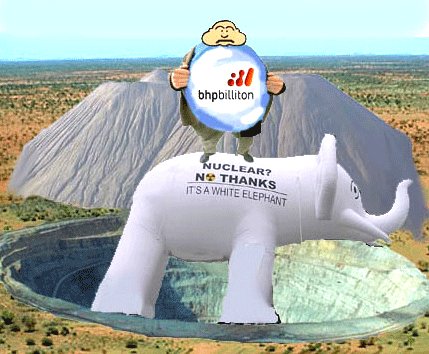
South Australia will be fine. Mining accounts for a relatively small share of South Australia’s overall economy, and only 1 per cent of its employment.
the carbon emissions from Olympic Dam would have dwarfed all the gains in emissions reductions that South Australia has made in renewable energy in recent years
The Olympic Dam Delay Has A Silver Lining New Matilda, By Ben Eltham 23 Aug 12, Why did BHP Billiton halt the Olympic Dam mine? The project was just too expensive. The decision is good news for the South Australian environment, writes Ben Eltham
Picture a hole in the ground four kilometres long and one kilometre deep. Picture a manmade mountain of dirt next to it nearly as high — a mountain of dirt dug from the ground and heaped next to that hole, a new landmark on the South Australian horizon.
Picture a mega-project so large and so thirsty that it would have required a new baseload electricity generator to meet its power needs, and a new desalination plant hundreds of kilometres away on the coast to make the water it required.
Picture a mine so vast, it would have increased the world supply of Uranium by a third.
This was the vast edifice that was to be Olympic Dam — when finished, the largest mine in the world. This astonishing feat of human ingenuity would have seen the excavation of a kilometre of rock in order to mine an ore body with the chimerical value of $1 trillion. Just getting to the ore body was expected to have taken four years of digging. At its peak, the mine was expected to consume more electricity than the city of Adelaide, and 100 Olympic swimming pools worth of fresh water every day.
Olympic Dam was too expensive. Mining is a costly business at the best of times, and in the middle of the great Australian mining boom of the 2000s, the costs of labour, capital and equipment have been ratcheting up across the industry. The Olympic Dam expansion was budgeted for perhaps $30 billion worth of capital expenditure, a vast sum of money by anyone’s measure……
There’s been a lot of speculation in the media that the Olympic Dam announcement means the beginning of the end of the mining boom. That may be true. However, as we’ve argued here before at New Matilda, a slowdown in mining investment would not necessarily be such a bad thing. Falling mining investment might help the Australian dollar to fall on world markets, assisting Aussie exporters. A slowing mining sector would also start to alleviate the very cost pressures that Marius Kloppers mentioned yesterday…..
South Australia will be fine. Mining accounts for a relatively small share of South Australia’s overall economy, and only 1 per cent of its employment. South Australia’s economy, like the rest of Australia, is mainly based in services in its capital of Adelaide. This sector will be largely unaffected, outside of a few specialist engineering firms.
There’s one unquestionable winner from the Olympic Dam decision: the South Australian environment. The delay in the expansion means that the vast earth moving project will be shelved for the time being. Millions of tonnes of uranium ore will no longer be dug up and shipped across the world to China. Millions of litres of water will no longer be needed. And vast amounts of greenhouse gases won’t be emitted. http://newmatilda.com/2012/08/23/olympic-dam-closures-silver-lining
As the Australian Conservation Foundation’s Simon O’Connor told New Matilda this morning, the costs and downsides of the Olympic Dam project were significant, but little understood by most South Australian voters.
“BHP was going to be creating a new mountain next to this biggest hole in the ground, and they were going to leave that mountain forever,” he said. “There was also a controversy that they were going to ship the unprocessed concentrate to China, and they were only going to separate out the uranium out there in China. That was always a real concern for us — that you’re sending this radioactive copper concentrate halfway across the world.”
O’Connor also points out that costs to the federal taxpayer in diesel fuel rebates was going to be significant, and that the mine’s greenhouse gas emissions were enormous….. O’Connor reckons the carbon emissions from Olympic Dam would have dwarfed all the gains in emissions reductions that South Australia has made in renewable energy in recent years. “It’s a nice example of the perversity of fossil fuel subsidies in Australia.” http://newmatilda.com/2012/08/23/olympic-dam-closures-silver-lining
No comments yet.
1 This month
7 April – WEBINAR – Australia and the Doomsday Clock – Preventing nuclear war through NoFirstUse and other policies
Online | Tuesday April 7, 4:00-5:30pm, Australian Eastern Time / 8:00-9:30am Central Europe Time
– Access the registration link
15 April – Zoom –Nuclear Power is Not the Solution
Apr 15, 2026 01:00 AM in Canberra, Melbourne, Sydney

Join the International Physicians for the Prevention of Nuclear War (IPPNW) on Tuesday, April 14th for a timely webinar exploring the risks associated with nuclear power and challenging the myth that it offers a simple, safe, carbon-free solution to the climate crisis

21 April Webinar: No Nuclear Weapons in Australia
Start: 2026-04-21 18:00:00 UTC Canberra, Melbourne, Sydney (GMT+10:00)
End: 2026-04-21 19:30:00 UTC Canberra, Melbourne, Sydney (GMT+10:00)
Event Type: Virtual
A virtual link will be communicated before the event.
Host Contact Info: australia@icanw.org

of the week – Australians for War Powers Reform (AWPR)
To see nuclear-related stories in greater depth and intensity
 Antinuclear
Leave a comment