Can Olympic Dam copper mine be developed without uranium recovery?
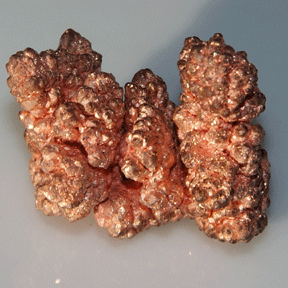
Dr Gavin M. Mudd Environmental Engineering, Monash University December 2010
“…… – it is eminently reasonable to propose a process flow sheet for Olympic Dam which does not include recovery of the uranium but still allows for copper, gold and silver to be produced.
http://users.monash.edu.au/~gmudd/files/ODam-Cu-only.pdf
Of course, a more modern idea is in design. Designing technologies so that it is practical and relatively easy to RECYCLE copper – C.M.
Tony Abbott “misspoke” on Olympic Dam, revealing Liberals’ confusion about carbon pricing
 Abbott having it both ways on BHP (includes video) August 23, 2012 Phillip Coorey Sydney Morning Herald It was eminently predictable the opposition was going to blame the decision to shelve the Olympic Dam expansion on the mining tax and the carbon price…..
When BHP announced the Olympic Dam decision yesterday, Kloppers’ statement cited ‘‘current market conditions, including subdued commodity prices and higher capital costs’’.
Minutes later, Tony Abbott, flanked by 10 South Australian Liberal MPs and senators, declared it was a catastrophic day for South Australia and blamed the mining tax and carbon taxes….
He kept at it on the 7.30 Report last night during an interview in which he said he had not read BHP’s statement issued hours earlier. Today he said he had misanswered the question and had read the statement…..
The Coalition is trying to have it both ways on the mining tax. It has been saying for months that the big miners, BHP included, have told it privately that they swindled the government during negotiations and will pay little or no tax for many years.
At the same time, the Coalition says the tax is killing such projects as Olympic Dam.
The mining tax did not apply to Olympic Dam because it only applies to iron ore and coal. There is a strong but unsubstantiated rumour in the industry that when the minerals giants renegotiated the mining tax with the government after Kevin Rudd was dumped, exempting uranium, gold and copper was a condition of Olympic Dam going ahead.
Either way, BHP cited neither the mining tax nor the carbon tax in its statement, and afterwards Kloppers told journalists the mining tax – which BHP will supposedly pay on its iron ore and coal projects – was not a factor.
‘‘As you know the tax environment for this particular project has not changed at all since we started working on it six or seven years ago,’’ he said.
‘‘The MRRT only covers coal and iron ore – not copper, not gold and not uranium – so the tax situation for this project has not changed. What has changed is the capital cost of construction. What has changed also is that post-Fukushima there is a different and still developing outlook on uranium..
.. Regardless of what BHP says, the opposition will continue to blame the carbon and mining taxes.
…: http://www.smh.com.au/opinion/politics/abbott-having-it-both-ways-on-bhp-20120823-24nle.html#ixzz24V97BzJ2
Calls for Australia’s nuclear wastes to go to Maralinga – Aboriginal political leader

 AUDIO http://www.abc.net.au/rural/nt/content/201208/s3574500.htm Indigenous party wants radioactive dump built on nuked land ABC Rural News, By Steven Schubert, 23 August 2012 The founder of the First Nations Political Party is calling for the nuclear waste dumped proposed fo Muckaty Station north of Tennant Creek to be built at Maralinga in South Australia instead.
That’s the site where the British Government tested several nuclear bombs during the 50s.
Maurie Japarta Ryan is running for the party in the seat of Stuart at the election, and says he believes Maralinga would be a better site for the dump.
“Why wreck a pristine place where there’s water at Muckaty, why not use scientific evidence, which they all talk about, and move it to a place where they’ve already nuked Australian people at Maralinga in South Australia?
“What I’m saying is scientifically nothing lives there, nobody goes there.”…. http://www.abc.net.au/rural/nt/content/201208/s3574500.htm
International Court of Law likely to protect Julian Assange’s bid for asylum
 Assange could go to international court THE AUSTRALIAN : AAP August 23, 2012 JULIAN Assange’s legal team will likely apply to the International Court of Justice (ICJ) to get the activist out of London to diplomatic asylum in Ecuador.
Former judge at Spain’s top criminal court, and head of Mr Assange’s legal team, Baltasar Garzon, says they are exploring a number of ways to guarantee his safety.
The ICJ is the world’s top arbitration body for disputes between states.
Speaking through an interpreter on the sidelines of the International Council of Archives Congress in Brisbane, Mr Garzon said the United Kingdom is bound by international law to offer his client safe passage to asylum. Continue reading
China will spend $372 billion to reduce energy use
Seven Chinese cities and provinces will launch CO2 emissions trading schemes over the next two years ahead of a national scheme later in the decade, as China seeks to move away from traditional command-and-control measures to combat spiraling carbon emissions.

 China to spend $372 billion on cutting energy use, pollution Planet Ark : 23-Aug-12 Kathy Chen and Stian Reklev China will plough $372 billion into energy conservation projects and anti-pollution measures over the next three-and-a-half years, part of a drive to cut energy consumption by 300 million tonnes of standard coal, the country’s cabinet said Tuesday.
A report from China’s State Council, or cabinet, said the investments will take China almost halfway to meeting its target to cut the energy intensity 16 percent below 2010 levels by 2015.
The government has earmarked $155 billion of the money for projects that shrink energy use, and while the plan did not detail which types of projects or sectors would benefit from the funds, a big share of the cash is expected to go to industry. Continue reading
DLP Senator John Madigan moves in Senate to stop Victorian wind farm
 Senator tries to halt Bald Hills wind farm ABC News, Aug 23, 2012 The DLP Senator for Victoria, John Madigan, will put a motion to the Senate to stop a wind farm development at Bald Hills in the state’s east. The power company Mitsui is building the 50 tower wind farm near Inverloch, in South Gippsland.
Senator Madigan says the Federal Environment Minister Tony Burke can stop the project….
http://www.abc.net.au/news/2012-08-23/senator-tries-to-halt-bald-hills-wind-farm/4217532
Anti wind farm activist appointed to Australian Wind Power Health Review
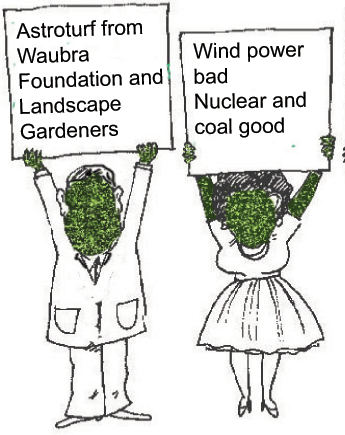 To direct the review, the NHMRC has created a reference group which also includes two observers….. the second observer is Peter Richard Mitchell, the founder of the Waubra Foundation. , the 77-year-old Mr Mitchell has a long career in the mining and fossil fuel industries Mr Mitchell has used a raft of other arguments to oppose wind farms.
Anti-turbine Activist Given Role as Observer on Australian Wind Power Health Review Desmoblog.com Graham Readfearn, 22 Aug 12, THERE are very few health symptoms these days which anti-wind power activists and suggestible and anxious residents have not at some point blamed on those spinning steel turbine blades.
According to a list compiled by Simon Chapman, the University of Sydney’s Professor of Public Health and much-awarded enemy of the tobacco industry, wind farms have been blamed for more than 180 different symptoms including weak bladders, cancers, weight gain, weight loss, herpes, kidney damage and, in one case, a woman having not one, but five menstrual periods in a single month.
Apparently, wind farms also cause chickens to be hatched with crossed beaks (and eggs being laid without yolks), cats to produce small litters, horses to get club feet and crickets to disappear.
Chapman noted recently at The Conversation that in Australia health complaints about wind farms have been relatively recent, despite some wind farms having been in operation for almost 20 years. In one area, Chapman said complaints had only been made after “a visit to the area by a vocal opponent, spreading anxiety”.
The Australian Government’s National Health and Medical Research Council has begun its second review of the “evidence” for such claims, examining studies and reports from around the world. The agency’s 2010 review looked at a range of issues which anti-wind groups often cite as the causes of symptoms in people living in wind farm areas. These included noise, low frequency sound and infrasound, shadow flicker, blade glint and electromagnetic radiation.
The review concluded that in each case, there was no evidence that wind turbines could have a direct impact on people’s health. The review said it was possible that people were getting annoyed by their sound, but also pointed out that a wind farm with 10 turbines at a distance of 350m was about as loud as a quiet bedroom. People were more likely to be annoyed by the sound if they also didn’t like the look of turbines on the landscape.
However, the review pointed out that “renewable energy generation is associated with few adverse health effects compared with the well documented health burdens of polluting forms of electricity generation”, and then concluded,
This review of the available evidence, including journal articles, surveys, literature reviews and government reports, supports the statement that: There are no direct pathological effects from wind farms and that any potential impact on humans can be minimised by following existing planning guidelines.
Desmogblog (http://s.tt/1lpk2)...
The NHMRC is currently reviewing the scientific literature on wind farms in order to update its public statement, which it hopes to publish by May 2013. Continue reading
Busting the nuclear lobby’s spin about thorium reactors
 thorium is merely a way of deflecting attention and criticism from the dangers of the uranium fuel cycle and excusing the pumping of more money into the industry….. the nuclear industry itself is also sceptical
‘ these arereally U-233 reactors,’ This isotope is more hazardous than the U-235 used in conventional reactors, he adds, because it produces U-232 as a side effect (half life: 160,000 years), on top of familiar fission by-products
Don’t believe the spin on thorium being a ‘greener’ nuclear option Ecologist, Eifion Rees 23rd June, 2011 It produces less radioactive waste and more power than uranium but the UK would be making a mistake in looking to it as a ‘greener’ fuel. The Ecologist reports….. nuclear radiologist Peter Karamoskos, of the International Campaign to Abolish Nuclear Weapons (ICAN), says the world shouldn’t hold its breath.
‘Without exception, [thorium reactors] have never been commercially viable, nor do any of the intended new designs even remotely seem to be viable. Like all nuclear power production they rely on extensive taxpayer subsidies; the only difference is that with thorium and other breeder reactors these are of an order of magnitude greater, which is
why no government has ever continued their funding.’ Continue reading
Renewable Energy Development Program (REDP) stumbles, with Martin Ferguson in charge
Does Ferguson have it in for Renewables? Climate Spectator, 23 Aug 2012 Tristan Edis Yesterday the Australian National Audit Office provided us with yet another damning indictment on a grant tendering program administered by the Australian government bureaucracy – the Renewable Energy Development Program (REDP).
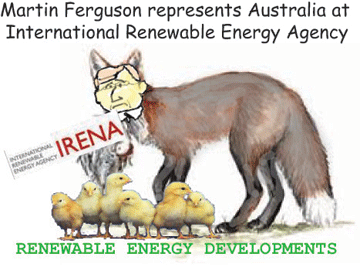
Energy Minister Martin Ferguson is probably the last person in the current government that you’d want to task with fostering the development of the renewable energy industry. His passion clearly lies more with pulling fossil fuels out of the ground, than keeping them there. Continue reading
Australian a leader in Green Climate Fund
Aust, S Africa to lead Green Climate Fund Herald Sun John Heilprin From: AAP August 24, 2012 A NEW global fund on climate change that aims to channel $US100 billion ($A95 billion) a year in aid to poor countries selected
officials from Australia and South Africa as its leaders at its first meeting.
The Green Climate Fund, created as part of a deal struck in December 2011 at the 194-nation climate talks in Durban, South Africa, will be led by Ewen McDonald, deputy head of Australia’s international development agency, and Zaheer Fakir, head of international relations for South Africa’s environment agency, the fund said in a statement on Thursday. Continue reading
1 This month
7 April – WEBINAR – Australia and the Doomsday Clock – Preventing nuclear war through NoFirstUse and other policies
Online | Tuesday April 7, 4:00-5:30pm, Australian Eastern Time / 8:00-9:30am Central Europe Time
– Access the registration link
15 April – Zoom –Nuclear Power is Not the Solution
Apr 15, 2026 01:00 AM in Canberra, Melbourne, Sydney

Join the International Physicians for the Prevention of Nuclear War (IPPNW) on Tuesday, April 14th for a timely webinar exploring the risks associated with nuclear power and challenging the myth that it offers a simple, safe, carbon-free solution to the climate crisis

21 April Webinar: No Nuclear Weapons in Australia
Start: 2026-04-21 18:00:00 UTC Canberra, Melbourne, Sydney (GMT+10:00)
End: 2026-04-21 19:30:00 UTC Canberra, Melbourne, Sydney (GMT+10:00)
Event Type: Virtual
A virtual link will be communicated before the event.
Host Contact Info: australia@icanw.org

of the week – Australians for War Powers Reform (AWPR)
To see nuclear-related stories in greater depth and intensity
 Antinuclear