How Internet information is manipulated by corporate power, examples from UK, Russia, Germany

Russia’s natural resource oversight body to keep mum on catastrophes from now on Anna Kireeva, Charles Digges, 16/08-2012 […] Now, all information requests sent to Rosprirodnadzor’s press service will be subject to scouring by the special commission before it is released to the public – a decision greeted by some of Kirillov‘s subordinates as anti-democratic and needlessly complex.
Rosprirodnadzor is one of the Russian government’s most important sources of information about environmental conditions in Russia
How to manipulate the Internet by arclight2011 1 September 12, Below, are quotes from some articles that are looking at issues of internet blocking and manipulation of searches etc..
I live in the UK, and recently discovered that Uk government requests to access peoples personal data was much lower than other countries. This was because laws passed last year allow authorities to hack anyone of interest…..
they do not need to apply to the courts any more, they have to put them on the recently renamed DOMESTIC EXTREMIST DATABASE (DED) office. The DED now have no name so as to deter data protection requests from a concerned public. As you will see below, other countries also censure/manipulate data to suit local needs and some countries are more open than others..
I wanted to cover censorship and manipulation in Japan and the USA after the Gulf Oil Spill and Fukushima tragedy but the PR company (OGILVY and MATHER, WPP) that smoothed over the disasters would need its own article.
For now here are some examples of how the manipulation works.
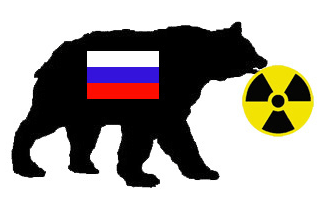 Irradiated Russian region moves to manipulate its Internet image Charles Digges, 29/07-2011[…] Authorities in Chelyabinsk have announced that they will pay the equivalent of $13,000 in order to try to alter the region’s “online footprint” so that people looking for information on Chelyabinsk on the internet read “positive or neutral evaluations of the ecological situation” there.
The campaign has drawn immediate outrage from local environmentalists
[…] The Chelyabinsk government put the order for the internet “optimization” project on the Federal government’s official site for tenders on regional projects, and specified that the project was to improve search results appearing on Google and the Russian search engine Yandex.
Optimizaton involves software experts using online tricks and techniques to “optimise” – or some say manipulate – search engine results. Specifically, the optimization project is targeted on altering the “first 10 returned queries” on these two search engines. [….]
Internet companies lining up to lend a hand According to published material on participants in the tender, the company Interregional Marking Centre Chelyabinsk-Moscow has said it can complete the optimization project for $5,000 and the Sitiko.ru internet firm has listed $7,000 as its price; the highly qualified IP Abyasov, which handles the internet site of the Chelyabinsk governor’s office said it will do the job for $24,000.
According to Mironova, the money to pay for the internet optimization project will come from Chelyabinsk’s regional budget. […] The searches would return positive or neutral results. The content of negative material, according to the project outline, would be no more than 20 percent, or no more than 30 per 150 lines of returned search material on either Google or Yandex. Wikipedia has been exempted.
The company signed to take on the optimization project would be expected to start cleansing negative information from December 31, 2011.
[…]Local authorities say they believe the regions ecological problems are exaggerated and say they are determined to clean up its image in order to attract more investment and tourism.
The protests of local authorities that Chelyabinsk’s environmental problems are on the mend, noted Mironova, are contradicted by the fact that the federal government sends an annual $464 million aid package to the region. […] http://www.bellona.org/articles/articles_2011/chelyabinsk_internet
Russia’s natural resource oversight body to keep mum on catastrophes from now on Anna Kireeva, Charles Digges, 16/08-2012 […] Now, all information requests sent to Rosprirodnadzor’s press service will be subject to scouring by the special commission before it is released to the public – a decision greeted by some of Kirillov‘s subordinates as anti-democratic and needlessly complex.
Rosprirodnadzor is one of the Russian government’s most important sources of information about environmental conditions in Russia, and the new process of reviewing journalistic requests will, at the very least, make reporting on Russia’s environment far more cumbersome, possibly leading to interminable delays on facts about eventual catastrophes – if indeed the special commission intends to release information at all.
[…]According to the daily official newspaper Izvestia, Rosprirodnadzor officials will now be forbidden to comment on any information concerning emergency situations. Information on environmental emergencies will be subject to special scrutiny by the new commission, according to Rosprirodnadzor’s remarks to the paper, in order to avoid fanning flames of panic among the population. The special commission will be made of up Rosprirodnadzor upper brass.
“Such a commission has not existed earlier, it’s a fresh directive that was issued literally this week by Kirillov, and I have no choice but to subordinate myself to it,” an unnamed source within the service told Izvestia. “We have many things of interest, and trying to hold in one’s head what can be told and what cannot be told is complicated. Our outward appearance is democratic, but that is not in fact the case.”
[…] “The best way to fight panic among the population is to be honest,” he said. “The commissions as proposed by Rosprirodnadzor will raise further suspicion to the information coming from the agency.”
Former Rosprirodnadzor deputy chief Oleg Mitvol, who is familiar with the forming of the commission, says the decision is “extremely unreasonable.”
[…] Kudrik agreed, adding that, ”The lack of adequate information about natural disasters is not an entirely Russian phenomena. Information released by Japanese officials about the Fukushima disaster was far from being adequate.”
[…] “If we look at the broader picture of the situation in Russia as of today, the initiative from Rosprirodnadzor is not an isolated incident but rather a trend characterized by a crack down on internet media,” he said, adding that Russia four state television stations and most of its daily newspapers were hardly in danger of shriveling in an information drought – mainly because truthful information is not their business. [.]http://www.bellona.org/articles/articles_2012/rosprirodnadzor_gag
The battle for liberty will be won or lost in cyberspace Published August 18, 2012 | By Slogger […] If, using my own pc with its clear relationship to The Slog’s identity, I Google even well-known political sites in Germany, I get redirected to an Austrian site for gays. While this suggests that even spooks have a sense of humour, it does make the flesh creep to discover that using someone else’s pc allows me to get through straight away.
No member of UNITE the Union can follow Slog links in the office. Nor can anyone working for at least two big UK banks – which (if nothing else) shows that my detractors are econo-politically eclectic.
[…] I could go on and on with the list of those who refuse to allow access to the site. I find it flattering, but above all worrying, that a site this small in the greater scheme of things is worth their attention – whoever ‘they’ are. Commercially, cyber-banning (and deliberate blocking) is now an industry in its own right. The Russians, Chinese and Americans lead the way in this area, as they do in the area of cyberblagging crime. Talk to any senior UK policeman off the record, however, and he or she will tell you that Merrie Olde Britannia is pretty clueless in this area.
Blacking out what The Other Side says has become one of those activities where the unthinking no longer even discuss the right of every individual to receive news of no real threat no national security. Instead, they do presentations to equally morally dead clients about ‘incoming traffic purity’ and other such Orwellian tosh. I think this reflects the growing trend over the last decade away from debate among equals, towards the trashing of those designated ‘the enemy’. In economics, climatology, nuclear generation, social ideology, finance, and of course politics, it is a slanging match between two sets of tiny, extreme minorities, during which the rest of us remain unrepresented.
Think for a minute or two about that deadly combo of adjectives: censorious and unrepresentative. They are two of the prime requirements – along with dictatorial elite megalomania, and a distracted electorate – required for the easy creation of a totalitarian State. With the arrival of casual cyber-blocking, Britain has the full set. We’re not the only ones – but we are worse than most.
[…]and the cloning of some of my now largely redundant Microsoft Outlook email addresses. (They’re redundant, by the way, because Microsoft blocked my send capability after a few probing pieces about Bill Gates, anti-Trust bribes and so forth. It’s all part of the same syndrome.)
[…] It simply won’t do to dismiss this as paranoia. The recent Bell Pottinger revelations showed how perniciously history itself was being written by some of the Bell-ends. It became obvious that Lord Bell’s ‘pr’ company was corrupting Wikipedia entries about an Asian country whose completely illiberal and torturous regime were paying him fat fees. It has always, I’m sad to observe, been obvious that Tim not so much lacks a moral compass, as refuses one on the grounds of them being surplus to his ethical requirements. But there are legions of folks around far, far worse than Tim Bell.
[…]Two things have made the reality (and potential effect) of ‘propaganda’ more real fifty years on…even though, ironically, the word used these days is ‘virtual’. The first is 24/7 news stations, preferring as they do speed and quantity over considered analysis. The outcome of this is the vastly increased ability to tell a dramatic lie and remain undetected…in other words, for ridiculous shibboleths to become received truth. The second – less well understood, but even more Stasi-like in its ability to keep like-minded people apart and dismiss the truth – is proactive cyber truth-bending, blocking and fact invention. This is now the big growth area.
I realise I have blogged this point many times before, but please allow me to say again that, if we care more about our liberties and personal dignity than we do for political affiliation, the internet remains the home of the Real Opposition. However, if we want to have an effect on the culture and constitution of our various societies, there are in turn two realities to face.
The first is that the pressure will be more valuable if it is applied to those who fund (by which I mean bribe) the Establishment. The second is that we all need to raise our awareness of when dirty tricks are in play…and how to combat them.
Anyone in good mental health is rightly suspicious of conspiracy theories. But over the last five years, senior civil servants, MPs, globalist media owners, bankers and governments have shown themselves to be pretty adept at conspiring. And the real inequality in Western society – that placed before the law – has shown how profoundly unwilling Estalishments are to prosecute wrongdoers. […] http://www.doomsteaddiner.org/blog/2012/08/18/the-saturday-essay-the-battle-for-liberty-will-be-won-or-lost-in-cyberspace/
How to Defeat Tyranny Published August 19, 2012 | By Brandon Smith
“…Tyranny is nothing but an opportunity for the best in all of us to rise….” http://www.doomsteaddiner.org/blog/2012/08/19/how-to-defeat-tyranny/
No comments yet.
1 This month
7 April – WEBINAR – Australia and the Doomsday Clock – Preventing nuclear war through NoFirstUse and other policies
Online | Tuesday April 7, 4:00-5:30pm, Australian Eastern Time / 8:00-9:30am Central Europe Time
– Access the registration link
15 April – Zoom –Nuclear Power is Not the Solution
Apr 15, 2026 01:00 AM in Canberra, Melbourne, Sydney

Join the International Physicians for the Prevention of Nuclear War (IPPNW) on Tuesday, April 14th for a timely webinar exploring the risks associated with nuclear power and challenging the myth that it offers a simple, safe, carbon-free solution to the climate crisis

21 April Webinar: No Nuclear Weapons in Australia
Start: 2026-04-21 18:00:00 UTC Canberra, Melbourne, Sydney (GMT+10:00)
End: 2026-04-21 19:30:00 UTC Canberra, Melbourne, Sydney (GMT+10:00)
Event Type: Virtual
A virtual link will be communicated before the event.
Host Contact Info: australia@icanw.org

of the week – Australians for War Powers Reform (AWPR)
To see nuclear-related stories in greater depth and intensity
 Antinuclear
Leave a comment