Sneaking nuclear power into NSW the Thorium way?
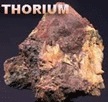 Citizens’ jury puts nuclear on the table http://m.smh.com.au/environment/energy-smart/citizens-jury-puts-nuclear-on-the-table-20120910-25ol6.html SMH, SEAN NICHOLLS September 11, 2012 A ”CITIZENS’ JURY” has recommended the government start a discussion about nuclear power stations in NSW as an issue that ”should not be dismissed”.
The jury of about 25 people from Sydney was one of two invited by the Parliament’s public accounts committee to participate in an inquiry into alternative energy. The other was from the New England area.
The juries were chosen by the New Democracy Foundation whose members include the chairman of Infrastructure NSW, Nick Greiner, and the former premier of Western Australia Geoff Gallop. Its founder is the executive director of Transfield Holdings, Luca Belgiorno-Nettis.
The Sydney jury’s report, released yesterday, urges the government to initiate ”informed public discussion” into ”emerging nuclear technologies” such as thorium as an energy source. ”The unanimous view of the jury was that the proposed issue of nuclear power generation should not be dismissed,” the recommendation – one of five – says.

”A minority view (10 per cent) supported starting deployment in the immediate future. While this view was not shared, the jury was in agreement that the topic should be discussed in greater detail withthe Australian public.”
The government is preparing to proclaim legislation that will overturn a 26-year ban on uranium exploration.
The Energy Minister, Chris Hartcher, and the Premier, Barry O’Farrell, have been at pains to deflect opposition claims that this could lead to nuclear power.
Mr Hartcher has previously said the decision was not about providing an alternative energy source to electricity generation. Unlike uranium, there is no ban on exploration or mining of thorium in NSW.
In its report, the New England jury said the community had no confidence in uranium-based power. But it also said the same applied to coal seam gas and neither should be pursued until that improved.
In an awkward recommendation for the government, it says the electricity distribution businesses, or ”poles and wires”, should be kept in public ownership. Mr O’Farrell has ruled out selling the poles and wires this term but has left the door open to taking it to the next election to raise infrastructure funds.
The chairman of the public accounts committee, Jonathan O’Dea, said the reports, which will be included in the committee’s final report, would be discussed on Thursday. A spokeswoman for Mr Hartcher said he would await the final report
before considering any recommendations.
TEN MYTHS ABOUT THORIUM AS A NUCLEAR ENERGY SOLUTION
http://www.beyondnuclear.org/storage/documents/THE%20MYTHS%20ABOUT%20THORIUM%20AS%20A%20NUCLEAR%20ENERGY%20SOLUTION.pdf
BEYOND NUCLEAR FACT SHEET
Excerpted from: Thorium Fuel: No Panacea for Nuclear Power, By Arjun Makhijani and Michele Boyd.
A Fact Sheet Produced by the Institute for Energy and Environmental Research and Physicians for Social Responsibility.
Thorium may be abundant and possess certain technical advantages, but it does not mean that it is economical. Compared to uranium, thorium fuel cycle is likely to be even more costly. In a once‐through mode, it will need both uranium enrichment (or plutonium separation) and thorium target rod production. In a breeder configuration, it will need reprocessing, which is costly. In addition, inhalation of thorium‐232 produces a higher dose than the same amount of uranium‐238 (either by radioactivity or by weight). Reprocessed thorium creates even more risks due to the highly radioactive U‐232 created in the reactor. This makes worker protection more difficult and expensive for a given level of annual dose. Finally, the use of thorium also creates waste at the front end of the fuel cycle. The radioactivity associated with these is expected to be considerably less than that associated with a comparable amount of uranium milling. However, mine wastes will pose long‐term hazards, as in the case of uranium mining. There are also often hazardous non‐radioactive metals in both thorium and uranium mill tailings.
1. There is no “thorium reactor.” There is a proposal to use thorium as a fuel in various reactor designs including light-water reactors – the most prevalent in the United States – as well as fast breeder reactors.
2. You still need uranium – or even plutonium – in a reactor using thorium.
3. Using plutonium sets up proliferation risks.
4. Uranium-233 is also excellent weapons-grade material.
5. Proliferation risks are not negated by thorium mixed with U-238.
6. Thorium would trigger a resumption of reprocessing in the US.
7. Using thorium does not eliminate the problem of long-lived radioactive waste.
8. Attempts to develop “thorium reactors” have failed for decades.
9. Fabricating “thorium fuel” is dangerous to health.
10. Fabricating “thorium fuel” is expensive.
History of Australian children exposed to nuclear radiation
Australian Map of Nuclear Sites, Overview Jim Green Sept 2012
Some of the recurring patterns in Australia’s nuclear history are discussed here under the following headings: children exposed to radiation; racism; struggle; unresolved radioactive contamination issues; deceit; whistleblowers; secrecy; rhetoric versus reality; lessons not learnt; and surveillance, intimidation, and police brutality.
Children exposed to radiation
Due to the lack of fencing, the contaminated Port Pirie Uranium Treatment Complex site was used as a playground by children for a number of years. The situation was rectified only after a six-year community campaign.
After mining at Rum Jungle in the NT ceased, part of the area was converted to a lake. As a crocodile-free water body in the Darwin region, the site became popular despite the radioactivity.
In November 2010, the Rum Jungle South Recreation Reserve was closed due to low-level radiation in the area. The Department of Resources advised the local council to shut down the reserve as a precautionary measure.
In 2012, damage to a security gate allowed children to enter a contaminated site near Kalgoorlie. More than 5,000 tonnes of tailings from the Yeelirrie uranium deposit, near Wiluna, were buried there in the 1980s. BHP Billiton said it would improve security.
In a 1997 report, WMC admitted leaving the contaminated trial uranium mine at Yeelirrie, WA, exposed to the public with inadequate fencing and warning signs for more than 10 years. A spokesperson for WMC said a 1995 inspection revealed the problems and also admitted that the company could have known about the problems as early as 1992. WMC said there was inadequate signage warning against swimming in a dam at the site, which was found to be about 30 times above World Health Organisation radiation safety standards and admitted that people used the dam for “recreational” purposes including swimming.
Children and adults alike have been exposed to radiation from the contaminated uranium processing site at Hunters Hill in Sydney (and children are more susceptible to radiation-induced cancers due to their growing bodies). Only in recent years has the contamination come to light after decades of deceit and obfuscation. The NSW Health Commissioncovered up the dangers of Hunters Hill. An internal memo in 1977 told staff to “stall and be non-committal” when responding to queries. Residents were told there was “no logical reason” to carry out radiation or health tests even though the NSW government knew that there were compelling reasons to do so.
A similar attitude has been displayed towards people living near the Lucas Heights research reactor. An internal 1998 federal Department of Industry, Science and Resources briefing document, obtained under Freedom of Information legislation, warns government officials: “Be careful in terms of health impacts − don’t really want a detailed study done of the health of Sutherland residents.”
Another incident with child safety concerns occurred in May 1997 when a radioactive source was stolen from an ANSTO promotional display at Menai High School. An ANSTO spokesperson said the source could be handled “quite safely but shouldn’t be for long periods.” The radioactive source was never recovered.
In the 1950s, the British-Australian nuclear cabal suppressed research demonstrating the contamination of grazing sheep and cattle with strontium-90 from nuclear bomb tests in Australia. Whistleblower Hedley Marston warned that proof of widespread contamination would be found “in the bones of children”. The nuclear cabal and the Australian government initiated a testing program in 1957, but it was done in secret using stolen body partsfrom dead babies, still-borns and infants.
The Advertiser conspicuously failed to inform residents of Adelaide of the plume of radioactivity which contaminated the city after the bungled nuclear bomb test of 11 October 1956. The Advertiser did however run a story in 1957 titled ‘Radioactive Children Are Brilliant’ − a baseless theory from a British psychiatrist linking strontium 90 to ‘brilliant’ children……….. http://australianmap.net/overview/
Australia to be part of ASEAN discussion on nuclear power for the region
ASEAN ministers explore nuclear power as a long-term option 11 September 2012 http://www.channelnewsasia.com/stories/southeastasia/view/1225292/1/.html SINGAPORE: Ministers from the member countries of the Association of Southeast Asian Nations (ASEAN) will explore nuclear power as a long-term option for the region’s energy needs when they meet on Wednesday, 12 September at the 30th ASEAN Ministers on Energy Meeting (AMEM) in Phnom Penh, Cambodia.
Singapore’s Ministry of Trade and Industry (MTI) said they will discuss collective efforts to develop ASEAN’s nuclear safety
capabilities, as well as a coordinated approach on regional nuclear emergency preparedness and response mechanisms with international partners.
As with previous years, the ASEAN ministers will be joined by their key energy Dialogue Partners and International Organisations, namely Australia, New Zealand, India, China, Japan, Korea, Russia, the US and the International Energy Agency (IEA). Continue reading
Yeah, why not have Australia fuel Pakistan’s nuclear bombs, as well as India’s?
Australia willing to help Pak combat energy crisis, Pakistan Observer, Amanullah Khan, 9 Sept 12. Karachi—Australian High Commissioner Peter Heyward has said there are certain technical requirements to ensure that nuclear capability would be used for domestic energy need and not for military purpose and if Pakistan fulfills such condition Australia may think of exporting uranium to Pakistan…. Speaking on the occasion Mian Abrar Ahmad , President, Karachi Chamber of Commerce and Industry said Pakistan needs to build civil nuclear capability to meet its energy requirements since ours is an energy hungry country……. http://pakobserver.net/detailnews.asp?id=173330
Police violence against Indian anti nuclear protestors at Kudankulam
Indian riot police attack 4000 nuclear protesters Examiner, SLIDESHOW SEPTEMBER 10, 2012 BY: DEBORAH DUPRE Saturday and Sunday, Indian riot police opened fire one group and assaulted thousands of others with tear gas, mainlywomen and children on the beach protesting Kudankulam Nuclear Power Project (KNPP), the country’s largest nuclear power facility, due to fire up soon. By late Sunday, there was one dead and many injured as police began rampaging homes of protesters.
“A large riot-gear bedecked police force is in the frontline facing the people, and tear gas lobbers are apparently on stand-by,” a human rights defender informed Counter Currents Sunday morning.
“Police are intimidating people by moving closer, swaying batons,” Dr. S P Udayakumar at the scene texted in an SMS at 11:30 a.m. “Thousands of women and children are here. Officials threatened with naval intervention. Situation is very tense and dangerous. We need your appeals to the governments.”
It seems that Tony Abbott lied about the BHP Olympic Dam report
 Sprung! Labor says Abbott didn’t read BHP report By Malcolm Farr National Political Editor news.com.au September 10, 2012 THE Government today released a “slide show” it claims shows Opposition Leader Tony Abbott did not read a a BHP statement when he said he did.
It’s not gripping viewing. The succession of photographs merely shows shadow treasurer Joe Hockey in Parliament.
But the Labor Party believes the series exposes the possibility that Mr Abbott had been misleading.
It goes back to the afternoon of August 22 when BHP Billiton announced it would not proceed with the multi-billion dollar expansion of its Olympic Dam project in South Australia.
Mr Abbott almost immediately blamed the Government’s mining tax and carbon pricing for the deferred investment. But on ABC TV that night he conceded he had not read the company’s statement explaining the decision, which did not include the tax or climate change measures.
The next day Mr Abbott appeared to change his story and said he had read the statement at around 3.45pm the previous day. Joe Hockey backed him up….. http://www.adelaidenow.com.au/news/south-australia/mal-slide-show/story-e6frea83-1226471159602
The world’s most dangerous nuclear reactor – Monju fast breeder reactor, Japan
Problem plagued nuclear reactor called world’s most dangerous via ABC News, The Atomic Age, May 2012 http://lucian.uchicago.edu/blogs/atomicage/2012/09/10/problem-plagued-nuclear-reactor-called-worlds-most-dangerous-via-abc-news/
Japan’s Monju nuclear reactor was supposed to be a model of power generation in the future, but it’s had many problems and in two decades it’s only generated one hour’s worth of electricity.
EMMA ALBERICI, PRESENTER: It’s supposed to be the future of nuclear power generation, a reactor that produces its own fuel in a self-sustaining cycle. Known as Monju, the reactor on the country’s west coast is held up as the saviour of a nation without energy resources. But Monju has been plagued with problems and many call it the most dangerous reactor in the world. In part two of his series on Japan’s so-called nuclear alley, North Asia correspondent Mark Willacy was given an exclusive look inside Monju.
MARK WILLACY, REPORTER: People frolic in its shadow, a reactor its critics call the most dangerous in Japan. The name Monju comes from one of Buddha’s chief attendants, a purveyor of enlightenment depicted resting on the back of a lion, a beast whose phenomenal powers are controlled only by Monju’s wisdom.
But opponents of this prototype reactor fear its operators do not have the wisdom to harness its enormous energy.
KEIJI KOBAYASHI, FAST-BREEDER REACTOR EXPERT (voiceover translation): If a meltdown happens, it will get out of control very quickly. If the reactor core was to melt, the explosive energy would produce a blast like a nuclear bomb.
FUKIKO IKEJIMA, ‘STOP MONJU’ GROUP (voiceover translation): If a big accident were to happen, the impact would not stop in Japan, but spread around the world. It is our most dangerous reactor.
MARK WILLACY: And this is one of the reasons many Japanese fear Monju, because it uses sodium to cool a reactor, the substance that can ignite upon contact with oxygen. In 1995, a sodium leak at Monju caused a serious fire, one that resulted in the plant being out of operation for 15 years.
Lateline was given an exclusive tour of Monju, including an interview with the plant’s director-general, Satoru Kondo.
Continue reading at Problem plagued nuclear reactor called world’s most dangerous
BHP has lost interest in exploring for uranium in South Australia
BHP Billiton No Longer Interested to Purchase Exploration Rights Near Olympic Dam – Tasman By Esther Tanquintic-Misa | September 10, 2012 After its earth-shaking announcement in August that it is scraping its $30 billion expansion plans into the Olympic Dam copper and uranium mine mega project in South Australia, BHP Billiton has consequently dropped related purchases of exploration rights surrounding the area of the dam…. http://au.ibtimes.com/articles/382334/20120910/bhp-tasman-exploration-olympic-dam-gold-copper.htm#.UE_hgrJlT4Y
South Australia: uranium licence agreement scrapped by BHP
BHP scraps Olympic Dam licence deal THE AUSTRALIAN, BY: ROBB M. STEWART From: Dow Jones Newswires September 10, 2012 BHP Billiton has scrapped plans to buy a basket of exploration licenses in the region of its Olympic Dam copper and uranium mine in South Australia after it last month shelved a $US30 billion plan to greatly expand the operation.
Exploration firm Tasman Resources said today that it had received a notice from BHP terminating conditional contracts that would have seen BHP buy five exploration licenses and one license application for the
Stuart Shelf region, which hosts the Olympic Dam deposit.
Tasman in mid-June had said BHP had agreed to buy the licenses in a $3 million deal subject to several conditions. It at the time said the land contains several targets that are thought to be deep and relatively high risk and therefore more suited to companies with larger exploration budgets…… http://www.theaustralian.com.au/business/
1 This month
7 April – WEBINAR – Australia and the Doomsday Clock – Preventing nuclear war through NoFirstUse and other policies
Online | Tuesday April 7, 4:00-5:30pm, Australian Eastern Time / 8:00-9:30am Central Europe Time
– Access the registration link
15 April – Zoom –Nuclear Power is Not the Solution
Apr 15, 2026 01:00 AM in Canberra, Melbourne, Sydney

Join the International Physicians for the Prevention of Nuclear War (IPPNW) on Tuesday, April 14th for a timely webinar exploring the risks associated with nuclear power and challenging the myth that it offers a simple, safe, carbon-free solution to the climate crisis

21 April Webinar: No Nuclear Weapons in Australia
Start: 2026-04-21 18:00:00 UTC Canberra, Melbourne, Sydney (GMT+10:00)
End: 2026-04-21 19:30:00 UTC Canberra, Melbourne, Sydney (GMT+10:00)
Event Type: Virtual
A virtual link will be communicated before the event.
Host Contact Info: australia@icanw.org

of the week – Australians for War Powers Reform (AWPR)
To see nuclear-related stories in greater depth and intensity
 Antinuclear