Lucas Heights medical nuclear reactor is unnecessary, a fig leaf on dirty dangerous nuclear power
 The nuclear lobby is sure working hard, globally, to improve its very unpopular image.
In Australia pro nuclear hypocrisy reaches a peak today, as Senator Chris Evans bleats out a whole lot of nauseous spin about expanding the role of ANSTO (Australian Nuclear Science and Technology Organisation) and the Lucas Heights nuclear reactor. His media release is full of sanctimonious blather about the benefits to the sick, Australia having a leading role in the world, and wonderful Synroc ( a waste disposal technology that was discredited decades ago.
There are drawbacks – expense is one, – but these drawbacks can be overcome: research to this end is going on in Canada – scientific teams in Alberta Saskatchewan, Manitoba and Quebec.
The Alberta team was able to produce viable quantities of high-quality technetium-99m using a 19-mega-electron-volt cyclotron, a circular particle accelerator, said Sandy McEwan, a researcher with the University of Alberta and medical director with Alberta Health Services’ Cross Cancer Institute in Edmonton, in a news release.
“This means there is now a potentially valid alternative to reactor-produced medical isotopes,” he said. June 1012.
The real problem with medical isotopes such as those produced in Australia, at Lucas Heights, is that this really functions as a fig leaf over nuclear power. The ‘medical’ nuclear reactor is a foot in the door for the nuclear industry. It should be shut down, and replaced by a cyclotron. – Christina Macpherson, 20 Sept 12
Australian govt to expand its nuclear industry at Lucas Heights, Sydney
 Govt to invest $168m in nuclear medicine 9 News Sep 19 2012 The federal government says it will get a $1 billion return from investing $168 million in nuclear medicine and treatment to create jobs, and help half a million Australians and millions of people around the world.
Senator Chris Evans, Minister for Science and Research, has announced the investment plan to construct a nuclear medicine manufacturing plant and a world first Synroc plan will generate 250 jobs.
It will be delivered by scientists at the Australian Nuclear Science and Technology Organisation (ANSTO) at Lucas Heights using the existing low-enriched uranium reactor.
The nuclear medicine manufacturing plant will secure Australia’s ability to produce Molybdenum-99 (Mo-99) which is used for diagnosis of heart disease, cancers, and kidney and gastrointestinal tract
disorders, Senator Evans said…
..Today is an important day for the 550,000 people who require a nuclear medicine procedure in Australia each year, as well as the 45 million people across the globe who will be able to access Australian-produced nuclear medicine,” Senator Evans said.
Australia will earn a return by meeting half the world’s needs for Mo-99, he said…. http://news.ninemsn.com.au/article.aspx?id=8535511
Worldwide pressure to keep Japan’s nuclear reactors going – the global industry can’t afford closure in japan
 The nuclear farce in Japan is enough to have people shaking their heads. The comments and actions from the nuclear industry in and outside of Japan and various governments are even more interesting.
Japan’s Nuclear Exit; Nuclear Farce Or Who Is Behind The Resistance To Change Simply Info, September 17th, 2012 Japan’s turn against nuclear energy if it actually does happen would be considerably bigger than Germany’s. Most of the big nuclear companies are now owned all or in part by Japanese companies. Toshiba-Westinghouse and GE-Hitachi are two of the big players. With Japan staking so much on nuclear power over the years, their exit would really be a blow to the world nuclear industry.
The US government has decided to stick their nose into Japan’s energy policy. High ranking US Department of Energy officials have come out harshly against Japan’s new pledge to phase out nuclear. One of the US NRC commissioners (William Magwood) also has been commenting on Japan’s nuclear phase out. This is even more notable since the NRC is supposed to be the safety regulator for nuclear power in the US, yet one of the commissioners is cheerleading for the industry
Japan’s Nuclear Exit; Nuclear Farce Or Who Is Behind The Resistance To Change, Simply info September 17th, 2012 |Japan’s DPJ has announced that they intend to phase out the use of nuclear power by 2030. While the campaign promise has many hopeful it is quite vague, without immediate actions and leaves open the potential to un-do the policy in the future. It is also newsworthy that the DPJ’s new effort to avoid election defeat is causing some very telling reactions throughout the world.
Most in Japan proclaimed it as progress though many were cautious about the lack of concrete action. The phase out states “2030′s” as in it could stretch it out to 2039 actually making it 2040. Also that all of this policy will be revisited periodically and could be changed. Continue reading
Nuclear lobby successfully pressuring Japan’s government to avoid nuclear power shutdown
 Japan, Under Pressure, Backs Off Goal to Phase Out Nuclear Power by 2040 NYT, By HIROKO TABUCHI 19 Sept 12 TOKYO — In an abrupt turnabout, the Japanese government on Wednesday stopped short of formally adopting the momentous goal it announced just last week — to phase out nuclear power by 2040 — after the plan drew intense opposition from business groups and communities whose economies depend on local nuclear power plants
The cabinet of Prime Minister Yoshihiko Noda said it would “take into consideration” the 2040 goal, but formally endorsed only a vague promise to “engage in debate with local governments and international society and to gain public understanding” in deciding Japan ’s economic future in the wake of the 2011 nuclear disaster at Fukushima. Energy policy will be developed “with flexibility, based on tireless verification and re-examination,” the cabinet’s resolution read.
A day earlier, the chairmen of Japan’s most prominent business associations, including the influential Keidanren group, called a rare joint news conference to demand that Mr. Noda abandon the 2040 goal. On Wednesday, they praised the cabinet’s decision. Continue reading
Lynas has applied to Australian Radiation Protection and Nuclear Safety Agency (ARPANSA) to import radioactive waste
 Lynas: People before corporate greed, who will pay the TOL? Concerned Sydney activists in support of Malaysians are gathering at Lynas Corporations head office on Pitt St in Sydney’s CBD at 12:30pm today, to express their dissent over the companies plan to export rare earths to Malaysia for processing.
Lynas Corporation has recently received a two year temporary operations license (TOL) from the Malaysian Atomic Energy Licensing Board (AELB), as of the 5th of September. This is an issue of significance to Australians, as the ore to be processed at the plant will come from Mount Weld rare earths deposit in Western Australia. The Lynas Applied Materials Plant (LAMP) hasn’t even submitted an environmental impact assessment to begin operations of one of the worlds largest rare earth refineriery located on the east coast of Malaysia in the Pahang state at Gebeng, Kuantan.
Tully McIntyre from Friends of the Earth stated “Lynas plans to export 22,000 tonnes of ore annually to Malaysia for processing, which risks polluting important mangrove coastal ecosystem and major sources of livelihoods for local people in Malaysia. There are well over 700,000 people living in a 30 km radius of LAMP.”
“These people were not consulted about the refinery, or a proper environmental impact statement carried out for LAMP.”
The Australian High Commissioner to Malaysia stated last week Lynas had submitted an application to Australian Radiation Protection and Nuclear Safety Agency (ARPANSA) to import waste back to Australia, if so Australians are wondering where it would be stored.
Miss McIntyre went on to say “Australian activists are calling for more stringent research to be carried out in Australia and abroad before proceeding further, Malaysians do not want LAMP and an Australian company should not be forcing the project on an unwilling international community. The campaign against Lynas in Malaysia is the biggest environmental campaign in Malaysian history. Australian activists will remain to show strong support with the Malaysians to stop Lynas exporting this toxic legacy.”
Greens MP Jamie Parker NSW will address the concerned activist at the lunch time protest.
For more information or media comment contact: Tully McIntyre (Friends of the Earth, Melbourne) 0410 388 187 Peter Boyle (Malaysian activist) 0401 760 577
Toro undecided about developing Wiluna uranium mine, as stricter environmental rules imposed
 Toro Energy‘s WA Uranium Mine Receives Stricter Environmental Conditions International Business Times, By Esther Tanquintic-Misa | September 19, 2012 Western Australia’s first uranium mine project, five years after a ban was lifted that constricted uranium mining in the area, has received new and stricter environmental conditions from an independent appeals committee.
On Wednesday, WA environment minister Bill Marmion said an independent committee, based on 21 grounds of appeal, had recommended several changes to the draft conditions that WA’s Environmental Protection Authority (EPA) granted in May to Australian uranium project developer and explorer Toro Energy Limited, owner of the currently highly controversial Wiluna uranium mine.
The said new and stricter environmental conditions, according to Mr Marmion, targets to strengthen the protection of stygofauna and groundwater dependent vegetation, as well as better address surface water flows, dust management and rehabilitation around the area…… Uranium is what is used to fuel nuclear reactors. Global sentiment on the use and safety of nuclear reactors as a main energy source has been on the negative after the catastrophic meltdown of Japan’s Fukushima nuclear reactors in 2011, triggered by the magnitude 9.0 earthquake and tsunami that hit the country in March.
Adelaide-based Toro Energy, Wiluna uranium mine owner, has until the first half of 2013 to decide whether to proceed developing the project.
Controlled 39 per cent by OZ Minerals, Toro Energy plans to start the construction and commissioning through 2013, with first sales expected in 2014. Toro Energy forecasts a 1,200-tonne a year uranium oxide production from Wiluna. Its projected mine lifespan is up to 14 years. http://au.ibtimes.com/articles/385890/20120919/uranium-toro-australia-fukushima-nuclear.htm#.UFtskrJlT4Y
Worldwide uranium companies react to yet another drastic fall in uranium price
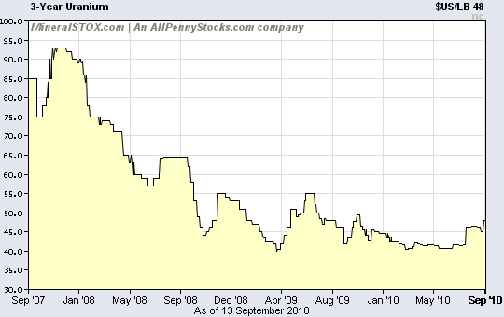 Uranium Recovery Postponed as Price Drops to 2-Year Low Bloomberg, By Christopher Donville – Sep 19, 2012 Uranium’s recovery from the Fukushima nuclear accident may take one or two years longer than analysts estimated as stockpiles in Japan and Germany keep prices low and cause mining companies to defer new development.
The price of uranium for immediate delivery declined to $47 a pound as of Sept. 17, its lowest in two years, according to Ux Consulting, a Roswell, Georgia-based uranium information provider.BHP Billiton Ltd. (BHP) and Paladin Energy Ltd. (PDN) have slowed or deferred development this year of some projects to produce the raw material in nuclear reactor fuel……
BHP, the world’s largest mining company, last month put on hold an expansion that would make its Olympic Dam project in Australia the biggest uranium mine.
 Cameco Corp. (CCO), the world’s third-largest producer, said in July that its Kintyre uranium project in Australia would need a $67 uranium price to be economical. The company sold uranium for $42 a pound during the second quarter..
… Paladin, an Australian company that mines uranium in Africa , is delaying a feasibility study on phase four of its Langer Heinrich mine in Namibia , the company said on a conference call in May….Dustin Garrow, Paladin’s executive general manager of marketing.: “You’d have to see $85 uranium on a sustained basis to justify construction of new mines ..”
India tests yet another long range nuclear-capable missile

India successfully test-fires nuclear capable Agni-IV India on Wednesday successfully test-fired nuclear capable Agni-IV for its full range of 4,000 km from Wheeler Island, off the coast of Orissa. …
http://www.indianexpress.com/news/india-successfully-testfires-nuclear-capable-agniiv/1005200/
The psychology of people accepting misinformation
Misinformation: Psychological Science Shows Why It Sticks and How to Fix It 20 sept 12, http://www.psychologicalscience.org/index.php/news/releases/misinformation-psychological-science-shows-why-it-sticks-and-how-to-fix-it.html Childhood vaccines do not cause autism. Barack Obama was born in the United States. Global warming is confirmed by science. And yet, many people believe claims to the contrary.
Why does that kind of misinformation stick? A new report published in Psychological Science in the Public Interest, a journal of the Association for Psychological Science, explores this phenomenon. Psychological scientist Stephan Lewandowsky of the University of Western Australia and colleagues highlight the cognitive factors that make certain pieces of misinformation so “sticky” and identify some techniques that may be effective in debunking or counteracting erroneous beliefs. Continue reading
Canberra’s drive for 100% renewable energy by 2020
Canberra Shooting For 90% Renewable Energy By 2020 http://www.energymatters.com.au/index.php?main_page=news_article&article_id=3387 by Energy Matters, 19 Sept 12 The ACT Government has set a goal of 90% of the Territory’s electricity being sourced from renewables by 2020.
The Government has also set the most ambitious greenhouse gas reduction targets in Australia, committing to a goal of zero net emissions by 2060 and a 40% reduction in greenhouse gas emissions from 1990 levels by 2020.
An updated paper detailing the plans, Weathering the Change – ACT Climate Change Strategy 2007 – 2025, details 18 actions to be undertaken. Among them is an increased focus on renewables; including wind and solar power.
The plan states a major barrier to deployment of renewables in the ACT currently is a lack of publicly accessible information on the ability of the Territory’s electricity distribution network to cope with additional generation capacity. One the first steps needed in order for Canberra to attain its lofty goal is for the government to develop detailed mapping of these resources.
Making a significant contribution to the target will be the recently announced 20MW Royalla FV Solar Farm, a facility that will consist of approximately 83,000solar panels; and other similar projects are expected to be constructed between now and 2020.
Should Canberra reach its goal, the impact on carbon emissions will see a reduction of 1,471,000 tonnes of carbon equivalent in 2020. Canberra already has a healthy show of solar in the form of home solar panel systems, with uptake being supported by a feed in tariff incentive. Owners of systems are paid the same rate as their electricity supply tariff for surplus power exported to the mains grid.
According to Energy Matters, a 4kW system installed in Canberra can generate electricity bill savings exceeding $1,000 a year.
The updated Weathering the Change – ACT Climate Change Strategy 2007 – 2025 paper can be viewed here (PDF).
Christine Lins states the need for stability in Australian renewable energy policy.
Renewable Energy Investment – Stability, Stability, Stability http://www.energymatters.com.au/index.php?main_page=news_article&article_id=3386 by Energy Matters, 20 Sept 12 Echoing comments made earlier this week by the Clean Energy Council, the producer of the world’s most frequently referenced renewables market report underlines the need for stability in Australian renewable energy policy.
In a speech to the Australian National Conference on Resources and Energy in Canberra on Wednesday, Christine Lins, Executive Secretary of REN21, will state a key requirement for significant and sustained investment in Australia is policy stability, which Australia needs to take into consideration in the current review of the nation’s 20 per cent Renewable Energy Target. Continue reading
Advance in renewable energy storage patented at Murdoch University
A water-based sodium battery is an affordable and safe option to store power from renewable generation.
This new concept – patented at Murdoch University – replaces lithium with a sodium component in the device’s makeup, resulting in a more environmentally friendly system. The battery offers a four-fold energy increase
A step forward for renewable energy storage? http://www.climatespectator.com.au/commentary/step-forward-renewable-energy-storage, 19 Sep 2012 Manickam Minakshi-Sundaram and Danielle Meyrick The Conversation Energy storage will be critically important as we work towards sustainable living. Developing cost-effective ways to store large amounts of electricity from wind turbines and solar farms will be essential in turning from fossil fuels to renewables as our primary source of energy.
As these technologies develop and our reliance on them grows, there will be an increasing need for rechargeable energy storage capability. Continue reading
Renewable energy deals: Pacific Hydro, ARENA, Hydro Tasmania.Suntech Power
GREEN DEALS: Pacific’s solution, Climate Spectator, 18 Sep 2012
Pacific Hydro
Pacific Hydro has this week launched its long awaited retail offering. The initial launch will be in Victoria and Tasmania and will focus on business customers. Continue reading
1 This month
7 April – WEBINAR – Australia and the Doomsday Clock – Preventing nuclear war through NoFirstUse and other policies
Online | Tuesday April 7, 4:00-5:30pm, Australian Eastern Time / 8:00-9:30am Central Europe Time
– Access the registration link
15 April – Zoom –Nuclear Power is Not the Solution
Apr 15, 2026 01:00 AM in Canberra, Melbourne, Sydney

Join the International Physicians for the Prevention of Nuclear War (IPPNW) on Tuesday, April 14th for a timely webinar exploring the risks associated with nuclear power and challenging the myth that it offers a simple, safe, carbon-free solution to the climate crisis

21 April Webinar: No Nuclear Weapons in Australia
Start: 2026-04-21 18:00:00 UTC Canberra, Melbourne, Sydney (GMT+10:00)
End: 2026-04-21 19:30:00 UTC Canberra, Melbourne, Sydney (GMT+10:00)
Event Type: Virtual
A virtual link will be communicated before the event.
Host Contact Info: australia@icanw.org

of the week – Australians for War Powers Reform (AWPR)
To see nuclear-related stories in greater depth and intensity
 Antinuclear