Australia getting dangerously locked in to USA military operations in the Pacific
 An Australian General, Major General Richard Burr, has become a deputy commander of United States Army Pacific. He will be responsible for planning and advising on the further expansion of American armed forces throughout the Western Pacific.
Australia hostage to the politics of the US in the Asian Century, The Drum, MALCOLM FRASER, 27 Sept 12,
This week Malcolm Fraser delivered a speech on Australia-US relations in the Asian Century. In this edited extract, the former prime minister says our Government has made us hostage to the politics of the United States. Australia has, under this Labor Government and with apparent consent of the Coalition, become the southern bastion of America’s re-arming in the Western Pacific and Southeast Asia. This is an extraordinary consequence of Australian Government ineptitude and of military planning, which might recognise America’s interest, but pays little account of our own.
It makes us complicit in any military activity that the Americans might undertake. Continue reading
Aboriginal elders of Western Australian Nuclear Free Alliance (WANFA) fight uranium mining

 WANFA’s Elders speak out from Kutunatu Ngurra http://indymedia.org.au/2012/09/22/radiation-exposure-looming-for-wiluna Gerry Georgatos Traditional Aboriginal Elders have never been more concerned about the sovereign risk to Country, and of its very health, with the loom of uranium mining. The Western Australian Nuclear Free Alliance (WANFA), made up of Aboriginal Traditional Land Owners from the Pilbara, the Kimberley, the Goldfields, the Great Victorian Desert, the Central Desert, the Gascoyne, Perth and the South West, and alongside their supporters, have declared “that it is a must do in preventing uranium mining on Country.”
The WANFA met for its annual conference on September 16 at the registered sacred site of Kutunatu Ngurra camp just outside of Leonora, in the ochre heart of Western Australia.
WANFA chairperson Kado Muir said, “(The Elders and Traditional Land Owners) support Aboriginal sovereignty across all Aboriginal territories in WA. The State Government and its industries need to respect the basic human rights of Aboriginal peoples.”
Mr Muir said that everyone is concerned in light of the “fast-tracking of the Toro Energy Wiluna uranium project assessment.” Mr Muir had invited Environment Minister Bill Marmion to meet with WANFA representatives, Elders and land holders but he declined. “He shows an unwillingness to engage with our local Elders and community,” said Mr Muir.
Despite one approval after another, and the dismissal of appeals, by the Government to the prospective uranium miners Mr Muir said that WANFA is determined “to stop the poison of uranium mining contaminating Aboriginal lands.”
Mr Muir said that WANFA will “challenge the Australian Uranium Association’s Indigenous Dialogue Group who are representing the industry rather than a true Aboriginal community view.”
“We will also continue to expose anthropologists, archaeologists and pro-industry consultants who attempt to validate negligent practices of the mining industry.”
“We want our Land Councils, Native Title representative bodies and Native Title organisations to fulfil their legal requirements to be accountable, transparent and representative of their communities views.”
Ultimately, WANFA is calling for an independent public inquiry or royal commission into uranium mining. “We need an inquiry and it will be called for, and when this happens then maybe Governments and the nuclear industry will be forced to stop minimising and trivialising the dangers of radiation,” said Mr Muir.
USA classifies Julian Assange on same level as al-Qaeda terrorists and Taliban
 US Vice-President Joe Biden labelled Mr Assange a “high-tech terrorist” in December 2010 and US congressional leaders have called for him to be charged with espionage. Sarah Palin and Mike Huckabee – both once involved in presidential campaigns – have both urged that Mr Assange be “hunted down”.
Mr Assange’s US attorney, Michael Ratner, said the designation of WikiLeaks as an “enemy” had serious implications for the WikiLeaks publisher if he were to be extradited to the US, including possible military detention.
US calls Assange ‘enemy of state’, http://www.smh.com.au/opinion/political-news/us-calls-assange-enemy-of-state-20120927-26m7s.html#ixzz27joofxHc SMH, September 27, 2012 Philip Dorling THE US military has designated Julian Assange and WikiLeaks as enemies of the United States – the same legal category as the al-Qaeda terrorist network and the Taliban insurgency.
Declassified US Air Force counter-intelligence documents, released under US freedom-of-information laws, reveal that military personnel who contact WikiLeaks or WikiLeaks supporters may be at risk of being charged with “communicating with the enemy”, a military crime that carries a maximum sentence of death. The documents, some originally classified “Secret/NoForn” – not releasable to non-US nationals – record a probe by the air force’s Office of Special Investigations into a cyber systems analyst based in Britain who allegedly expressed support for WikiLeaks and attended pro-Assange demonstrations in London. Continue reading
The murky story of how anti-wind energy bullies hijacked a town’s name
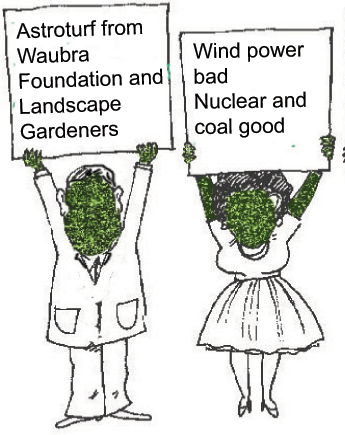
The New South Wales and South Australian governments are currently reviewing guidelines for wind farms. Neither government is likely to ignore a recent poll that 77 per cent of Australians support wind farms.
Waubra Fights The Anti-Wind Bullies. New Matilda , 26 Sept 12, By Sandi Keane The town of Waubra has had its name hijacked by anti-wind astroturfers. Locals say they’re happy with wind-farming – and it’s not making them sick. So who are the scare campaigners? Sandi Keane reports
It’s spring in the quiet sheep-farming hamlet of Waubra, an hour’s drive northwest of Ballarat in Victoria. With the shearing done and the crops in, local farmers have turned to a bit of springtime mending. Not fences, but the town’s image. After three years saddled with the negative legacy of the “foundation” that stole their name, local farmer, Karen Molloy, says the community is fighting back with a bumper festival.
Back in 2009, Waubra hit the news when powerful forces linked to mining interests, and Australia’s climate sceptic factory, the Institute of Public Affairs, used what was then the largest wind farm in the southern hemisphere as an easy target for their anti-wind scare campaign. The establishment of the Waubra Foundation followed.
“For three years, we’ve lived here quite happily. We love the wind towers and love Waubra. But it is so much more than wind so we’ve dropped the word “Wind” from the Waubra Community Festival”, Molloy said.
The festival, which takes place on Saturday 6 October, will showcase the positives of renewable energy as well as the fresh produce grown in its red volcanic soil. There’ll be a “Waubra Gift” running race, free rides, entertainment for the whole family, a free bus from Ballarat and a tour of the wind farm. Continue reading
BHP’s shares down as it dallies again with the expensive Olympic Dam dream
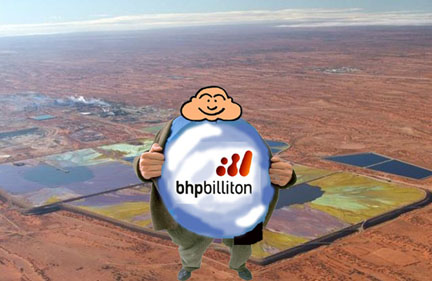 BHP seeks more time on Olympic Dam Kristie Batten , 27 September 2012 THE South Australian government says it will carefully consider a request by BHP Billiton for an extension to the December deadline for its shelved $A28 billion Olympic Dam expansion
The government received a letter requesting the four-year extension beyond December 15 ahead of a meeting between the miner and Minister for Mineral Resources and Energy Tom Koutsantonis in Adelaide yesterday.
“Very careful consideration will now be given to the company’s request and the reasons given for seeking an extension,” Koutsantonis said in a statement…….
this will require a lot more work at the pit, a lot more work here in Adelaide and the scale and the scope of that work will be in the hundreds of millions of dollars.”
However, SA Greens politician Mark Parnell told ABC Adelaide the government should reject the request and renegotiate.
“Extending a bad deal for four more years doesn’t improve it one iota,” he said.
“This is really a chance for South Australia to renegotiate with the world’s richest resource company a deal that looks after the environment, is better for the economy, guarantees local jobs and makes sure that all South Australians benefit from the resources that we own.”
BHP has said it did not expect to approve any major projects in the current financial year. Shares in BHP last traded 27c down to $32.54.
Australia in danger, as part of USA’s military machine
Is it time to downgrade US defence? Business Spectator, Jackson Hewett , 26 Sep 2012 Malcolm Fraser says it is time we end our “dangerous and foolish” complicity with US military policy in the Asian region and renegotiate the ANZUS treaty.
He calls Defence Minister Stephen Smith’s assertion that joint US Australian military operations are not bases as “political spin of the worst kind”, something that Professor Richard Tanter, the Director of the Nautilus Institute for security studies agrees with.
Fraser says that the 2500 marines on permanent rotation in the Northern Territory, proposed US surveillance bases in the Cocos Islands and expanded roles of Pine Gap linked to US bomber command in Hawaii, send a clear message that Australia is becoming the “the southern bastion of America’s re-arming in the Western Pacific and Southeast Asia” – something that “spells danger for the entire region”. If citizens fully understood the level of US control over
military operations here, there would be “rage across Australia”.
Fraser is calling for a complete review of the ANZUS treaty and says that we have failed to work within the treaty’s stated aim of “consultation” on defence, and instead we have become “supplicants” who uncritically take part in American wars.
It is time, Fraser says, to show “the guts, the grit and the gumption” to communicate to the region that we are independent of America. Under current American policy, Fraser believes, our unwavering alliance with the US puts us in more danger than not….. http://www.businessspectator.com.au/bs.nsf/Article/us-alliance-america-australia-china-foreign-policy-pd20120926-YH2Q9?OpenDocument&src=sph%20&src=rot
Solar energy going backwards in Queensland, with its anti-renewable energy government
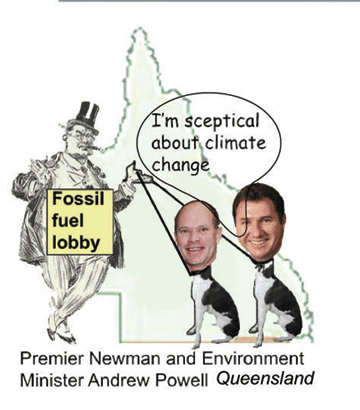 Queensland a leader in solar? Not on Campbell Newman’s watch By Charis Palmer 27 September 2012 The Conversation Around the clock solar power could be a reality for Australians in the foreseeable future, but experts say a hostile state government stands in the way of Queensland becoming the solar power leader suggested by the Climate Commission.
The latest instalment from the Climate Commission on the impacts and opportunities of climate change is “wilfully blind to reality”, with no mention of the massive coal and coal seam gas industries in Queensland, said Chris McGrath, senior lecturer in environmental regulation at the University of Queensland. The report says Queensland’s solar resources are among the best in the world, and the state should take more advantage of the opportunity.
But in the absence of positive deployment policies from the state government, it will take some time to see large solar power stations serving retail customers, said Mark Diesendorf, deputy director of the Institute of Environmental Studies at University of New South Wales. The Climate Commission’s report cites the Kogan Creek Solar Boost Project, which will provide a solar thermal addition to the neighbouring coal-fired power station, expected to be the largest solar integration project in the world.
But in July, Queensland Premier Campbell Newman withdrew $75 million in funding from the proposed stand-alone 250 megawatt Solar Dawn project near Chinchilla.
Dr Diesendorf said concentrated solar thermal could be vital to solar power generation in the longer term. “It’s not very expensive to store the heat on concentrated solar thermal and therefore have 24 hour solar power.”
But with several coal-fired power stations running at less than capacity in Queensland, organisations investing in new solar infrastructure will find it difficult to compete, Dr McGrath said. He added that the government’s focus remained on coal and coal seam gas, with renewables seen as a small component only.
“They’re talking about Queensland as a leader for solar, but Queensland’s going backwards in terms of participating in any funding for addressing climate change, and unwinding programs.” Dr McGrath said the picture painted by the Climate Commission in its report is the same one that’s been painted for ten years with no action taken.
He said a blunter approach was needed from the Commission and agreed that while it may not be an advocacy group, it was up to scientists to point out the consequences of policy choices. “It’s not advocating if you say the 5 per cent by 2020 goal will lead to three degrees warming and we won’t have a Great Barrier Reef at this point. That’s just joining the dots for people to see.”
AUDIO: Queensland is especially vulnerable to global warming
 Global warming threatens Qld agriculture sector: report http://www.abc.net.au/news/2012-09-25/global-warming-threatens-qld-economy-report/4278764 ABC News By Sharnie Kim 26 Sept 12, The Federal Government’s Climate Change Commission is warning in a new report of a looming crisis in Queensland’s agricultural sector.
 AUDIO: Reports says Qld’s economy is vulnerable to global warming effects. (AM)
The Climate Change Commission says Queensland’s economy is particularly vulnerable to the effects of global warming.
It says rising temperatures and changing weather patterns will lead to falls in beef, sugar and cereal production.
Commissioner Lesley Hughes says it is critical to quickly reduce greenhouse gas emissions.
“The challenge that we have in front of us is how quickly we can act to avoid the worst of those changes,” she said.
But she says some change is inevitable and farmers must adapt.
“There will be some sorts of agricultural practices that simply won’t be able to occur where they occur now,” she said.
The Commission’s report also warns of threats to the state’s coastal developments, biodiversity and tourism sector.
Ms Hughes says urgent action is needed to reduce carbon emissions.
“Nowhere’s doing enough so I wouldn’t single out Queensland in any way – Queensland is particularly vulnerable,” she said.
“Its economy, its natural environment, its agricultural industries and its coastal infrastructure is extremely vulnerable to the impacts of climate change, so Queenslanders have to do their bit.”
BHP prolongs the indecision on Olympic Dam uranium mine
BHP Billiton’s request for an indenture extension keeps the Olympic Dam project alive, says Greg Kelton. Adelaide Now 27 Sept 12 GET ready for another four years of “will they or won’t they”. South Australians will have to play the pol-itical guessing game of what will happen to the much-vaunted Olympic Dam mine expansion, albeit on a much smaller scale.
The state has already gone through one major economic disappointment with BHP Billiton shelving the planned $30 billion expansion last month, claiming it was due to world economic conditions.
The proposed expansion had been sold to the public by Government, economic commentators and many in the mining industry as the state’s economic saviour, the major project which would put SA up with the mining giant states of WA and Queensland.
BHP Billiton’s decision to ask for an extension of the indenture which was due to expire at the end of this year, keeps the project, in some form at least, alive….. Both parties now realise the project cannot be seen as the be-all and end-all for the state’s economy. Both have stated the need for more diversification of the state’s economic base. However, whatever they think, both parties will be keen for some form of Olympic Dam expansion to proceed. Their political futures might well depend on it. http://www.adelaidenow.com.au/news/opinion/bhp-billiton-guessing-game-set-to-continue-in-south-australia/story-e6frealc-1226482133887
Western Australian Aborigines fear radiation pollution from Wiluna and Yeelirrie uranium mining projects
 Radiation exposure looming for Wiluna http://indymedia.org.au/2012/09/22/radiation-exposure-looming-for-wiluna 22 Sep 2012 By Gerry Georgatos Perth Western Australia Gerry Georgatos – courtesy National Indigenous Times – nit.com.au “They are going to kill our people, some will die quickly, some by a thousand cuts,” said Wiluna Elder Glen Cooke.
“We don’t want Maralinga all over again where our people will be hurt and die sick and young, and for decades the truth hidden.” “If they bring uranium out of the ground at Wiluna and radiation to our people many of our young children today will be tomorrow’s Yami Lesters.”
Toro Energy’s Wiluna uranium project’s final environmental approval looks near certain from the Environmental Protection Authority (EPA) and the uranium mine will become the front runner for more uranium mining throughout Western Australia and predominately on Aboriginal lands where communities continue to thrive – for now.
The many years-long ban on uranium mining in WA has been lifted.
Angst has ripped through Aboriginal communities State-wide and especially at Wiluna and Yeeliree.
“The Government has not said that they cannot guarantee against radiation poisoning of our people,” said Mr Cooke. EPA chairman Paul Vogel said radiation exposure for people living near Wiluna would be “very low”.
Yeeliree Traditional Owners and chairperson of Western Australians Nuclear-Free Alliance (WANFA), Kado Muir said all the Elders from across WA who make up WANFA cannot believe the “high risk” claim by Dr Vogel of “very low” radiation exposure risks to communities nearby the proposed Wiluna mine. “There are no genuinely safe levels with radiation – radiation exposure at any level is bigger than exploding dynamite. Chernobyl and Fukishima didn’t get it safe, so what makes us think Australia will? This is our peoples lives they are putting at real risk, not theirs.”
“How many Western Australian communities have suffered lead and aluminium poisoning from leaks along freight routes and from refineries, and it was said risks would be contained but they weren’t? They skyrocketed past base levels and with uranium a thousand times more dangerous, what are they saying? Are they mad? Uranium belongs in the ground, not above it.”
“Don’t our peoples, our communities, our Country matter to these Boards?”
The EPA claim to have tightened conditions around the uranium project after an independent appeals committee made 21 new recommendations after appeals were made by independent groups, the Conservation Council of WA and WANFA and its Elders to the EPA decision to approve Toro Energy’s Wiluna uranium project.
Canadian company CAMECO is also seeking approvals to mine uranium on Mr Muir’s Tradtional Country – Yeeliree.
WA environment minister Bill Marmion said nine appeals had been lodged against the EPA decision in May. The EPA has three uranium proposals before it. “I am satisfied the appeals committee has carefully considered all the matter raised in the appeals and have accepted their recommendations,” Mr Marmion said in a statement. He said he would consult the Radiological Council and the Ministers for Indigenous Affairs and Health
Spread of nuclear weapons now likely,if SILEX laser uranium enrichment goes ahead
U.S. Nuclear Agency OKs License for Laser Enrichment, Despite Worries NTI Sept. 25, 2012
By Elaine M. Grossman Global Security Newswire WASHINGTON — Nuclear Regulatory Commission staff on Tuesday issued the first U.S. commercial license ever for a process in which uranium is enriched by laser, opening what many issue experts have warned could be a new chapter in the global proliferation of sensitive atomic materials.
“This is going to further validate a new enrichment technology when we’re trying to get countries to restrict the old enrichment technologies, because they’re dangerous enough,” said one House aide, describing a concern held by several members of Congress. “How is this a positive for nonproliferation?”
Under the new permit, nuclear energy giant GE-Hitachi can construct and operate what it calls a “Global Laser Enrichment” facility in Wilmington, N.C., that would produce atomic fuel for reactors worldwide. The commercial consortium has said initial tests of the technology have been successful, potentially laying the groundwork for a more cost-effective method of enrichment than today’s centrifuge approach.
Smaller facility space and less energy consumption make lasers an appealing tool for commercial uranium enrichment, but might also prove attractive to a handful of nations around the globe interested in the illicit production of weapon-grade uranium, according to nonproliferation specialists.
Critics have said any U.S. action to approve laser enrichment domestically would be likely to spur new research on the technology abroad — both for commercial and clandestine use.
Based on such concerns, the American Physical Society in 2010 petitioned the Nuclear Regulatory Commission to begin requiring proliferation assessments as part of its licensing process for any new uranium enrichment or plutonium reprocessing technologies.
Experts subsequently asked the five NRC commissioners to postpone the agency’s decision on the GE-Hitachi laser enrichment license until they could decide the matter of whether such permit requests should undergo appraisals for their potential proliferation ramifications.
However, an NRC decision on mandating such analyses is not expected until November at the earliest.
“The petition review package is due to the Office of the Secretary by Oct. 31,” NRC spokesman David McIntyre said on Tuesday. “It should reach the commission a few days after that.”
By regulation, the NRC staff had 10 days to issue the laser enrichment operating permit following Atomic Safety and Licensing Board approval on Sept. 19.
Led by Chairwoman Allison Macfarlane, the NRC commissioners have not actually voted on whether to approve the GE-Hitachi license, according to McIntyre. Rather, the NRC spokesman said, “the commission was notified verbally that staff was prepared to issue the license, and since the commission did not direct otherwise, the staff proceeded.”
Now that staff has approved the permit, the commissioners have 120 days to revisit the licensing board’s findings and potentially put the brakes on the laser enrichment effort, if they see fit. Such NRC reviews are “rare but not unheard of,” McIntyre said…….
there could still be enough time to revisit the laser enrichment license approval even after the NRC commissioners’ anticipated consideration this fall of the American Physical Society petition on proliferation assessments……. The pending American Physical Society petition “offers the commission a second opportunity to take a stance on proliferation matters, for which I am optimistic,” said Kemp, now an assistant professor of nuclear science and engineering at the Massachusetts Institute of Technology. “However, whether the commission will have the high-mindedness and public spirit to revisit the [laser enrichment] decision at that time remains an open question.”http://www.nti.org/gsn/article/us-nuclear-agency-oks-license-laser-enrichment-despite-worries/
Queensland’s Liberal govt not concerned, not acting on Climate Change
Flannery questions Newman’s climate record, SMH, September 25, 2012 Australia’s climate change commissioner says it’s too early to say whether the Queensland Premier is taking global warming seriously enough.
Environmentalist Tim Flannery was in Brisbane today to launch the Australian climate commission’s latest report, which examines the impact of global warming on Queensland.
The Critical Decade: Queensland Climate Impacts and Opportunities warns that the state’s economic powerhouses of tourism and agriculture are at significant risk from rising sea levels and changing weather patterns.
Meanwhile, the Liberal National Party government, since gaining power in March, has wound back Labor’s solar power subsidies and scrapped eight carbon reduction programs to save money……the Queensland Greens said state Environment Minister Andrew Powell was on the record as questioning the science behind global warming.
The party’s Senate candidate Adam Stone said responsible action on climate change would protect communities and have economic benefitsthrough clean energy.
“But it is hard to be optimistic that our state government will seize that opportunity given their sorry record,” Mr Stone said in a statement. http://www.brisbanetimes.com.au/environment/climate-change/flannery-questions-newmans-climate-record-20120925-26isx.html#ixzz27eB2Py2b
Fossil fuels subsidised by Australia- how much solar we’d have if they weren’t
How Much Solar Could We Have If Fossil Fuels Weren’t Subsidised? by Giles Parkinson, editor of RenewEconomy.com.au, 26 Sept 12 How much more solar power could we have installed if we had gotten rid of subsidies for fossil fuels, and pushed them towards a new technology? According to the European Commission, nearly 10 times more than we have now.
Fossil fuel subsidies have been a continuing sore point for international organizations. The International Energy Agency and various UN bodies have been campaigning for their removal, and even got the support of the G20 group of leading economies. But little has happened.
It is estimated that the world spent up to $7.5 trillion on combustibles, fuels and electricity from 2007 to 2010. Of this, the level of direct consumption subsidies and tax break to fossil fuels amounted to $1.8 trillion, according to a joint report compiled by the IEA, OPEC, the OECD, and the World Bank.
The EC, in a report on solar PV technologies released this week, says these subsidies would have been sufficient to install some 340 GW of PV systems world-wide at the prices prevailing at the time. At current prices, it would be enough to install 610 GW. To put that figure into perspective, Australia has just below 2GW of solar PV installed, and Germany is the leading country in the world with 30GW.
The IEA has been pushing for the removal of subsidies because it says that the energy game will change “quickly and substantially” once removed. “I see fossil fuel subsidies as the appendicitis of the global energy system which needs to be removed for a healthy, sustainable development future” IEA chief economist Fatih Birol told the Financial Times recently.
The joint study estimated that energy consumption could be reduced by 600 Mtoe (million tonnes of oil equivalent) or the combined current consumption of Japan and Australia – if the subsidies are phased out between now and 2020. That consumption cut would save the equivalent of the current carbon dioxide emissions of Germany, France, Italy, and Spain. …. http://www.energymatters.com.au/index.php?main_page=news_article&article_id=3396
1 This month
15 April – Zoom –Nuclear Power is Not the Solution
Apr 15, 2026 01:00 AM in Canberra, Melbourne, Sydney

Join the International Physicians for the Prevention of Nuclear War (IPPNW) on Tuesday, April 14th for a timely webinar exploring the risks associated with nuclear power and challenging the myth that it offers a simple, safe, carbon-free solution to the climate crisis

of the week – Australians for War Powers Reform (AWPR)
To see nuclear-related stories in greater depth and intensity
 Antinuclear