Uranium mining for Queensland – NOT a job provider, and NOT needed
 As for respecting the wishes of Aboriginal Queenslanders, neither our State nor Federal legal frameworks give traditional owners the right to refuse mining on their lands, so it is difficult to see how their wishes will be respected should they not wish to host a uranium mine. And given the findings of a 2006 study that found a 90% higher incidence of cancer amongst indigenous peoples living in close proximity to uranium mines in Kakadu, one can well understand how that might be their preference.
Queenslanders have thus far decided we don’t want to be part of an industry that generates toxic waste with no functioning long-term storage solution, fuels weapons of mass destruction, and has no future in electricity generation because it grows ever more expensive while clean energy alternatives grow ever cheaper.
The jobs aren’t in uranium: Stone Opinion: Adam Stone | 6th October 2012 “……..The LNP obviously decided to insulate their campaign from public concern about uranium mining by committing that they would not change Queensland’s anti uranium mining policy, but their underlying conviction on the subject is completely at odds with this position. After all, they openly campaigned in favour of repealing the policy in the 2009 State election …..
The Queensland Resources Council (QRC) and Australian Uranium Association (AUA) have opened by arguing that uranium mining in Queensland will: provide jobs, respect the wishes of indigenous Queenslanders, cut greenhouse gas emissions, only supply uranium for peaceful purposes, and is necessary for baseload power generation as only nuclear, hydro and fossil fuels can meet this need. Continue reading
91 Year Old Prisoner of War Hero, Tom Uren, launches Hiroshima Exhibition
 He had spent three years as a prisoner of the Japanese, forced to work on the Burma-Thai death railway before being shipped to Japan to labour in copper and lead smelters. He was in a camp at Omura, about 60 kilometres from Nagasaki, when the sky discoloured.
”As I got to understand nuclear war and the nuclear industry I realised the dropping of those bombs on Japan was a crime against humanity,” he says.
he will bring his anti-nuclear message to Melbourne tomorrow when he launches Hiroshima, assembled by the
Hiroshima-Nagasaki Atomic Bomb Exhibition Abroad at the Gasworks Arts Park in Albert Park
At 91, peacemaker still fights nuclear threat The Age October 8, 2012 Tony Wright National affairs editor TOM Uren is 91 now, but he retains a vivid memory of the sky turning crimson when the ”Fat Man” atomic bomb exploded over the Japanese city of Nagasaki on August 9, 1945. ”I’ve seen the most beautiful sunsets in the Northern Territory, but
this was a magnification of one of those sunsets by about 20 times,” he says.
Mr Uren had no idea that he was witnessing the second use of an atomic bomb in world warfare, or that it killed 39,000 people instantly and wounded another 25,000, with many more to perish of blast burns and radiation exposure. Continue reading
Australia’s pro nuclear con man Leslie Kemeny soundly refuted
Not warming to the nuclear option, Independent Australia The evidence consistently shows that nuclear energy – even aside from its noxious and socially unacceptable character – is just too expensive, writes Ludwig Heinrich. The evidence consistently shows that nuclear energy – even aside from its noxious and socially unacceptable character – is just too expensive, writes Ludwig Heinrich.
[On economics and technologies] “…[Kemeny] has not understood either the economics nor the technologies he writes about. Professor John Quiggin has elsewhere noted that baseload power is a myth, and he and others have shown that it is an artifact of our old ways of doing things. Our large centralised power generating systems could not and cannot be varied to match demand, so instead they churn out power at all times and sell it at a discount when there is low demand. As well as being economically silly, this also contributes to more pollution.
[on reliability of energy supply] The notion that somehow supply would be unreliable and insecure is another zombie argument from the nuclear club, who like to dismiss renewable energy systems without understanding them, on the basis that they compete with their large insecure generating systems. And yes, I did say insecure; a nuclear plant is intrinsically insecure. It is fueled by a toxic substance and throughout the entire cycle requires a high level of security and oversight. Of course, it is also insecure in the sense of being a target for terrorism and a prime military target, whereas distributed renewable systems do not share this flaw. There is another insecurity associated with nuclear power too — in that, after Fukushima, local citizenry may feel rather insecure as well….
[on Kemeny’s claim that nuclear power is “clean”] how clean is uranium mining? And how will you clean up after Fukushima? Which brings us to the most risible element of Kemeny’s article, the claim that nuclear power production makes economic sense. As I have remarked elsewhere, once one adds in the security, decommissioning, financing and insurance costs nuclear power is simply too expensive. Nor does it make sense to ignore the non-financial cost — the loss of social amenities, the added militarisation and the diminished sense of security that nuclear power entails…..
[on renewable energy] There have been a number of studies that have shown that Australia can meet all its energy needs through renewables and all he has to offer are hat-tips to the International Energy Agency, Martin Ferguson and the head of the China Nuclear Energy Industry — hardly unbiased witnesses to his claims.
[on climate change] Kemeny then goes global in his song of praise but, to jump to the chase, why doesn’t he point out that to use nuclear energy systems to address global climate change, it would require some 11,000 new reactors worldwide? Or that many of these would need to be located in failed states and countries currently beset by internal wars?
[on costs of renewables versus nuclear] Kemeny tells us that the Green concept of replacing Australia’s hydrocarbon-fuelled electricity industry with renewables is ‘naive’. But obviously he has not consulted a dictionary to find out what that word means. He, and the other promoters of nuclear energy, are the ones who are naïve — in that they show no knowledge or wisdom. It is not green groups or even Green Parties that have stalled the nuclear juggernaut — it is accountants, actuaries and economists, who have consistently shown that nuclear energy – even aside from its noxious and socially unacceptable character – is just too expensive.
When will the nuclear industry and its shills learn this lesson? http://www.independentaustralia.net/2012/environment/not-warming-to-the-nuclear-option/
As Gillard heads to India, anti nuclear protests there, and police repression, continue
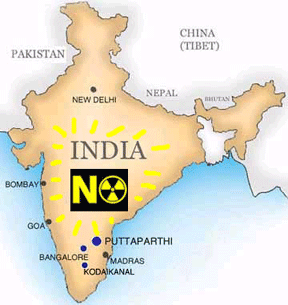 Anti-nuclear protesters plan siege to sea tomorrow http://www.ptinews.com/news/3031167_Anti-nuclear-protesters-plan-siege-to-sea-tomorrow Madurai, Oct 7 (PTI) Stepping up their protest against the Kudankulam Nuclear Power Plant, People’s Movement Against Nuclear Energy (PMANE), spearheading the stir, would lay siege to the sea at about 500 meters
away from the KNPP tomorrow.
Fishers, farmers, traders and volunteers of various political parties from Kanyakumari, Tirunelveli and Thoothukudi districts would participate in the protest, a PMANE source said today.
Heavy police force has been deployed at various places to prevent any untoward situation, police said.
1 This month

of the week – Australians for War Powers Reform (AWPR)
To see nuclear-related stories in greater depth and intensity
 Antinuclear