Australia’s pathetically weak role in the international Comprehensive Nuclear-Test-Ban Treaty (CTBT )
 Australia’s Foreign Minister Bob Carr makes much of weak treaties like this one. I would trust Bob Carr about as far as I could throw him. Carr is an enthusiastic member of Australia’s pro nuclear elite. He is adept at publicising seemingly effective nuclear disarmament moves – but when you look at them properly moves like this much vaunted strengthening of the Comprehensive Nuclear-Test-Ban Treaty (CTBT ) – are really hypocritical sops to those of us who are anxious about nuclear weapons – Christina Macpherson
AUSTRALIA-NZ PACT FALLS SHORT OF ABOLISHING NUKES IDN-InDepthNews – October 21, 2012 By Neena Bhandari SYDNEY – Australia and New Zealand have entered into a scientific and technical cooperation agreement to strengthen detection of nuclear explosions under the framework of the international Comprehensive Nuclear-Test-Ban Treaty (CTBT ) and work together to promote a permanent and effective ban on nuclear weapon tests….. The move would see Australian Radiation Protection and Nuclear Safety Agency and Geoscience Australia working more closely with New Zealand’s Environmental Science and Research (ESR) to enhance their capabilities to detect nuclear explosions……
‘Move quickly to a Nuclear Weapons Convention’
But Chairman of the Mayors for Peace Foundation and former expert advisor to the Hiroshima Peace Culture Foundation , Steve Leeper, feels countries like Australia that have signed and ratified the CTBT should be doing far more than talking about a new framework.
“It makes it look like the two countries are doing something about nuclear weapons when what they are really doing is refusing to support the nuclear weapons convention. Continue reading
Gillard government takes its orders from USA – uranium to India
Gillard is helping to destabilise the sub-continent by fuelling a dangerous arms race involving India’s rivals, China and Pakistan.
The Labor government’s about face on uranium sales to India under Gillard was carried out on Washington’s orders. In November 2011, the US ambassador to Australia, Jeffrey Bleich, publicly called on Canberra to “sort out” its issues with India, as the US had done when it resolved the “thorny point” of uranium sales through the 2008 nuclear deal that exempted India from the Nuclear Non-Proliferation Treaty (NPT)

Australian PM visit to India bolsters new “strategic partnership” WSWS, By Patrick O’Connor 20 October 2012 Australian Prime Minister Julia Gillard’s three-day trip to India this week was aimed at deepening military, diplomatic, and economic ties between the two countries.
Washington has encouraged the closer relations as part of its aggressive drive to undermine the influence of China in the Indo-Pacific region. Gillard met with Prime Minister Manmohan Singh on Wednesday. High on the agenda was progress towards Australian uranium sales to India, Continue reading
Red Cross and red Crescent want a nuclear free convention – NOW
 AUSTRALIA-NZ PACT FALLS SHORT OF ABOLISHING NUKES IDN-InDepthNews – October 21, 2012
By Neena Bhandari “……. This is where governments should focus their diplomatic efforts. Negotiations need not, and must not, await the entry into force of the CTBT. We need nuclear-free countries to play a leading role, rather than simply waiting for the nuclear-armed countries to act. This is an urgent humanitarian necessity,” Wright told IDN.
Australian Red Cross in conjunction with Flinders University and the Bob Hawke Prime Ministerial Centre at University of South Australia are co-hosting a conference in Adelaide in the first week of November 2012 to advance the debate on the urgent need to develop a legally binding tool to prohibit and ultimately eliminate nuclear weapons. Continue reading
Policy Meltdown: LNP uranium U-turn bad news for Queensland
22 Oct 12, State government plans to open the door to the uranium industry in Queensland have been condemned by the ACF as irresponsible, ill-considered and in clear breach of pre-election commitments.
Germans happy to pay more for setting up clean energy
 Poll finds large majority of Germans favor phasing out nuclear power despite rising costs
  News Ser 22 Oct 12 Poll: Germans accept nuke exit despite rising bill ASSOCIATED PRESS |22 Oct 12 A new poll finds that a large majority of Germans back the government’s decision to phase out nuclear power and switch to renewable energies within a decade, despite rising electricity bills.
The poll for German news magazine Focus published Sunday found that 72 percent continue to support the country’s energy switchover. Only 24 percent were opposed to the policy.
Germany’s grid operators announced earlier this month that a surcharge on households’ electricity prices financing the expansion of renewable energies will increase by 47 percent starting in January. A typical family of four will then have to pay about (EURO)250 ($325) per year on top of their bill… http://www.newser.com/article/da21vv5g1/poll-finds-large-majority-of-germans-favor-phasing-out-nuclear-power-despite-rising-costs.html
Dirty energy still gets the government subsidies
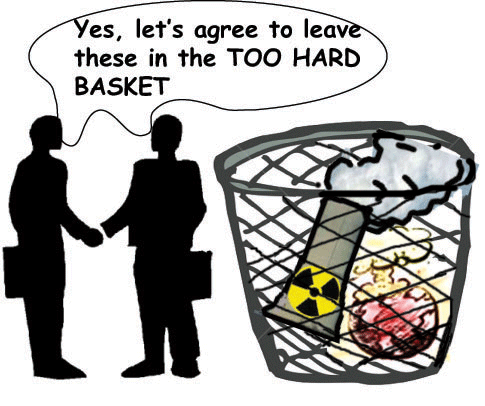 When It Comes to Government Subsidies, Dirty Energy Still Cleans Up http://www.businessweek.com/articles/2012-10-21/when-it-comes-to-government-subsidies-dirty-energy-still-cleans-up
by: Charles Kennyn October 21, 2012 The Oct. 16 presidential town hall debate featured Mr. Romney and Mr. Obama facing off on who was really Mr. Oil or Mr. Gas or Mr. Coal. Neither candidate even mentioned climate change. And while President Obama did refer to renewable production, solar got short shrift—doubtless because of the fracas over now-bankrupt thin-film solar manufacturer Solyndra, which had received loan guarantees as part of the stimulus bill.
That’s a shame, because the reason panel production has moved from such countries as America and Germany to China is because prices have dropped and production has become a commoditized, high-volume enterprise. That may be bad news for Western manufacturing jobs, but it’s great news for the global environment, consumers, and even American energy security.
In fact, if we had a level playing field, where neither fossil fuels nor renewable energy received favorable regulatory or subsidy treatment, solar would be increasingly competitive. Mr. Coal would be going home, and Mr. Sun would be coming out to play.
Global subsidies for oil, gas, and coal amounted to $409 billion in 2010 —compared with $60 billion for renewable energy that year. Cutting those subsidies would be economically efficient, reduce overall energy consumption, and level the playing field with renewable power. The International Energy Agency suggests that removing fossil fuel subsidies would reduce carbon dioxide emissions by as much as 2.6 gigatonnes a year by 2035. That’s half of what’s required to prevent the planet’s average temperature from increasing by two degrees centigrade or more per year. Continue reading
Denmark exceeds its solar energy goal
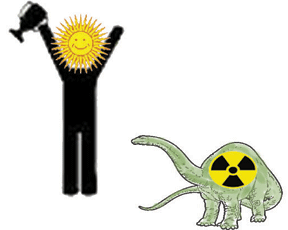
 Denmark Hits 200 Megawatt Solar Capacity Goal 8 Years Ahead of Schedule by Molly Cotter, 10/15/12http://www.stumbleupon.com/su/1jrNeg/inhabitat.com/denmark-hits-200-megawatt-solar-capacity-goal-8-years-ahead-of-schedule/ Lets face it – its rare we see a government goal reached on time, let alone early. Not too long ago, the Danish Government announced an ambitious goal to reach 200 megawatts of solar capacity by 2020, and as of last week, they have already met it! The country is currently installing an average of 36 megawatts of solar panels each month. At this rate, their resulting capacity by 2020 will be over five times the original goal. Denmark‘s power is currently 20% supplied by renewable sources, and the nation has set a goal of sourcing 100% of its energy from renewable sources by 2050.
Western Australian Labor party’s weak opposition to uranium mining
Uranium mine: ‘more than the issues we’ll lock on to’ Green Left , October 20, 2012 By Alex BainbridgeTwenty-four hours after telling the world that “people need to start showing some respect for the environment they live in”, WA environment minister Bill Marmion showed what he meant by that statement by approving Western Australia’s first uranium mine The October 9 decision gives state approval to Toro Energy for its Wiluna uranium mine. The mine still requires approval from the federal Labor government, but the state approval is considered to be a major hurdles passed.
The state Labor opposition tries to walk both sides of the street, claiming it is opposed to uranium mining but promising not to close down any mines approved by the current government. This stance contrasts with the policy WA Labor had under its previous leader and is a marker of the shift to the right under Mark McGowan.
Socialist Alliance candidate for Willagee Sam Wainwright said this is a mistaken policy. “Labor should be threatening to reverse approval for the mine and promising to utilise every democratic means possible – including the power of the people – to avoid paying a cent in compensation.
“At the moment, Labor is just giving comfort to the uranium industry and promising to give them a toe-hold to maintain their existence – just as the Bob Hawke government did in 1983 with their ‘Three mines policy’…… Anti-Nuclear Alliance of WA spokesperson, Marcus Atkinson told Green Left Weekly that after protesting at Toro, the group moved to state parliament where they were joined by Manufacturing Workers Union state secretary Steve McCartney who spoke against the approval.
Other speakers included former Greens senator Jo Vallentine and anti-nuclear campaigner Mia Pepper.
ANAWA is planning to contest the mines development in every possible way, including a possible legal challenge….. http://www.greenleft.org.au/node/52565
Australia: electricity demand is falling, and power companies are lying about this
 Farmer finds facts lost in transmission. The Age October 22, 2012, Michael West Four months ago – on hearing of a proposal to run giant transmission lines through his property – a farmer from the NSW north coast, Bruce Robertson, delved into the claims the power companies had been making about electricity prices. He found they were untrue.
Four days ago, the Productivity Commission corroborated what Robertson had been saying all along. That is, escalating power bills were principally the upshot of over-investment in electricity networks; not the carbon tax, not rising consumption.
”Demand is falling, not rising,” Robertson says. ”This basic premise is factually incorrect.”…… ”It is often said that if you lie long enough and loud enough, then the lies become the accepted truth,” Robertson says.
”And so it is with Grid Australia, in their submission to the Senate inquiry into electricity prices. Many of the statements made to the Senate inquiry are purely and simply fabrications.”…..
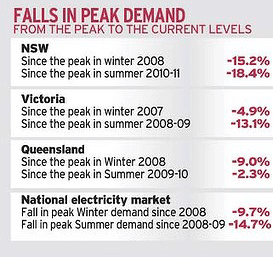 Demand for electricity had been falling since 2008 in Victoria, NSW and Queensland at roughly 1 per cent a year, despite forecast rises of 2.2 per cent a year.
Demand is now 10 per cent below where the industry forecast it would be four years ago. Mild weather, changing consumer behaviour and rising costs have all been factors in this, Robertson says.
In July, as ”gold-plating” started to become a buzzword in Canberra, Robertson launched into numerical detail of how the industry figures had been inflated and distorted…..
Peak demand was falling. Recent figures from the Australian Energy Regulator show the clear change in trend since 2008-09. Peak demand for both summer and winter demands in the national electricity market are on the wane.
In NSW, the largest market in the NEM, peak demand has veritably collapsed. ”The fall in peak in winter since 2008 has been 15 per cent and the fall in the summer peak since 2010-11 has been 18 per cent. This collapse has seen peak demands fall to levels not seen for a decade,” Robertson says.
Despite the hard numbers, we still have a ”he said, she said” debate. ”The only place that peak demand is rising is in the minds of electricity industry executives,” Robertson says……
The essence of the problem of rising power prices is the structure of the industry and its regulation. Continue reading
Falling demand for electricity results in halting New South Wales coal fired power station
 Fossil Fuel Power – Another One Bites The Dust, by Energy Matters, 21 Oct AGL Energy Limited (AGL) announced on Friday the suspension of the first stage of its 1,000 MW Dalton power station in New South Wales. According to a very brief statement from the company, economic viability of the project had been under review for several months due to market conditions…
… The rising demand hasn’t happened – in fact, quite the opposite. According to a report from REC Agents Association (RAA) earlier this year, over the last three years electricity consumption in the eastern states’ National Electricity Market (NEM) had dropped by 3.2 % (6,565 GWh); with over half that reduction attributable to hundreds of thousands of solar hot water and rooftop solar panel installations, along with energy efficiency initiatives.
According to a Sydney Morning Herald article, electricity industry sources estimated more than 10 per cent of electricity demand in NSW was supplied by rooftop solar power systems during much of the daylight hours earlier last week.
The Dalton power station suspension adds to a continually growing scrap heap of gas and coal-fired projects around Australia. Elsewhere in New South Wales, the end of coal fired generation at Munmorah power station has been confirmed. In Queensland, Stanwell Corporation Limited is taking two units at its Tarong facility in Queensland offline soon and last week, it was announced some of Victoria’s Yallourn Power Station’s generation capacity would be mothballed. http://www.energymatters.com.au/index.php?main_page=news_article&article_id=3432
By extracting massive amounts of groundwater, an earthquake can be triggered
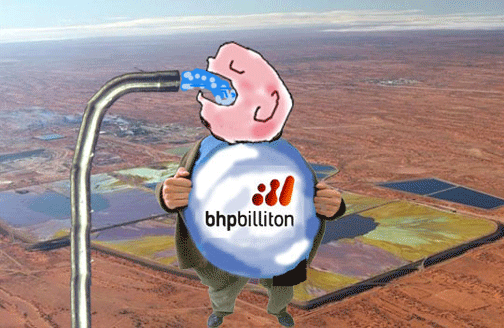
Geologists are finding that massive extraction of groundwater triggers off earthquakes. This should have implications for BHP’s extractionof water for its Olympic Dam uranium mine – for which it is entitled to get 42 million litres daily – for free. – Christina Macpherson
 Water extraction helped trigger quake http://www.heraldsun.com.au/news/breaking-news/water-extraction-helped-trigger-quake/story-e6frf7k6-1226500379044 SMH October 22, 2012 MASSIVE extraction of groundwater helped unleash an earthquake in southeastern Spain last year that killed nine people, injured at least 100 and left thousands homeless, geologists say. The finding adds a powerful piece of evidence to theories that some earthquakes are human-induced, they say.
But the May event was unusual because it was so devastating and yet so mild – only 5.1 magnitude – in terms of energy release. Researchers led by Pablo Gonzalez of the University of Western Ontario in Canada probed the mystery.
Reporting in the journal Nature Geoscience, they found the quake occurred at a very shallow depth, of just three kilometres, so the shockwave swiftly reached the surface with little to dampen it on the way.
The quake also happened on a complex but dormant fault that ripped open after water had been extensively pumped out of a neighbouring aquifer, causing a domino effect of subterranean stresses, they said. Gonzalez’s team first used ground-radar imaging by the European satellite Envisat to build a map of how terrain around Lorca changed before and after the quake.
The picture confirmed that the event had occurred on the so-called Alhama de Murcia fault, which slipped between five and 15 centimetres. They then investigated the Alto Guadalentin Basin, an aquifer lying just 5km south of the fault, where they found widespread evidence of subterranean subsidence from water extraction.
Between 1960 and 2010, the level of groundwater from this aquifer fell by at least 250 metres, according to records from local wells. A computer model put together by the team suggests what happens: lowering of the water table caused part of the crust, located next to the Alhama de Murcia fault, to break. This led to an “elastic rebound” of the crust that in turn cranked up horizontal pressure on the fault, bringing it that much closer to rupture.
The investigation adds to anecdotal evidence that human activities, ranging from exploration for shale gas, quarrying and even water reservoirs, can cause quakes. “Our results imply that anthropogenic (man-made) acclivities could influence how and when earthquakes occur,” said the study.
In a commentary, Jean-Philippe Avouac, a geologist at the California Institute of Technology (Caltech), said water extraction at Lorca probably accelerated a natural process of stress accumulation rather than unleashed the earthquake by itself.
Even so, “the consequences are far-reaching”, said Avouac. He pointed to carbon storage, a still-experimental technique in which carbon dioxide from a fossil-fuel power station is pumped into underground caverns rather than released to the atmosphere, where it would add to global warming.
“For now, we should remain cautious of human-induced stress perturbations, in particular those related to carbon dioxide sequestration projects that might affect very large volumes of crust,” said Avouac.
“We know how to start earthquakes, but we are still far from being able to keep them under control.”

Risking nuclear over safe renewables, Independent Australia, 20 Oct 12, Ever since the Fukushima meltdown, nuclear apologists have been in a full spin cycle, culminating in Australia now deciding to risk selling uranium to India, says Ludwig Heinrich. Ever since the Fukushima disaster, there has been a veritable tsunami of articles from nuclear apologists presenting specious arguments for nuclear power. These have increased recently — which seems to be a
campaign to smooth the path of uranium sales to India.
I have written about these pro-nuclear arguments elsewhere but, in sum, it can be said that there is no compelling argument for nuclear power but there are compelling economic, social and moral reasons for avoiding it and
its consequences. Not the least of these being the intergenerational toxicity management. Biblical curses only go unto the 7th generation — nuclear ones go at least twice as long.”……
http://www.independentaustralia.net/2012/international/risking-nuclear-over-safe-renewables/
1 This month
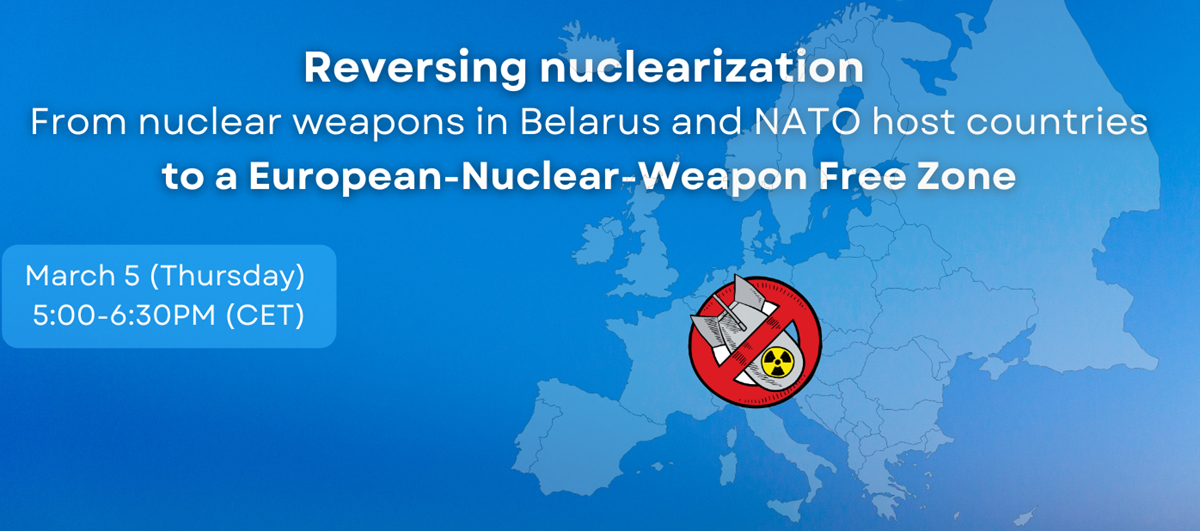
6 March -Online – Reversing nuclearization:
From nuclear weapons in Belarus and NATO host countries to a European-Nuclear-Weapon Free Zone
Mar 6, 2026 03:00 AM in Canberra, Melbourne, Sydney

of the week – Australians for War Powers Reform (AWPR)
To see nuclear-related stories in greater depth and intensity
 Antinuclear