Australia: electricity demand is falling, and power companies are lying about this
 Farmer finds facts lost in transmission. The Age October 22, 2012, Michael West Four months ago – on hearing of a proposal to run giant transmission lines through his property – a farmer from the NSW north coast, Bruce Robertson, delved into the claims the power companies had been making about electricity prices. He found they were untrue.
Four days ago, the Productivity Commission corroborated what Robertson had been saying all along. That is, escalating power bills were principally the upshot of over-investment in electricity networks; not the carbon tax, not rising consumption.
”Demand is falling, not rising,” Robertson says. ”This basic premise is factually incorrect.”…… ”It is often said that if you lie long enough and loud enough, then the lies become the accepted truth,” Robertson says.
”And so it is with Grid Australia, in their submission to the Senate inquiry into electricity prices. Many of the statements made to the Senate inquiry are purely and simply fabrications.”…..
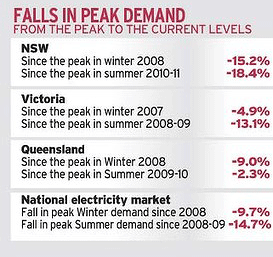 Demand for electricity had been falling since 2008 in Victoria, NSW and Queensland at roughly 1 per cent a year, despite forecast rises of 2.2 per cent a year.
Demand is now 10 per cent below where the industry forecast it would be four years ago. Mild weather, changing consumer behaviour and rising costs have all been factors in this, Robertson says.
In July, as ”gold-plating” started to become a buzzword in Canberra, Robertson launched into numerical detail of how the industry figures had been inflated and distorted…..
Peak demand was falling. Recent figures from the Australian Energy Regulator show the clear change in trend since 2008-09. Peak demand for both summer and winter demands in the national electricity market are on the wane.
In NSW, the largest market in the NEM, peak demand has veritably collapsed. ”The fall in peak in winter since 2008 has been 15 per cent and the fall in the summer peak since 2010-11 has been 18 per cent. This collapse has seen peak demands fall to levels not seen for a decade,” Robertson says.
Despite the hard numbers, we still have a ”he said, she said” debate. ”The only place that peak demand is rising is in the minds of electricity industry executives,” Robertson says……
The essence of the problem of rising power prices is the structure of the industry and its regulation.
Robertson travels to Canberra at the end of this month with Rob Oakeshott, who is putting a reform bill before Parliament. The guts of the bill is to turn the hodge-podge of state regimes into one federal law and to overhaul the perverse structure of the regulatory environment which acts as a fillip to gold-plating.
Among other mooted solutions to the crisis in energy bills, Robertson sees smart meters as potentially transferring business risk onto the consumer. They are also expensive to install.
A simpler system would be to change the regulations that would allow one access fee and three simple time-of-day tariffs – high, medium and low, he says.
”At the moment, if you want access to off-peak you have to pay. This is ‘dumb-metering’, as it does not encourage people to use electricity when it should be encouraged to be used.
”I can’t work out why the largest possible cost saving as identified by Deloitte [commissioned to report on solutions] that is, peak demand management on pool pumps and airconditioners, is not implemented first.”…… http://www.theage.com.au/business/farmer-finds-facts-lost-in-transmission-20121021-27zeg.html#ixzz2A3gruNhi
1 Comment »
Leave a comment
1 This month

6 March -Online – Reversing nuclearization:
From nuclear weapons in Belarus and NATO host countries to a European-Nuclear-Weapon Free Zone
Mar 6, 2026 03:00 AM in Canberra, Melbourne, Sydney

of the week – Australians for War Powers Reform (AWPR)
To see nuclear-related stories in greater depth and intensity
 Antinuclear
Magnificent site. Lots of useful
info here. I am sending it to several friends ans also sharing in
delicious. And certainly, thanks for your effort!
LikeLike