By extracting massive amounts of groundwater, an earthquake can be triggered
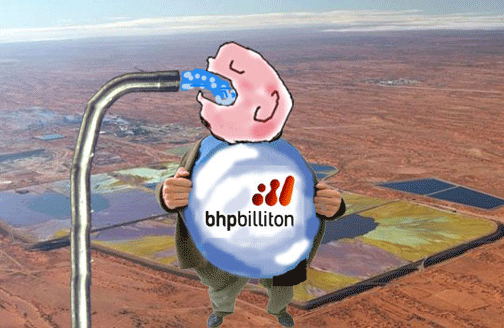
Geologists are finding that massive extraction of groundwater triggers off earthquakes. This should have implications for BHP’s extractionof water for its Olympic Dam uranium mine – for which it is entitled to get 42 million litres daily – for free. – Christina Macpherson
 Water extraction helped trigger quake http://www.heraldsun.com.au/news/breaking-news/water-extraction-helped-trigger-quake/story-e6frf7k6-1226500379044 SMH October 22, 2012 MASSIVE extraction of groundwater helped unleash an earthquake in southeastern Spain last year that killed nine people, injured at least 100 and left thousands homeless, geologists say. The finding adds a powerful piece of evidence to theories that some earthquakes are human-induced, they say.
But the May event was unusual because it was so devastating and yet so mild – only 5.1 magnitude – in terms of energy release. Researchers led by Pablo Gonzalez of the University of Western Ontario in Canada probed the mystery.
Reporting in the journal Nature Geoscience, they found the quake occurred at a very shallow depth, of just three kilometres, so the shockwave swiftly reached the surface with little to dampen it on the way.
The quake also happened on a complex but dormant fault that ripped open after water had been extensively pumped out of a neighbouring aquifer, causing a domino effect of subterranean stresses, they said. Gonzalez’s team first used ground-radar imaging by the European satellite Envisat to build a map of how terrain around Lorca changed before and after the quake.
The picture confirmed that the event had occurred on the so-called Alhama de Murcia fault, which slipped between five and 15 centimetres. They then investigated the Alto Guadalentin Basin, an aquifer lying just 5km south of the fault, where they found widespread evidence of subterranean subsidence from water extraction.
Between 1960 and 2010, the level of groundwater from this aquifer fell by at least 250 metres, according to records from local wells. A computer model put together by the team suggests what happens: lowering of the water table caused part of the crust, located next to the Alhama de Murcia fault, to break. This led to an “elastic rebound” of the crust that in turn cranked up horizontal pressure on the fault, bringing it that much closer to rupture.
The investigation adds to anecdotal evidence that human activities, ranging from exploration for shale gas, quarrying and even water reservoirs, can cause quakes. “Our results imply that anthropogenic (man-made) acclivities could influence how and when earthquakes occur,” said the study.
In a commentary, Jean-Philippe Avouac, a geologist at the California Institute of Technology (Caltech), said water extraction at Lorca probably accelerated a natural process of stress accumulation rather than unleashed the earthquake by itself.
Even so, “the consequences are far-reaching”, said Avouac. He pointed to carbon storage, a still-experimental technique in which carbon dioxide from a fossil-fuel power station is pumped into underground caverns rather than released to the atmosphere, where it would add to global warming.
“For now, we should remain cautious of human-induced stress perturbations, in particular those related to carbon dioxide sequestration projects that might affect very large volumes of crust,” said Avouac.
“We know how to start earthquakes, but we are still far from being able to keep them under control.”

No comments yet.
1 This month

of the week – Australians for War Powers Reform (AWPR)
To see nuclear-related stories in greater depth and intensity
 Antinuclear
Leave a comment