CSIRO mapping Australia’s wealth of solar energy
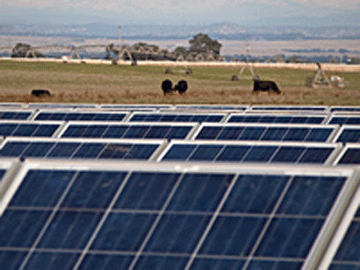 Solar mapping to shed light on rich resource , SMH, October 24, 2012 Peter Hannam We may be a nation of sun-worshippers but when it comes to forecasting where the sun shines longest, Australia’s energy authorities are stuck in the dark ages.
The CSIRO is hoping to fill that information void with a lot more riding on it than the best place to get that tan. Energy energy suppliers – current and future – need the data to predict how much solar electricity is likely to flow through the nation’s power grids.
For potential developers of large-scale solar power plants, radiation records are needed to bolster investment certainty as they try to secure finance from bankers or government agencies. The real urgency for hard numbers, though, is coming from the rapid take-up of solar photovoltaic (PV) panels, with the total now approaching 900,000 across the country.
“It’s essentially an unknown quantity what those cities full of
roof-top PV are producing and we’d like to be able to forecast it,”
said Peter Coppin, the senior renewable energy researcher leading
CSIRO’s bid.
The Australian Solar Institute, due to be rolled in to the larger
Australian Renewable Energy Agency (ARENA) at the end of the year, has
earmarked funds for solar resource forecasting techniques…….
The ASI has alone invested $150 million in 60 solar projects around
the country and there are at least two more large-scale solar projects
approved, as the emerging technology takes hold across the sunnier
regions of the country.
Earlier this month, First Solar, the world’s biggest maker of
thin-film panels, officially opened its 10-megawatt Greenough River
project in Western Australia, the nation’s first large-scale solar
plant. The solar project, owned by General Electric and Verve Energy,
may quadruple capacity.
According to AEMO’s 2012 report on national forecasting, rooftop PV
will supply 3.4 per cent of annual energy generation by 2021 –
although tumbling panel prices may see that tally exceeded. A separate
recent government report tipped solar PV and onshore wind to have the
cheapest generation costs by the mid-2030s.
The funding bid, which also includes the Bureau of Meteorology,
universities and German and American groups, would aim to deliver the
new mapping system by the end of 2014, Dr Coppin said.
“By two years’ time, when we’ve got something in place, it will be
just in time,” he said.
http://www.smh.com.au/environment/climate-change/solar-mapping-to-shed-light-on-rich-resource-20121024-2846z.html#ixzz2AFAreZeT.
No comments yet.
1 This month

of the week – Australians for War Powers Reform (AWPR)
To see nuclear-related stories in greater depth and intensity
 Antinuclear
Leave a comment