Japan’s new nuclear regulator insists on wider evacuation zones for nuclear plants
The wide area of forecasted contamination means local governments will face a greater burden in compiling effective disaster management plans.
Shunichi Tanaka, chairman of the Nuclear Regulation Authority, has called such plans a minimum requirement before nuclear plants can be cleared for a restart.
If local governments cannot compile effective disaster management plans, it means the security of local residents is not assured. In such circumstances, not only would it be difficult to resume operations at such plants, but the very existence of those plants could be called into question.
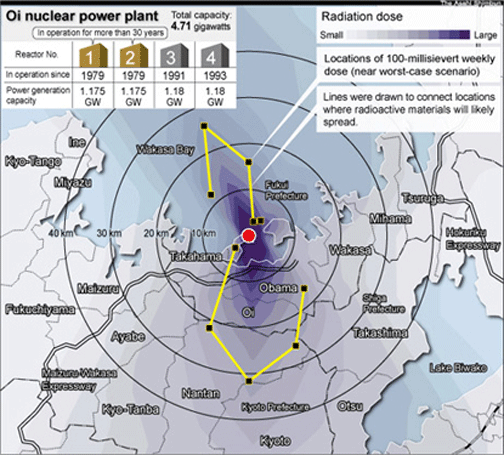
Forecast predicts wider evacuations needed if nuclear disaster repeated Nuclear watchdog may broaden definition of active fault lines October 24, 2012 THE ASAHI SHIMBUN A forecast of the radiation released in another nuclear accident shows that at four plants, a 30-kilometer evacuation zone would be insufficient for public safety, and that more distant residents would need to flee their homes too.
The findings mean additional local authorities may need to draw up
contingency plans for evacuations, and power companies may need to
seek the approval of those extra governments for reactor restarts.
In the first published survey of its kind, the Nuclear Regulation
Authority on Oct. 24 released the results of a study that used the
estimated radioactive materials released from the accident at the
Fukushima No. 1 nuclear power plant and modeled likely fallout at
plants in 16 other locations, taking into consideration factors such
as reactor size and local meteorological data.
The study found that at four plants, radiation doses more than 30
kilometers away would exceed the current safety threshold and would
require evacuations.
It was the first time the central government had assessed the impact
of a serious accident at each of Japan’s nuclear plants and released
the results,,,,
The Nuclear Regulation Authority’s planned extension of its
prepare-to-evacuate zone to 30 kilometers meant that the number of
municipalities required to compile evacuation plans will increase to
135 across 21 prefectures, up from the earlier total of 45 in 15
prefectures.
And the latest findings mean that additional municipalities may need
to draw up plans too, faced with possible evacuation-triggering
fallout levels outside the 30-kilometer zone.
A key figure used in the forecast was the modeled release of 770
quadrillion becquerels of radioactive materials (a quadrillion is one
thousand trillion). This was the size of the atmospheric release
during the Fukushima nuclear accident.
In the event of another accident, local weather conditions will affect
the spread of such materials. However, the forecast assumed that the
wind direction at the time the release began continued for a week. It
considered meteorological records in determining the possible
direction of a radioactive plume.
The map produced showed which areas, in 16 different points of the
compass from the nuclear plant, could end up with accumulated
radiation exposure levels of 100 millisieverts.
The wide area of forecasted contamination means local governments will face a greater burden in compiling effective disaster management plans.
However, Shunichi Tanaka, chairman of the Nuclear Regulation Authority, has called such plans a minimum requirement before nuclear plants can be cleared for a restart.
If local governments cannot compile effective disaster management plans, it means the security of local residents is not assured. In such circumstances, not only would it be difficult to resume operations at such plants, but the very existence of those plants could be called into question.
In the past, electric power companies needed to fulfill few conditions
before constructing new plants or additional reactors at existing
ones, and reactivating them. They needed the approval of the central
government and the consent of both the hosting municipal governments
and corresponding prefectural governments.
If the number of municipalities that could be affected by a nuclear
accident is increased, the utilities will need to take into
consideration the greater number of local governments that will have
to draw up disaster management plans.
Some local governments have already made known their opposition to
reactivating nuclear power plants. That means electric power companies
will face even longer delays before obtaining the support of such
governments. http://ajw.asahi.com/article/0311disaster/fukushima/AJ201210240073
No comments yet.
1 This month

of the week – Australians for War Powers Reform (AWPR)
To see nuclear-related stories in greater depth and intensity
 Antinuclear
Leave a comment