Queensland Premier Newman admits uranium not necessarily a job provider
 No evidence jobs flow from uranium mining ABC News By Eric Tlozek, 26 Oct 12, Queensland Premier Campbell Newman admits the State Government has no economic modelling or studies to show lifting a ban on uranium mining will create jobs or investment in the state.
In announcing the lifting of the ban this week, Mr Newman said the decision was partially prompted by Prime Minister Julia Gillard’s recent support for uranium sales to India…
.. Mr Newman says the State Government has no modelling to show the industry will create jobs or increase investment in regional areas. He says the proposal was put to Cabinet after just one meeting with the Mines Minister.
Uranium has not been mined in Queensland since the closure of the Mary Kathleen mine in the state’s north-west in 1982.
http://www.abc.net.au/news/2012-10-25/no-evidence-jobs-flow-from-uranium-mining/4333390?section=qld
Fukushima emergency workers- heroism, but social stigma
 Nuclear workers in Japan Heroism and humility Meet the “Fukushima 50”, the men on the front line of the nuclear disaster The Economist Oct 27th 2012 | TOKYO | ACCORDING to his friends, the man in charge of the Fukushima Dai-ichi nuclear-power plant during the 2011 disaster, Masao Yoshida, says it felt like being on Iwo Jima. That is the North Pacific island heroically defended by the Japanese in 1945 but doomed to fall to the Americans.
His two underlings, Atsufumi Yoshizawa and Masatoshi Fukura, do not portray the struggle quite so graphically. In their first interviews since the disaster, they spoke of the sense of responsibility of the so-called Fukushima 50, those who risked their lives to fight the soaring levels of radiation coming out of the plant in the hours and days after the earthquake and tsunami on March 11th last year. They were driven, especially, by a desire to protect the local communities in which many of their families lived.
Yet the Fukushima 50, despite heroic efforts, still suffer from the complex of emotions that soldiers might experience when returning from a losing battle. A sense of shame and stigmatisation lingers. Continue reading
USA: Litany of the collapse of the nuclear industry
 The Rust-Bucket Reactors Start to Fall http://www.nukefree.org/editorsblog/rust-bucket-reactors-start-fall , Harvey Wassermann, 26 Oct 12, The US fleet of 104 deteriorating atomic reactors is starting to fall. The much-hyped “nuclear renaissance” is now definitively headed in reverse.
The announcement that Wisconsin’s Kewaunee will shut next year will be remembered as a critical dam break. Opened in 1974, Kewaunee has fallen victim to low gas prices, declining performance, unsolved technical problems and escalating public resistance.
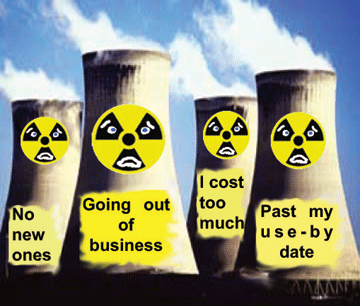
Many old US reactors are still profitable only because their capital costs were forced down the public throat during deregulation, through other manipulations of the public treasury, and because lax regulation lets them operate cheaply while threatening the public health.
But even that’s no longer enough. Continue reading
Small scale solar power racing ahead in Australia
 The full report: “Benefits of the Renewable Energy Target to Australia’s Energy Markets and Economy” can be viewed here (PDF).
$21.1 Billion Small Scale Solar Power Investment In Australia By 2020 http://www.energymatters.com.au/index.php?main_page=news_article&article_id=3440, by Energy Matters, 26 Oct 12, An independent report shows Australia’s 20 per cent Renewable Energy Target (RET) has generated $18.5 billion in investment overall so far, with potentially many billions more to be invested – if the policy is left unchanged.
Released by the Clean Energy Council, the report shows Australia’s Renewable Energy Target has resulted in a reduction of fossil-fuel base power generation since it was introduced since 2001 and has also assisted in reining in wholesale electricity prices.
“The report shows that, if left unchanged, the Renewable Energy Target will result in 12 per cent less coal-fired generation and 13 per cent less gas-fired generation between now and 2030, with no reliability or security of supply issues identified,” said CEC Chief Executive David Green. Continue reading
Drop in Australia’s wholesale energy prices: success of Renewable Energy Target
Renewable energy target succeeding: report THE AUSTRALIAN, : AAP October 25, 2012 AUSTRALIA’S renewable energy target (RET) has driven $18.5 billion of investment in clean power and eroded wholesale energy prices since it was introduced a decade ago, a new report suggests.
The Clean Energy Council analysis released on Thursday finds wholesale prices are as much as $10 per megawatt hour lower as a result of the RET being in place since 2001.
The target is meant to ensure 20 per cent of Australia’s electricity comes from renewable sources by 2020. It’s currently being reviewed by the Climate Change Authority amid speculation that softer demand and the popularity of rooftop solar
panels means the 20 per cent target may be exceeded… Continue reading
The past week in Australian nuclear news
 AUSTRALIA
Uranium prices continue to plummet – with no indication of a recovery any time soon. Nuclear industry in decline, with more reactors closing than new ones starting.
Martin Ferguson, our Minister for Promoting Nuclear Power, excelled himself this week, telling beaut furphies to salivating uranium executives, in Perth. He reassured them that nuclear power was clean, and getting cheaper all the time!
Senators John Madigan and Nick Xenophon have come to the rescue of all those ailing people, laid low by wind energy – with the Renewable Energy (Electricity) Amendment (Excessive Noise from Wind Farms ). What a relief! This Bill could help stop those evil wind farms. (But wait a minute – didn’t CSIRO find that they’re harmless?)
Kyoto Protocol – up for renewal. Australia, seen as a leader amongst the many countries acting on climate change, urged to join the new agreement.
Renewable Energy Target – under pressure from fossil fuel lobby, as the RET and carbon tax help to get Australia’s renewable energy up and running. Carbon tax not making much difference to prices. The first official consumer price figures show a far lower impact than predicted by the Treasury.
Falling demand for electricity highlights problems of utilities, and of regulation, and leads to suspension of Dalton coal-fired power station in NSW.
Australia joins a very wishy washy pact with New Zealand, supposed to strengthen the Comprehensive Nuclear-Test-Ban Treaty (CTBT ). What we really need is a Nuclear Weapons Convention and get some teeth into the movement to stop nuclear weapons.
Queensland. Uranium lobby, mainstream media, and some politicians were ecstatic, when Premier Campbell Newman ditched his pre-election promises, and his recent statements that Queensland’s uranium ban would stay. A few others, like farmers, environmentalists, and people interested in renewable energy – weren’t so keen. Some thought it a bit of a pity to turn the “sunshine state” into the “radioactive state”. Watch out now, as Newman and the nuke lobby turn their attention to the Nuclear Facilities Prohibition Act, which requires a federal plebiscite to allow nuclear power plants.
South Australia: after years of internecine fighting, the partners in the Four Mile uranium project boast that the mine is now to go ahead. Australian should hang their heads in shame to have ever let nuclear weapons maker General Atomics get into this country to almost fully own these 2 mines – Beverley and Four Mile.
Western Australia Aboriginal opposition to Wiluna uranium mine continues. Toro’s mine is far from becoming a reality.
Campbell Newman’s next move – get rid of Nuclear Facilities Prohibition Act.?
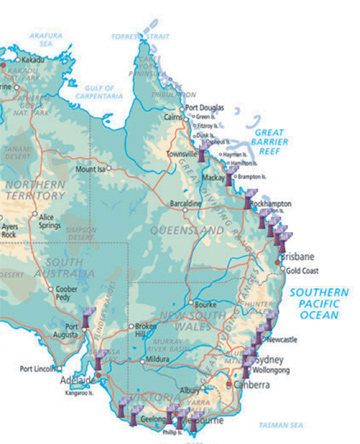 Qld opposition fears nuclear power plants, new.com.au by: Marty Silk October 24, 2012 THE Queensland opposition says allowing uranium mining in the state will eventually lead to a nuclear power industry. Premier Campbell Newman announced on Monday the state would lift a decades-old uranium mining ban, despite saying before the March election the Liberal National Party had no plans to allow it.
Deputy Opposition Leader Tim Mulherin said he fears Mr Newman, like some of his federal counterparts, wants to build nuclear power plants in Queensland. “He’s proved his word on the nuclear industry is worthless,” Mr Mulherin told reporters. He said if the coalition were to win the federal election next year, it would be “a recipe for nuclear power
plants in our state and all the risks they pose”. Nationals Senator Barnaby Joyce’s pro-nuclear power stance should
worry all Queenslanders, he said.
Mr Mulherin said the only thing standing in the Newman government’s way of introducing nuclear power is the Nuclear Facilities Prohibition Act.
The act, introduced by the former Labor state government in 2007, requires a federal plebiscite to allow nuclear power plants. “But if the Newman government repeals the act, our state is wide open to the plans of Senator Joyce and others in the LNP pushing us down the nuclear path,” Mr Mulherin said……
Bans at both levels of government have prevented uranium mining in Queensland since 1982, when the Mary Kathleen mine, near Mount Isa, ceased production.
http://www.news.com.au/breaking-news/national/uranium-mining-no-greater-risk-qld-govt/story-e6frfku9-1226502416198#ixzz2AKgTBMPw
Time for Australia to sign up to the new Kyoto Protocol
 Sign on now, UN climate chief says October 25, 2012 THE United Nations climate chief has called on Australia to sign up to a new round of the greenhouse-gas-limiting Kyoto Protocol, saying it already has significant clean-energy
policies in place.
EU likely to exceed Kyoto carbon-cut target
”From a national perspective it wouldn’t change that much what Australia is already doing,” the head of the UN Framework Convention on Climate Change, Christiana Figueres, said in Sydney. ”It would send a very clear message internationally that what Australia is doing at a national level is actually contributing to global interests.”
The comments by Ms Figueres come as the government weighs joining the federal opposition in backing a second round of the 1997 climate treaty. The current period of the Kyoto Protocol, under which most developed nations pledged to limit their greenhouse gas emissions, lapses at the end of the year. Continue reading
Australia’s uranium deal with India increases world’s nuclear war danger
 Once the “intervention” had got under way, hundreds of licences were granted to companies exploring for minerals, including uranium.
Australia’s Uranium Bonanza: Making the World a More Dangerous Place, The Eager Role of Julia Gillard By John Pilger Global Research, October 24, 2012 “…… The poorest, sickest, most incarcerated people on earth provide a façade for those who oversee the theft of their land and its plunder.
Australia has 40% of the world’s uranium, all of it on indigenous land. Prime Minister Julia Gillard has just been to India to sell uranium to a government that refuses to sign the Nuclear Non Proliferation Treaty (NPT) and whose enemy, Pakistan, is also a non-signatory. The threat of nuclear war between them is constant.
Uranium is an essential ingredient of nuclear weapons. Gillard’s deal in Delhi formally ends the Australian Labor Party’s long-standing policy of denying uranium to countries that reject the NPT’s obligation Continue reading
1 This month

of the week – Australians for War Powers Reform (AWPR)
To see nuclear-related stories in greater depth and intensity
 Antinuclear