Australian uranium to India, a mirage more than a reality
 the glacial pace of nuclear power plant construction and activation in India in the face of anti-nuclear campaigns;
Indian uranium deals a long way off GEOFF HISCOCK The Australian October 29, 2012 AUSTRALIA’S new willingness to sell uranium to India is more about snuggling up to Asia’s third largest economy than any actual nuclear
commerce. It is highly unlikely that Australian uranium will be powering Indian nuclear reactors in this decade. Continue reading
Rockhampton mayor rejects Liberal Party push for nuclear power
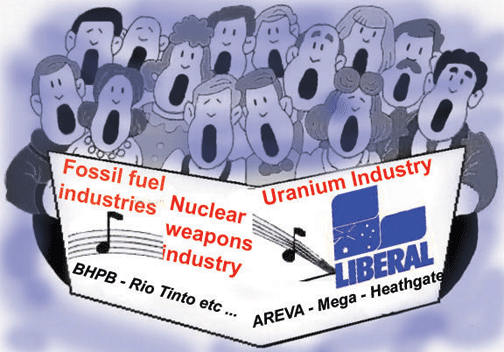 Rockhampton mayor says nuclear “over my dead body” The Bulletin Christine Mckee 29th Oct 2012 “Over my dead body”. These are the words of Rockhampton Regional Council mayor Margaret Strelow in response to the possibility of building a nuclear plant in the region.
Media reports on the weekend revealed secret plans from the Bjelke-Petersen era to construct a nuclear enrichment plant in the Rockhampton region are being revisited by the Federal Opposition.
“It’s not even a discussion I want to have,” Cr Strelow says. “I’m a Mum and a grandma.”
Broadmount, 30 kms south-east of Rockhampton, and Boolburra, 95km west of Rockhampton, were among three preferred options put forward 40 years ago for a $1 billion uranium enrichment plant. North Queensland MP Warren Entsch says it makes sense to reconsider the plan, and Senator Barnaby Joyce is also showing his support…..http://www.themorningbulletin.com.au/news/strelow-rejects-plan-for-uranium-plant/1600099/
Abbot Point recommended for World Heritage, not for uranium exports
Uranium export claims rejected by environmentalist Daily Mercury Dominic Geiger 29th Oct 2012 A BOWEN-BASED environmentalist has hit back at Federal Member for Dawson George Christensen’s claims the town would support uranium being exported from Abbot Point.
Mr Christensen made the claims following State Premier Campbell Newman’s recent decision to lift the ban on uranium mining in Queensland. “Abbot Point (is) an established resource port that (is) far removed from an urban area and the Bowen locals would love the potential work and opportunity,” he said.
But Bowen resident Ian Lee said the town had a history of opposing uranium mining and nuclear power. “Before the amalgamations, Bowen Shire Council voted to become a uranium-free and a nuclear-free shire,” Mr Lee said. “They’re all now jumping on the bandwagon and wanting to make Abbot Point a massive port.
“The World Heritage Committee has recommended there be no major developments outside the long established major ports. Abbot Point is classified as a minor port.”
Mr Christensen isn’t the first Federal Member for Dawson to come under criticism for a pro-nuclear stance. Former member De-Anne Kelly was deposed in 2007 after supporting a short-lived push to have a nuclear
power plant established in the Mackay region…..
http://www.dailymercury.com.au/news/uranium-export-claims-rejected/1599798/
Uranium, nuclear power? not economic
 The [2006 Switkowski] report’s caution that nuclear power would probably be between 20 and 50 per cent more costly to produce than power from a new coal-fired plant is even more unpalatable at a time when electricity costs are soaring,
Forget uranium sales, nuclear riches always bomb out by:Terry Sweetman The Sunday Mail (Qld) October 28, 2012 URANIUM has been the biggest disappointment in my life since Santa Claus turned out to be Dad tripping over the Christmas tree while three sheets to the wind.
People of my generation grew up with fantastic promises of clean, limitless energy that drove everything from flying cars to spaceships. Prowling through newspapers of the late 1940s and ’50s, I find that even adults were fed the same reassuring diet under the label of Atoms for Peace, all the while being pumped with pride over bigger and better nuclear weapons to defend them and democracy.
It never seemed to happen, any more than did the endless riches that were to feed through the land when places like Mary Kathleen sent Geiger counters clicking and Australians went into the uranium business, big-time. Continue reading
Sri Lanka’s concerns about nuclear safety – too close to Kudankulam nuclear plant
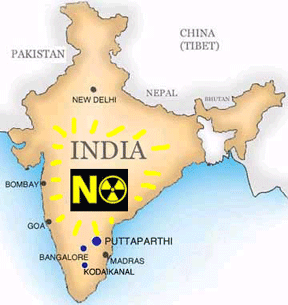 India’s nuclear fallout: Raise the bar to political level, The Sunday Times, 28 Oct 12 The Indian Government’s plans to expand its nuclear energy programme by establishing 48 new reactors throughout the sub-continent, more
than double of what it has, is already causing ripples within that country.
It will also be cause for concern for Sri Lanka whose population is less than 160 kms from India’s southern-most plant at Kudankulam and not too far away from the Kalpakkam plant. Continue reading
India cracks down on civil liberties, 70 peaceful activists arrested
 KOODANKULAM: 71 Activists Arrested on Way to Protests in Chennai Planned on 29th October http://www.dianuke.org/koodankulam-71-activists-arrested-on-way-to-protests-in-chennai-planned-on-29th-october/
We have information that 25 members of Tamizhaga Vazurimai Iyyakam from Salem (including the district secretary), 2 members of Dalit Viduthalai Katchi from Avinashi, and 1 member each from MDMK and Nam Tamilar Iyyakam from Tirupur are presently under preventive detention. The Police have maintained that they are only being detained and will not be arrested but the status remains unclear at the time of sending out this report.
Another 42 members of Pengal Munnani have been detained by the police at Kulithalai Railway Station and taken to Kulithalai police station. The police have said that they will get the signatures of the people and let them leave after 11 pm.
Watchful nuclear industry is confident of safety, prepared for hurricane

 Nuclear Reactors Await Hurricane Sandy By MATTHEW L. WALD, NYT October 28, 2012, Among the various immobile pieces of infrastructure in the path of the East Coast hurricane are around 20 nuclear reactors, from Calvert Cliffs in southern Maryland to Pilgrim in Plymouth, Mass., and Vermont Yankee, just north of the Massachusetts line in Vernon, Vt.
But the industry and regulatory officials say that this is an anticipated challenge…. The most severe weather to afflict nuclear reactors may have been Hurricane Andrew, in August 1992, which was a Category 5 storm when it hit the Turkey Point reactors 25 miles south of Miami. The plant lost telephone communications with the outside world, and
the access road was blocked by fallen trees, but there was no significant damage to safety systems, the regulatory commission found later …. http://green.blogs.nytimes.com/2012/10/28/nuclear-reactors-await-hurricane-sandy/
16 USA nuclear reactors in the path of Hurricane Sandy
Bloomberg reports:
“Because of the size of [Hurricane Sandy], we could see an impact to coastal and inland plants,” Neil Sheehan, a spokesman based in Philadelphia for the U.S. Nuclear Regulatory Commission, said by phone today. “We will station inspectors at the sites if we know they could be directly impacted.”
The NRC met earlier today to discuss the necessary precautions to take for the storm, Sheehan said. Plants must begin to shut if wind speeds exceed certain limits, he said.
As of 2 p.m. New York time, Sandy had winds of 75 miles (121 kilometers) per hour, according to the National Hurricane Center in Miami. It was about 430 miles south-southeast of Charleston, South Carolina, moving north at 7 mph.
The current Hurricane Center track calls for the system to come ashore just south of Delaware Bay on Oct. 30.
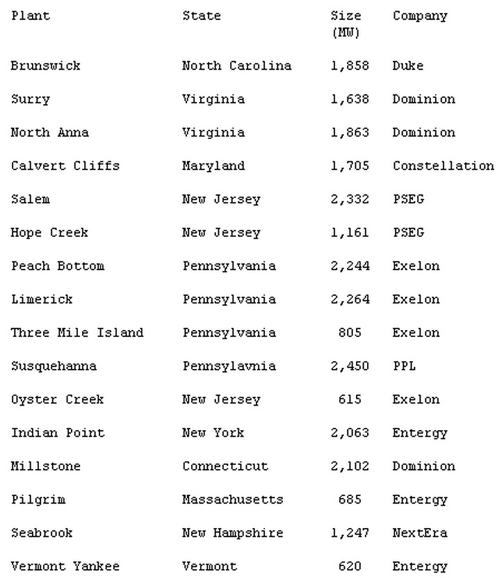
Reuters provides a list:
The following lists the nuclear reactors and utilities in Sandy’s potential path.
While we don’t foresee any problems, the risk of nuclear accident in the U.S. is actually much greater than it was in Japan before Fukushima.
For example, fuel pools in the United States store an average of ten times more radioactive fuel than stored at Fukushima, and have virtually no safety features.
Indeed, Pilgrim’s spent fuel pools (3rd from last on Reuters’ list) – contain more radioactive cesium than released by Fukushima, Chernobyl and all nuclear bomb tests combined.
If Indian Point (5th from last) melted down, it could close New York City for years, and cost half a trillion dollars or more.
North Anna (3rd from top) leaked tritium last year after an earthquake shook the plant and shifted around gigantic radioactive storage casks.
Vermont Yankee (last) – which has around 10 times more spent fuel rods than any of the individual Fukushima reactors – also leaked tritium.
And Three Mile Island (9th from top) suffered another leak in the cooling system last month.
With a little more digging, we could easily document problems at all of the nuclear plants. After all, the U.S. has 23 reactors which are virtually identical to Fukushima. The archaic uranium reactor designs developed more than 40 years ago are only good for making bombs.
Most American nuclear reactors are old. They are aging poorly, and are in very real danger of melting down. And yet the NRC is relaxing safety standards at the old plants. And see this.
Indeed, while many of the plants are already past the service life that the engineers built them for, the NRC is considering extending licenses another80 years, which former chairman of the Tennessee Valley Authority and now senior adviser with Friends of the Earth’s nuclear campaign David Freeman calls “committing suicide”.
Audio: Donna Mulhearn tells the story of Fallujah

 Donna Mulhearn on her work to protect innocent Iraqi and Palestinian civilians from the ravages of war http://ifyoulovethisplanet.org/?p=6520 This week, Dr. Helen Caldicott speaks with Sydney-based peace activist Donna Mulhearn, an author, former journalist and political adviser. She was a human shield in the war in Iraq in 2003 and later returned to Iraq as a humanitarian aid worker. Mulhearn was part of an international team of volunteers that established a small NGO “Our Home – Iraq’ which set up a shelter for street kids in Baghdad, a center for traumatized children and provided emergency aid to displaced families. During this time she witnessed the massacre of Fallujah in April 2004, survived constant bombing, being kidnapped by fighters, and being shot at by American soldiers. In 2004- 2005, Mulhearn spent four months in the West Bank of Palestine as a volunteer with the International Solidarity Movement. During these years she continually wrote reports and reflections called pilgrim notes, which were distributed widely around Australia and the world.Listen to Dr. Caldicott’s June 2010 interview with Mulhearn.
Comparing Romney and Obama on climate policies
 Obama vs Romney on energy, climate change and environment Reneweconomy By Zachary Shahan on 29 October 2012 “…..Mitt Romney has promised to roll back basic air and water protections and stop the Environmental Protection Agency from limiting mercury and other toxic power plant emissions. He wants to eliminate federal oversight of oil and gas drilling on federal lands. He opposes new standards that will double our auto mileage and cut our gasoline bills dramatically while simultaneously helping our environment and air quality. He would end support of the dramatic growth we’re making in clean, renewable, made-in-America energy, and instead do whatever possible to expand our dependence on oil, coal and other dirty fuels. Romney has moved his rhetoric toward the center in the debates – a tacit acknowledgment of where the American public is – but he hasn’t shifted his campaign’s anti-environmental positions at all.
Americans support clean energy and the environment. A recent University of Texas poll, for instance, found that 58 percent of Americans are more likely to vote for a candidate who supports expanding investments in renewable energy than those who don’t. Furthermore, poll after poll shows voters prefer President Obama’s plan to move America toward a more sustainable future. An October poll from USA Today/Gallup gave Obama a 13-point advantage of Romney on energy issues. Even Gov. Romney seems to recognize this, as he has tried to portray himself as an advocate of clean energy despite the content of his platform.
Don’t take our word on all of this. Remember what the candidates themselves said on these issues: Continue reading
Wind power for Tasmania, and for export to Pacific islands
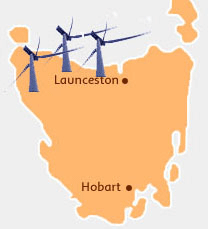 Island communities targeted for wind plant BY:MATTHEW DENHOLM :The Australian October 29, 2012 AUSTRALIA is seeking to export an off-grid power plant – capable of providing 100 per cent renewable energy – to remote and island communities currently reliant on diesel throughout the Asia-Pacific.
A prototype of the plant has been developed by Hydro Tasmania on King Island and by the end of next year will be providing 65 per cent of the Bass Strait island’s energy needs from renewable sources, or 100 per cent on windy days.
By reducing reliance on diesel generators – previously the source of 100 per cent of the island’s power – the wind and solar plant will save $4.5m a year….. http://www.theaustralian.com.au/news/health-science/island-communities-targeted-for-wind-plant/story-e6frg8y6-1226504898547
Petra Ball, Red Cross and Red Crescent – Towards Eliminating Nuclear Weapons
 Changemakers – Petra Ball Pro Bono News, October 29, 2012 Petra Ball, International Humanitarian Law Officer for Australian Red Cross in South Australia, is profiled in Changemakers – a regular column which examines inspiring people and their careers in the Not for Profit sector.
Australian Red Cross is a member of the International Red Cross Red Crescent Movement, the world’s largest humanitarian movement which operates in more than 188 countries. Red Cross has thousands of members, volunteers and supporters who assist in its disaster, international humanitarian law and ongoing everyday work supporting the most vulnerable people in the community, both here and overseas.
What are you currently working on in the organisation?
Planning and preparing for an international conference on nuclear weapons has been almost my sole focus for a number of months now – and here it is, just around the corner! I am really excited about it!
The conference, called Towards Eliminating Nuclear Weapons , focuses on ways to push forward the debate on a legally binding tool to prohibit and ultimately eliminate nuclear weapons, looks at new ways of measuring the humanitarian and environment impacts of use of nuclear weapons and what fantastic initiatives there are coming from civil society – especially young people to keep this critical topic on the radar of the public and the decision makers in our local and international community.
The speakers are all impressive, the topics really stimulating and a weekend in Adelaide in early November is bound to be lovely! One of the great things about the conference is the opportunity to profile the human agency involved in nuclear weapons and we are really glad to focus on the lived experience of nuclear weapons. One of our presenters will be coming from the Marshall Islands, where communities still live with the impacts of nuclear testing, and Junko Morimoto, a Sydney-based survivor of the Hiroshima bombing in 1945 will share her experiences from that time. http://www.probonoaustralia.com.au/news/2012/10/changemakers-petra-ball#
How one Soviet naval officer prevented nuclear war, 50 years ago
 The launch of the B-59’s nuclear torpedo required the consent of all three senior officers aboard. Arkhipov was alone in refusing permission.
Thank you Vasili Arkhipov, the man who stopped nuclear war Fifty years ago, Arkhipov, a senior officer on the Soviet B-59 submarine, refused permission to launch its nuclear torpedo Edward Wilson guardian.co.uk, 27 October 2012 If you were born before 27 October 1962, Vasili Alexandrovich Arkhipov saved your life. It was the most dangerous day in history. An American spy plane had been shot down over Cuba while another U2 had got lost and strayed into Soviet airspace. As these dramas ratcheted tensions beyond breaking point, an American destroyer, the USS Beale, began to drop depth charges on the B-59, a Soviet submarine armed with a nuclear weapon. Continue reading
Fairy tales on Thorium: it won’t save the nuclear industry
 Thorium, Not The Nuclear Savior Claimed http://www.simplyinfo.org/?p=3101 As people have been discussing the issues surrounding the Fukushima Daiichi Disaster, the future of nuclear power comes up. Frequently someone will show up to the discussion to proclaim thorium will be the savior of the nuclear industry and all of the world’s power needs.
The misinformation on thorium is highly promoted by the nuclear industry and various companies that want investment dollars for thorium reactors and fuel. This fairy tale being told about thorium is far from accurate and realistic. The problem becomes worse as uninformed people hear a brief propaganda piece on thorium and pass on that information without any research of their own.
One myth is that thorium is safe. Continue reading
1 This month

of the week – Australians for War Powers Reform (AWPR)
To see nuclear-related stories in greater depth and intensity
 Antinuclear