Australia’s amazingly fast uptake of solar panels
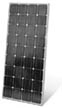 Australia Hits 2GW Solar Panel Installations http://www.energymatters.com.au/index.php?main_page=news_article&article_id=3460 by Energy Matters, 11 Nov Australia has reached the 2 gigawatts of cumulative sub-100kW PV installation milestone this month and at least 45MW of solar panel installations larger than 100kW in capacity can be added to this figure. The news comes from in-depth analysis of the REC Registry by solar consultancy firm SunWiz.
“This threshold has been reached in previously only-dreamed of rapidity, and has been paradoxically accelerated rather than decelerated by the removal of government incentives,” says SunWiz’s Warwick Johnston. Continue reading
Obama – Gillard attitudes on climate change – not a good omen for Tony Abbott
The same vested interests who tried their darndest to kill carbon pricing here will try and kill it in the US.
Could this be a global game-changer in 2013, validating Australia’s early action?
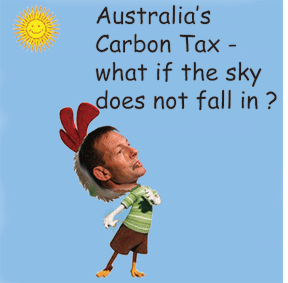 The vibes from America are bad for Abbott The Age, November 12, 2012 Katharine Murphy “…… Australian politics watched the US race closely, as politics does. It would be silly to draw too many conclusions and export the precise conditions of the US to here – but it’s not silly to see election season in America as a harbinger for our own contest in 2013.
Australian politics is manifesting the same broad issues: the forwards/backwards construction that’s an oldie but a goodie when progressives and conservatives vie for government……
Climate change is one issue that could get interesting between now and the Australian federal election in 2013.
Obama keeps bringing it up. There’s speculation carbon pricing is back on the agenda in the US, either as a revenue raising measure (and God knows they need revenue), or as an Obamacare ”vision thing” equivalent to rally the progressive base….. Continue reading
USA- Australia co-operation on climate change action
 Australia’s Minister for Climate Change, Greg Combet, told the Carbon Expo conference in Melbourne on Friday that he was ”very pleased” with Mr Obama’s victory, and said he held already spoken on the issue with his US counterpart since the elections.
The minister has also been discussing the prospects of linking Australia’s planned market for greenhouse gas emissions with California. The biggest US state will auction its first pollution permits this week with the emissions trading scheme (ETS) to start on January 1.
 Obama keen to tackle climate, The Age, November 12, 2012, Peter Hannam THE Australian government has wasted little time to sound out the newly re-elected Barack Obama over his administration’s climate change policies and the potential to work more closely together.
An issue excluded from the US presidential debates, the argument over global warming was revived when superstorm Sandy slammed into north-eastern US states a week before polling day, leaving a damage bill some expect to exceed $US50 billion ($A48 billion).
Mr Obama signalled his intention to tackle climate change in his second term during his acceptance speech in Chicago, where he underlined the issue as among his top priorities.
”We want our children to live in an America that isn’t burdened by debt; that isn’t weakened by inequality; that isn’t threatened by the destructive power of a warming planet,” he said. Continue reading
Dear old Ziggy Spinowski is back – spinning again
 “it’s definitely a clean technology,” Ziggy Switkowski said.
“We could by the middle of the century have a substantial amount of our electricity generated by nuclear power.”
Fukushima has turned Australians off nukes, SMH, November 11, 2012 The Fukushima disaster has set back Australia’s willingness to embrace nuclear power, physicist Ziggy Switkowski says.
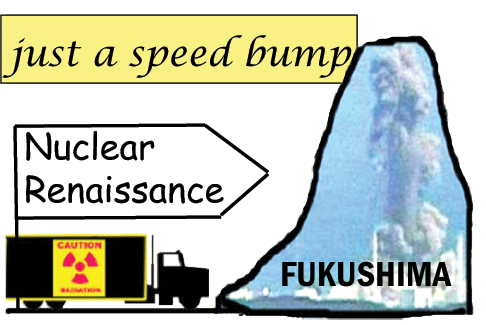
Dr Switkowski, who in 2006 chaired a commonwealth government inquiry that recommended Australia start using nuclear energy, said on Sunday that Australians were now less likely than they were then to accept nuclear energy due to problems at reactors. Referring to Japan’s March 2011 tsunami and nuclear disaster, Dr Switkowski said the momentum in favour of nuclear power had been steadily building but had been set back several years…… Continue reading
Cancer increase near Scotland’s radiation contaminated zone
 the increase in rates of two types of the disease – liver cancer and lymphoma – is of genuine concern.
A full investigation to establish the extent of links between radioactive contamination and cancer rates, if any, is now required.
A compelling case for transparency on radiation risk, Herald Scotland 12 Nov 12 The slow drip of worrying news about the radioactive contamination at Dalgety Bay does nothing for the people of Fife but  engender fear. Today’s revelations in the Sunday Herald that Government scientists have discovered a near-doubling in the incidence of cancers among people living near the contaminated zone will inevitably cause disquiet locally. Continue reading
High rates of systemic lupus erythematosus in uranium processing area
Researchers at the University of Cincinnati and Cincinnati Children’s Medical Center sought to explain an excessive number of lupus cases reported in a community five miles from a former uranium plant in Fernald, Ohio
“What prompted us was the knowledge that lupus patients may be sensitive to sunlight and irradiation, in addition to literature hinting that miners may be at increased risk for developing lupus,”
 HIGH LUPUS RATES NEAR FORMER URANIUM ORE PLANT, OmGlobe.com, 11/10/2012 – High rates of systemic lupus erythematosus have been linked to living in proximity to a former uranium ore processing facility in Ohio, according to new research findings presented this week at the American College of Rheumatology Annual Meeting in Washington, D.C. Systemic lupus erythematosus, also called SLE or lupus, is a chronic inflammatory disease that can affect the skin, joints, kidneys, lungs, nervous system, and/or other organs of the body. The most common symptoms include skin rashes and arthritis, often accompanied by fatigue and fever. Lupus occurs mostly in women, typically developing in individuals in their twenties and thirties – prime child-bearing age. Continue reading
New research into the storage of solar energy
 Using rust and water to store solar energy as hydrogen e! science News, November 11, 2012 How can solar energy be stored so that it can be available any time, day or night, when the sun shining or not? EPFL scientists are developing a technology that can transform light energy into a clean fuel that has a neutral carbon footprint: hydrogen. The basic ingredients of the recipe are water and metal oxides, such as iron oxide, better known as rust. Kevin Sivula and his colleagues purposefully limited themselves to inexpensive materials and easily scalable production processes in order to enable an economically viable method for solar hydrogen production. The device, still in the experimental stages, is described in an article published in the journal Nature Photonics……
The results presented in the Nature Photonics paper represent a breakthrough in performance that has been enabled by recent advances in the study of both the iron oxide and dye-sensitized titanium dioxide, and both of these technologies are rapidly advancing. Sivula predicts that the tandem cell technology will eventually be able to attain an efficiency of 16% with iron oxide, while still remaining low cost, which is, after all, the attractiveness of the approach. By making it possible to store solar energy inexpensively, the system developed at EPFL could considerably increase the potential of solar energy to serve as a viable renewable energy source for the future.
Source: Ecole Polytechnique Fédérale de Lausanne
http://esciencenews.com/articles/2012/11/11/using.rust.and.water.store.solar.energy.hydrogen
1 This month
7 April – WEBINAR – Australia and the Doomsday Clock – Preventing nuclear war through NoFirstUse and other policies
Online | Tuesday April 7, 4:00-5:30pm, Australian Eastern Time / 8:00-9:30am Central Europe Time
– Access the registration link
15 April – Zoom –Nuclear Power is Not the Solution
Apr 15, 2026 01:00 AM in Canberra, Melbourne, Sydney

Join the International Physicians for the Prevention of Nuclear War (IPPNW) on Tuesday, April 14th for a timely webinar exploring the risks associated with nuclear power and challenging the myth that it offers a simple, safe, carbon-free solution to the climate crisis

21 April Webinar: No Nuclear Weapons in Australia
Start: 2026-04-21 18:00:00 UTC Canberra, Melbourne, Sydney (GMT+10:00)
End: 2026-04-21 19:30:00 UTC Canberra, Melbourne, Sydney (GMT+10:00)
Event Type: Virtual
A virtual link will be communicated before the event.
Host Contact Info: australia@icanw.org

of the week – Australians for War Powers Reform (AWPR)
To see nuclear-related stories in greater depth and intensity
 Antinuclear