Kakadu yellowcake legacy no blueprint for Queensland
 Gundjeihmi Aboriginal Corporation November 23rd 2012 Traditional owners directly affected by uranium mining in the Northern Territory, the Mirarr people of Kakadu, have rejected suggestions that the Ranger uranium mine provides a model for Queensland to follow and called on others to heed their experience.
Supporters of the LNP’s decision to open Queensland to uranium mining, including the Australian Uranium Association head Michael Angwin, have made public claims about the ‘excellent’ track record of Ranger uranium mine.
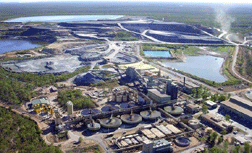 “The suggestion that Ranger provides a blueprint for Queensland must be contested,” said Justin O’Brien, executive officer of Gundjeihmi Aboriginal Corporation, the organisation established and operated by the Mirarr to represent their rights and interests.
The Mirarr, traditional owners of lands in the Kakadu region, including the Ranger and Jabiluka uranium deposits, have the longest lived experience of uranium mining in Australia. The Ranger mine was imposed on Mirarr against their strong opposition and has been operating for 30 years.
“Despite three decades of mining royalties, the socioeconomic standing of local Indigenous people remains below that of the NT average and well below the national standard. It is only in very recent years that income from Ranger has been adequately invested in social and cultural development programs,” Mr O’Brien said.
“The suggestion that Ranger’s track record confirms the high environmental standard of Australia’s uranium mining industry is in stark contrast to the Mirarr experience of mining on their land. Water and tailings management at the mine continue to cause serious concerns and what environmental gains we have secured have been hard fought for over decades.
“In addition, the Mirarr hold grave concerns about the legacy of uranium mining as well as the impact of its products. The fact that Australian uranium was in the failed reactors at Fukushima that have caused so much damage and human misery remains a source of great sadness for the Mirarr.
“To cite Ranger as a rationale for expanding the uranium industry in Australia is disingenuous,” Mr O’Brien concluded.
Examining Paladin Energy – an example of the true plight of uranium companies
Given a downturn in nuclear reactors globally, the oversupply and stockpiling of uranium in Japan and the launch of new uranium mining projects in Canada, there is little evidence to indicate any meaningful revival in the uranium price.
Paladin’s continuing failings a warning for small uranium miners http://ccwa.org.au/blogs/paladin%E2%80%99s-continuing-failings-warning-small-uranium-miners#.UK-2DuR9JLt November 22nd 2012 by Mia.Pepper The Conservation Council of WA has been following the activities of Perth based uranium miner Paladin in collaboration with a number of other environmental NGO’s and social justice groups globally. In consultation with local groups in Malawi and Namibia, where Paladin have operating mines, we have prepared a number of questions that we will be asking at their Annual General Meeting on the 22nd November 2012.
CCWA are concerned that Paladin’s proposed cost cuts will exacerbate existing problems at the company’s mines in Africa. Given the poor economic climate for uranium mining and with some indication from the board that the company is in trouble – we are concerned that the company may abandon projects in the future with no compensation or effective clean up of their existing mine sites.
Background information on Paladin’s operations: Continue reading
Paladin Uranium CEO predicts boom in uranium, especially for Japan
Paladin pins hopes on new Japanese govt, SMH, Kim Christian From: AAP November 22, 2012 URANIUM miner Paladin Energy hopes a new Japanese government will decide to restart the country’s nuclear reactors, as the price of uranium hovers around two-year lows.

Chief executive John Borshoff said that despite the shutdown of nuclear power stations in Japan after the Fukushima nuclear disaster, some reactors were now coming on line.
“We are confident that these will start coming back, working in the fleet in 2013, particularly with the change of government,” Mr Borshoff told the company’s annual general meeting in Perth on Thursday…..
He said that in order to meet worldwide demand, 15 to 30 mines would need to be built this year, an impossible task.
Paladin recently announced it will slash costs by up to $US80 million ($A76.97 million) and cut some staff after putting a freeze on development due to the weak uranium price. The company on Thursday reiterated production guidance for fiscal 2013 of between eight million pounds and 8.5 million pounds.
Shareholders on Thursday approved the company’s 2012 remuneration report, with seven per cent of votes cast against the 2012 report that showed Mr Borshoff earned $3.4 million, up from $2.5 million in 2011.
http://www.heraldsun.com.au/business/breaking-news/paladin-pins-hopes-on-new-japanese-govt/story-e6frf7ko-1226522231616
Solar energy is popular and growing fast in Japan
The Land of the Rising Sun Goes Solar http://financialconservation. blogspot.com/2012/11/the-land-of-rising-sun-goes-solar.html#ixzz2D4daQDH6 Business Insider, Michael E. Douroux, Financial Conservation | Nov. 22, 2012 “According to a new report from the Japan Photovoltaic Energy Association, domestic shipments of solar cells and modules have risen by 80% in the July-September quarter of this year.
 This is on the heels of the Japanese government enacting an ambitious solar energy incentive initiative, a feed-in tariff (known as net energy metering in California) that aims to help support the adoption of solar energy throughout the country.
The feed-in tariff was introduced in the wake of the Fukushima disaster of 2011, when a powerful earthquake and tsunami triggered a nuclear crisis in Northern Japan. After the disaster, the government made moves to abandon nuclear power. While moving away from nuclear energy has proven to be a slow and laborious process, the country has been keen to aggressively replace nuclear with other forms of alternative energy that are considered safer. Solar energy has, thus
far, become one of the country’s most favored forms of alternative energy for this purpose.”
Victoria’s very large wind farm will be operational in early 2013
 AGL readies biggest wind farm in southern hemisphere November 23, 2012 – AGL Energy, Australia’s largest operator of renewable energy projects, expects its $1 billion Macarthur wind farm to be operating fully in February as the country seeks to reduce it reliance on coal. “It’s on time, on budget and, in fact, may well be completed a little ahead of schedule,” Managing Director Michael Fraser said.
Sydney-based AGL and partner Meridian Energy are starting the 420-megawatt Macarthur project in Victoria, the largest wind farm in the Southern Hemisphere, as Australia moves toward its goal of getting 20 per cent of its power from renewable energy by 2020.
The company expected Macarthur to be completed by the end of March 2013, Fraser said……
With natural gas prices on the east coast of Australia projected set to double and the government’s price on carbon emissions discouraging fossil fuels, the cost of gas-fired power stations may converge with that of wind farms, he said.
Australia in July started charging about 300 of its largest polluters a fixed price of $23 a ton for their carbon emissions. It plans a market-based system beginning in 2015.
http://www.smh.com.au/business/carbon-economy/agl-readies-biggest-wind-farm-in-southern-hemisphere-20121123-29ubz.html#ixzz2D4V3rlIp
New Tesla electric car – agreement with Origin to use renewable energy

The diagram at left – highly inaccurate – as the new Tesla Model S is a five door sedan
Origin in deal with Tesla to help bring Model S to Australia http://reneweconomy.com.au/2012/origin-in-deal-with-tesla-to-help-bring-model-s-to-australia-68764 By Sophie Vorrath 21 November 2012
Tesla is set to launch the Model S five door sedan – the company’s first full-sized sedan, with a range of 480km – in Australia from mid 2013 after a fairly successful roll-out in the US since June; capped off this month by winning 2013 Motor Trend Car of the Year in a unanimous vote from the panel of judges. Reservations for the Model S currently exceed 13,000 worldwide.
In a similar deal to that which was brokered between Better Place and Holden for Volt customers, Tesla owners in Australia will have access to Origin’s accredited GreenPower, a variety of fully-installed charging equipment and services, and electricity management systems and advice.
Tesla’s Australia & New Zealand manager, Jay McCormack, said the agreement with Origin would provide Model S owners with the opportunity to use energy generated from renewable resources – although possibly not from wind energy, if Origin’s recent comments about Australia’s attitude to wind farms are to be taken seriously – and reduce the transport sectors’ dependence on oil – “a goal both of our companies share,” McCormack said.
Origin and Energy Australia – ignorant critics of wind energy community acceptance
But for Origin and Energy Australia to assert that there isn’t a social license to operate for wind farms in this country is preposterous given their small part in actually developing wind projects
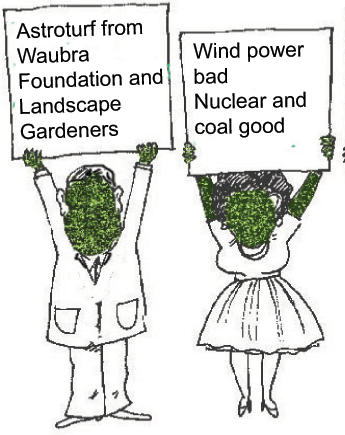 What would Origin and EnergyAustralia know about wind?, Climate Spectator, 21 Nov 2012, Tristan Edis
Origin Energy and EnergyAustralia (formerly TRUenergy) were on the front page of The Australian newspaper yesterday claiming the renewable energy target couldn’t be met because of community opposition to wind farms.
According to Origin Energy, wind farms are causing greater angst in the community than coal seam gas. And Energy Australia felt the around 300 MW of wind installed each year was “already testing the limits of community acceptance.” EnergyAustraia’s CEO Richard McIndoe was cited by the newspaper as claiming that the social licence wasn’t there to ramp up construction of wind farms.
This sounded rather interesting because I regularly talk to people heavily engaged in developing wind farms. These people attend community meetings, talk with local landowners, and deal with planning approval hearings – and this is very different to what they’ve told me. Every one of them of course has a horror story to tell about some particularly challenging people they’ve had to deal with in getting planning approvals. Often these people live several kilometres from the nearest turbine, or even outside of the local community, such as just about everyone involved in the Landscape Guardians and the Waubra Foundation.
But they generally find that if you take the effort to consult extensively within the community, you can get a large proportion of the community on-board. So it poses the question – do Origin and EnergyAustralia actually know what they’re talking about?… Continue reading
Britain’s huge problem of cleaning up old nuclear facilities
 Nuclear Legacy, The Construction Index, 23 Nov 12 Hazardous, time consuming and expensive: nuclear decommissioning projects pose some of the greatest technical challenges, and opportunities, for contractors. Emma Crates reports.
“….. the toxic legacy of life-expired power stations requires immediate action.
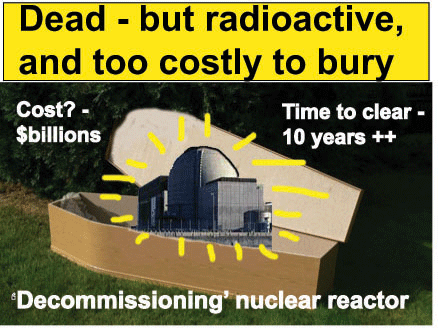
The UK was an early pioneer of this brave new technology, opening the world’s first commercial nuclear power station at Calder Hall in Cumbria in1956. At the time, little thought was given to what would happen after the facilities passed their useful working life.
Six decades on, the Nuclear Decommissioning Authority (NDA), the public body responsible for cleaning and decommissioning civil nuclear sites, presides over a complicated legacy. Its portfolio of 19 sites stretches from Dounreay in Scotland to Winfrith in Dorset. Collectively the sites contain hundreds of structures contaminated with radioactive material, each posing a unique set of challenges.
Working in the nuclear sector is not for the faint-hearted: it can take years of planning, preparation and testing before a single structure can be safely defueled, decommissioned and dismantled. The process is hazardous, costly and time consuming. Bespoke solutions are often required….. Continue reading
Wind farms a financial boon for local communities in UK
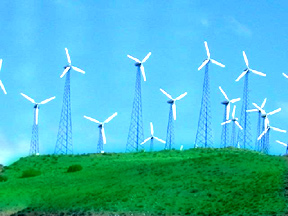 The latest government research shows that onshore wind is supported by 66% of the public with 12% opposed, including 4% who are strongly opposed. However, there is evidence that communities become more supportive when they benefit directly from local wind farms. There is much greater public acceptance of renewables in Germany, where two
thirds of all turbines and solar panels are owned by individuals, farmers and communities.
Good Energy announces local tariff scheme, Renewable Energy Magazine, Robin Whitlock, 22 November 2012 Local residents near the company’s wind farms will benefit from lower energy bills under a plan to ensure community interest remains at the heat of renewable energy generation in the UK
Good Energy has announced the UK’s first Local Tariff to reward households near its wind farms with lower electricity bills,
pioneering a blueprint to put community interest at the heart of renewable energy generation across Britain. Customers who live within two kilometres of the company’s flagship 9.2MW Delabole wind farm in north Cornwall, will qualify for its new Local Tariff, offering a 20% discount on its standard electricity prices. It will currently save an average Good Energy customer in the area around £100 over a year.
The discount will be available to existing and new customers from early 2013. The tariff will also pay out a ‘windfall’ credit of up to £50 per household every year that the turbines exceed their expected performance….. Continue reading
Energy storage systems to revolutionise renewable energy
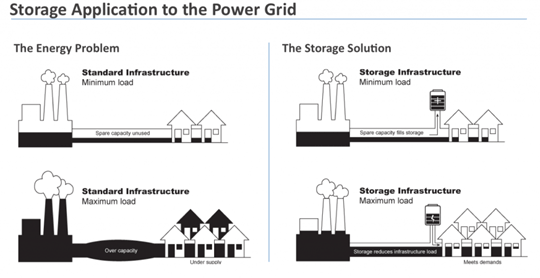
 Energy storage systems signal arrival of ‘baseload’ renewables REneweconomy, By Giles Parkinson 21 November 2012 It has been widely thought that the arrival of cost-competitive rooftop solar PV systems would be the biggest game changer in the electricity market. But it may be that the emergence of affordable energy storage systems will have an even more profound impact.
There are predictions that the energy storage market is going to boom. One survey suggested that $30 billion will be spent on energy storage in the next decade in Australia alone. In the US, where $1 trillion is expected to be spent on electricity network infrastructure in the next 10 years, at least one fifth of that – or $200 billion – will be spent on energy storage.
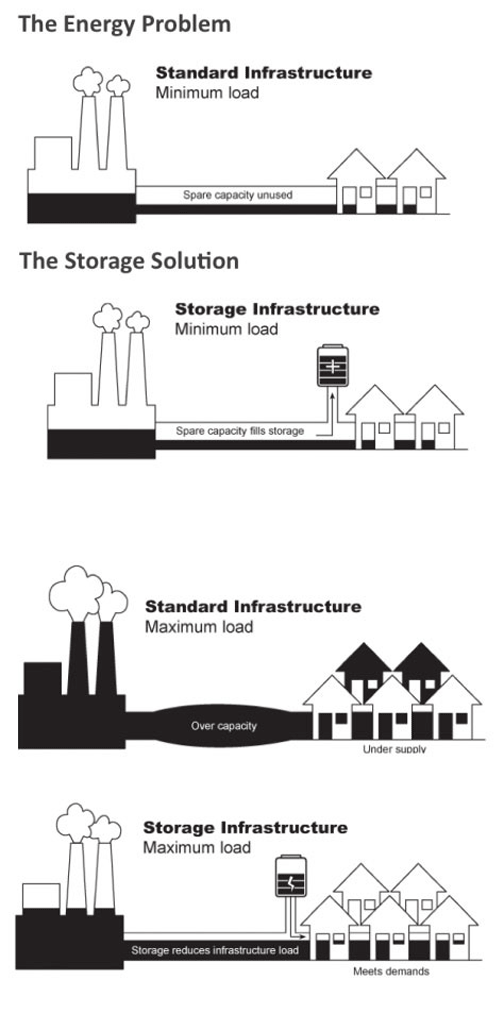
The big question is who is going to benefit most from that investment – the customer, or the utility that delivers or sells the electricity. Or maybe even both. Most people are still trying to figure that out. Continue reading
China’s Energy White Paper contrasts with Australia’s vision of “dig it up, ship it out”
The contrast with China’s Energy White Paper could not be starker. China clearly views its energy security as the most fundamental feature of its future prosperity. It is building renewable energy industries as fast as is economically and technologically possible, as its major ‘nation building’ 21st century project. All government departments are focused on achieving the energy goals.
So here we have a tale of two visions of the future of a country. In Australia, according to the Energy White Paper, we still have a vision of ourselves as a country that digs stuff up and ships it out, or burns it.
 A tale of two energy visions: China and Australia, The Conversation, John Mathews, 22
  November 2012, Over the past few weeks China and Australia have both released white papers on energy. The two documents could not be more different.
Australia’s white paper is largely about our continued obsession with becoming an alternative “Saudi Arabia” of gas. It has a view we should take over as the world’s largest exporter of gas before the year 2020.
The White Paper has extensive sections on building up the gas and petroleum sectors, as well as coal for export, and allowing market forces to work in the national markets for liquid fuels. In all this, the White Paper has a single paragraph on the country’s disastrous increasing dependence on petroleum products imports…… Its almost exclusive focus on export prospects for oil and gas (and to some extent coal) is achieved at the cost of any serious consideration of the building of the only long-term sources of energy security, which are renewables. Continue reading
42% of Fukushima children have thyroid nodules or cysts
German TV: 42% of Fukushima children now with thyroid disorders — Official blames too much seafood? (VIDEO) http://enenews.com/german-tv-42-of-fukushima-children-now-with-thyroid-disorders-official-blames-too-much-seafood-video German TV channel ZDF’s segment on the Fukushima Health Survey translated by SimplyInfo:
November 19th, 2012 More than 42% of 57,000 tested children have nodules or cyst, reports Dr. Suzuki who leads the examinations. In Chernobyl they found only 0.1 – 1%. nobody of the experts asks for the reasons. […] He explains the results mainly by improved diagnosis methods, but people don’t believe him. […] There are no refererence [sic] studies, Dr. Suzuki tells us, and maybe the children simply took too much iodine or seafood. He doesn’t know if this has something to do with radiation. “We are mainly here to inform the parents of the results of our study.” But what do such results mean to parents without proper explanations? The official handling of the disaster is more than questionable. Many people have completely lost trust in government and believe that the disaster is played down to protect the mighty nuclear industry of Japan.
Marathon resources chairman suggests South Australia for global nuclear waste dump

- Repository for nuclear waste … The inevitability of all global stakeholders agreeing that a safe haven must be found somewhere in a stable geological and political environment is an opportunity this State should consider.. Peter Williams, Chairmans Address 2012AGM_
What a uranium company CEO thinks of the Australian media
 Funny – I go through the uranium so-called news each day. What I find there is a succession of obvious handouts from the uranium lobby, presumably to grateful journalists, who don’t bother to check the accuracy of these uranium market forecasts . Article after article has glowing predictions for the financial boom to come, (just a little later) from investing in uranium.
Nearly every article concentrates on China.And, I think to myself. Do these uranium dreamers ever consider that the Chinese might be intelligent? That they might notice how unpopular nuclear power has become globally, and the reasons why (- economic, and safety). Yes, China is reported as planning to expand its nuclear power programme. Oh goody! They might want our uranium! But what if China wakes up to the dismal outlook for nuclear, elsewhere.
But never mind. The Australian media dutifully regurgitates the China uranium-buying boom to come, – no mention of the other countries (especially India’s political mess over nuclear power). We carefully ignore the nuclear decline in Germany, Switzerland, USA, UK, even France.
However, the poor old uranium lobby still thinks itself to be hardly done by Australia’s government and media.- Christina Macpherson
Marathon Resources Chairman , Peter Williams, lambasts Government on resources industry attitude – today’s A.G.M. 22 Nov 12,
“……..The overwhelming influence of environmental and heritage activists and bureaucrats in South Australia in recent years, supported by Government, has seen the pendulum swing far away from balanced development and economic growth….
The SA Government’s actions in the North Flinders have jeopardised the State’s reputation as a safe place for resource investment…. “
Japan’s new nuclear-proof robot failed to work
Japan’s new nuclear-proof robot gets stage fright http://ajw.asahi.com/article/economy/technology/AJ201211220024 November 22, 2012 REUTERS YOKOHAMA--A Japanese robot designed to withstand high levels of radiation and extreme heat at damaged nuclear plants such as Fukushima froze on its first public demonstration.
Despite being home to the largest number of industrial robots in the world, Japan did not have a device capable of entering the damaged Fukushima nuclear facility after last year’s devastating earthquake and tsunami.
Instead, Japan brought in U.S. robots to survey the extent of the damage inside the reactor buildings.
Toshiba Corp. unveiled Japan’s own nuclear-proof robot on Oct. 21, a four-legged device able to carry up to 20 kg of equipment and capable of lifting itself up if it falls over on uneven surfaces and amid debris.
During the demonstration, the robot experienced a case of stage fright. The shuffling Tetrapod locked up and suddenly froze after it tried to balance itself, forcing technicians to carry it away. It is the second time such Japanese robotic technology has experienced problems. Last October, a crawling robot developed by the Chiba Institute of Technology lost connection with operators and was abandoned inside Fukushima’s No. 2 reactor building.
1 This month

of the week – Australians for War Powers Reform (AWPR)
To see nuclear-related stories in greater depth and intensity
 Antinuclear