Broken Hill’s exciting future as Australia’s first renewable energy town

Most rural communities are dying – this is a town that has the potential to move forward.

ALTERNATE WMA VERSION | MP3 DOWNLOAD
Broken Hill a frontrunner in renewable energy adoption ABC Radio AM Margaret Paul reported this story on Tuesday, November 27, 2012 …
DARRIEA TURLEY: There is a possibility that Broken Hill could be the first town that would live on renewable energy, that would be sustained by renewable energy. No other town has done that.
MARGARET PAUL: Broken Hill’s acting Mayor is Darriea Turley.
She’s excited that Broken Hill is set to become home to two major renewable energy projects.
The first, a photovoltaic solar farm, is set to produce 125,000 megawatt hours of electricity every year – enough to power 17,000 homes.
The second is a wind farm to be developed at nearby Silverton that could power as many as 43,000 homes. Continue reading
2.4 million jobs in India’s Renewable Energy sector by 2020
 Indian Renewable Energy Sector to Create 2.4 Million Jobs by 2020 http://theenergycollective.com/energyjobline/147291/indian-renewable-energy-sector-create-24-million-jobs-2020 by C. Dominguez November 24, 2012 India’s renewable energy sector is to create up to 2.4 million jobs by 2020, according to a report jointly commissioned by environmental group
  Greenpeace, the Global Wind Energy Council and the European Renewable Energy Council.
To date, the sector employs 200,000 people, but this could jump 14 times by 2030 with the right policies and investments in place, stated India Energy [R]evolution report.
By 2050, about 92 percent of India’s energy infrastructure will be based on renewable energy sources. Renewables such as wind, solar thermal energy and photovoltaic, will comprise 74 percent of electricity generation. Continue reading
U.S. solar industry now employs 119,016 Americans,
The three year Census series paints a stunning picture of solar job growth. Since 2010, employment in the U.S. solar industry has grown 27percent – eight times faster than the overall economy during the same period
 The Solar Foundation’s National Solar Jobs Census 2012 Finds Installers Leading the Way More than 8,500 installation jobs created in the past year, continued industry wide growth expected in 2013 ALBANY, N.Y. (PRWEB) November 14, 2012 The Solar Foundation (TSF), an independent nonprofit solar education and research organization, today released the full version of its third annual National Solar Jobs Census at the Interstate Renewable Energy Council’s Clean Energy Workforce Education Conference. In early November, TSF announced that the Census found that the U.S. solar industry now employs 119,016 Americans, a figure which represents the addition of 13,872 workers and a 13.2 percent employment growth rate over the previous year. Continue reading
Gutless Australian government would not support UN resolution on depleted uranium
 Australia on depleted uranium – can’t lead and won’t follow Australia on depleted uranium – can’t lead and won’t follow 07 Nov 2012 Despite pretentions to playing a leading role in world affairs, the Australian Government showed a complete lack of leadership in the United Nations vote on depleted uranium.
Greens spokesperson for nuclear policy Senator Scott Ludlam said the decision to abstain from the vote on a resolution on depleted uranium weapons was “as inexplicable as it is disgusting”.
“This was the United Nations First Committee’s most far-reaching resolution on DU weapons to date, and 138 countries said yes – but the Australian Government couldn’t find the guts to get off the fence.
“The resolution recalls the positions taken by the UN Environment Programme following their fieldwork on DU affected sites in the Balkans. The Programme called for a precautionary approach to depleted uranium – reinforced by stringent clean-up and decontamination operations, awareness raising measures to reduce the risk of civilian exposure, and for the long-term monitoring of contaminated sites.
“Studies indicate that cancer rates and infant mortality rates increase in areas where depleted uranium armaments have been used. DU weapons should be banned entirely – yet the Australian Government was not prepared to back a moderately-worded proposal on mitigating the impact of depleted uranium.”
Rupert Murdoch extending his media empire in USA
 Will the FCC Give Rupert Murdoch the Powerful Gift of Media Consolidation?, 26 November 2012 By Mike Ludwig, Truthout | Just in time for the holidays, the Federal Communications Commission (FCC) is considering changes to media cross-ownership rules that watchdogs say could good give Rupert Murdoch’s massive conglomerate News Corporation the go-ahead to acquire more big media outlets.
The proposal could also keep women and minorities out of the media market, according to civil rights groups.
Reports suggest Murdoch has recovered from the British phone hacking scandal and is ready to jump back into the media consolidation game. Both the Chicago Tribune and the Los Angeles Times are on the list of potential targets.
These acquisitions would be illegal unless the FCC changes its rules, according to the media watchdog group Free Press.
The details are not yet public, but according to reports, FCC Chairman Julius Genachowski circulated a proposal last week among his fellow commissioners that would end a longstanding ban on owning the major daily newspaper and radio outlets in the same market, and would allow one company to jointly own a daily newspaper and TV stations in the nation’s top 20 markets. Continue reading
Australia’s opportunity to rapidly take up Renewable Energy – Climate Commission
Climate Commission Urges Rapid Uptake Of Renewables http://www.energymatters.com.au/index.php?main_page=news_article&article_id=3487 by Energy Matters, 26 nov 12, The Climate Commission’s ‘The Critical Decade: Generating A Renewable Australia’ was released Monday, summarising the state of renewable energy in Australia and its potential. Continue reading
Julian Assange’s new book warns on Internet surveillance
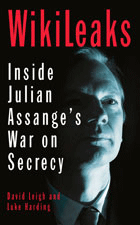 Julian Assange’s book an exercise in dystopian musings WikiLeaks founder’s Cypherpunks warns tool he relies on and used to make his name is ‘global surveillance industry’ target Esther Addley guardian.co.uk, 26 November 2012 Julian Assange‘s new book is not a manifesto, he writes in its introduction – “There is no time for that”. Instead the short volume,entitledCypherpunks: Freedom and the Future of the Internet and published on Monday, is intended to be what the Wikileaks founder calls “a watchman’s shout in the night”, warning of an imminent threat to all civilisation from “the most dangerous facilitator of totalitarianism we have ever seen” – the web……
Also contributing to the book are Jacob Applebaum, a US-based computer security expert, and Andy Müller-Maguhn, a leading German hacker….. http://www.guardian.co.uk/media/2012/nov/26/julian-asaange-paranoia-surveillance?commentpage=1#comment-19701760
Australian Renewable Energy Agency announces a regional program
the Australian Renewable Energy Agency has decided to have another go, announcing it will run a ‘Regional Australia’s Renewables program’.
Because these remote electricity demand loads are relatively small, you don’t have to install much renewable energy capacity, nor spend much money, before renewables become a very large proportion of total generation.
A bold pursuit of renewable-powered mining http://www.businessspectator.com.au/bs.nsf/Article/mining-renewables-ARENA-power-resources-electricit-pd20121127-2F257?opendocument&src=rss Tristan Edis, 27 Nov 2012 For those of you with reasonable memories, you’ll know the Australian government ran a program for around a decade called the Remote Renewable Power Generation Program or RRPGP. The idea behind the program was that remote off-grid regions or regions with only small grids tended to rely on very expensive diesel fuel for their power needs, and so renewable energy is closer to being a cost-effective option. To illustrate, the cost per megawatt-hour for diesel generation is close to $250 to $400, a price that solar with battery storage can match and even beat.
Japan’s cities are “nuclear money addicts” like drug addicts
 Another example of a local community dependent on money related to nuclear facilities is in Rokkasho, Aomori Prefecture, formerly a poverty-stricken village where most of its 11,000 residents relied on agriculture and fisheries for their livelihood. The village is now called one of Japan’s wealthiest municipalities.
If the government’s plan to phase out nuclear power in Japan is to be implemented, the whole concept of a nuclear fuel cycle in this country would collapse, which in turn would deal a serious blow to Rokkasho’s fiscal foundation.
the system in which money flows from the nuclear community into host municipalities remains intact, and unless
the link is cut off, those municipalities will continue to rely on the nuclear industry.
 Municipal nuclear addiction, Japan Times, 26 Nov 12 Municipalities hosting nuclear power plants throughout Japan have received large amounts of central government subsidies, donations from utilities and lucrative business contracts Now, 1½ years after the Fukushima nuclear disaste rs, those municipalities realize how much their finances depend on the nuclear power-induced money.
 “They’re like drug addicts cut off from supplies,” said a member of the assembly of Niigata Prefecture, which hosts Tokyo Electric Power Co.’s Kashiwazaki-Kariwa nuclear power plant on the Sea of Japan coast. All the reactors at the plant remain shut down after its No. 5 and 6 reactors went offline earlier this year……
Host prefectures and municipalities receive central government grants based on laws designed to promote development of power generation facilities. ….
While they both host Tepco’s Kashiwazaki-Kariwa plant, nuclear
plant-related subsidies or donations from the utility account for 14
percent of Kashiwazaki’s annual budget and as high as 30 percent of Kariwa’s. Continue reading
Japan’s small anti nuclear political parties plan joint election campaign
 Small parties join push for nuclear-free society The Yomiuri Shimbun, 27 Nov 12 Ichiro Ozawa’s People’s Life First party and a party jointly led by former farm minister Masahiko Yamada and Nagoya Mayor Takashi Kawamura have begun coordinating views to create a new party aimed at uniting smaller political forces advocating a nuclear-free society.
They want the new party to include Kuniko Tanioka, a House of Councillors member and coleader of Midori no Kaze, who supports the zero nuclear option.
The parties also have floated the idea of having Shiga Gov. Yukiko Kada, who has taken a cautious stance on restarting nuclear reactors, become leader of the new party, which according to Kawamura and other officials could be named “Nippon Mirai no To” (Japan Future Party).
Kada is expected to make her position clear on Tuesday….. http://www.yomiuri.co.jp/dy/national/T121126004153.htm
1 This month

of the week – Australians for War Powers Reform (AWPR)
To see nuclear-related stories in greater depth and intensity
 Antinuclear