Australians overspending on food, and wasting much of it
 Audio: Revellers warned to limit Christmas food waste, http://www.abc.net.au/news/2012-12-03/revellers-warned-to-limit-christmas-food-waste/4405820 ABC News, By Lindy Kerin Dec 3, 2012 Australians are expected to spend about $10 billion on food over the Christmas period, but a staggering 35 per cent will be wasted and end up as landfill.Food rescue group Oz Harvest, which collects leftover food and distributes it to charities, says it will pick up about 150 tonnes of food throughout December.
Oz Harvest founder Ronnie Khan says the group is distributing to more than 400 charities and welfare agencies.She says waste increases significantly at this time of year. “From mid-October to the end of December, we call this our harvest period,” she said. “It’s the time to collect as much as we can, because there’s an abundance of food being shared around with those people who have……
The shocking level of waste is of great concern to environment group Planet Ark. It says every year Australians generate about 361 kilograms of food waste per person. Planet Ark recycling programs manager Janet Sparrow says 35 per cent of food is expected to be wasted this month….
Planet Ark has launched an education campaign to encourage Australians to think about how they can reduce their environmental impact over the festive season.
Scientists appeal to Australian government not to give up its environmental powers
 Scientists warn against environmental powers being handed to states, December 4, 2012, Lenore Taylor National Affairs Correspondent for The Sydney Morning Herald Federal environmental powers that saved the Franklin River and the Great Barrier Reef need not be abandoned in a quest for faster development approvals, the respected Wentworth Group of Concerned Scientists says, in a last ditch appeal to the Gillard government to rethink a deal with the states.
Below – Miranda Gibson, in the observer tree, Tasmania

At the urging of the Business Council of Australia, the Prime Minister and premiers are due to sign the first stage of the controversial agreement at the Council of Australian Governments on Friday.
It will see the Commonwealth hand over environmental assessment and approval to state governments under specific ”standards” in a bid to remove ”green tape”. Continue reading
Australia at risk of losing its national environmental protection laws
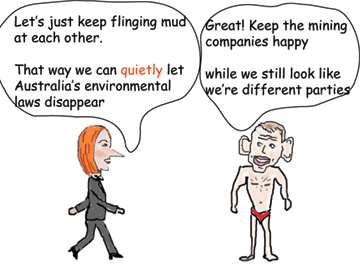
The Business Council of Australia hastily prepared a discussion paper and released it the day before the Forum, calling for a slashing of so-called green tape. The Prime Minister agreed to the business demands and took the proposals to COAG. State and Territory leaders duly fell in line. As is the practice with COAG, the first official notification of the detail of the proposals was in the communique following the meeting.
It is a broad-ranging package of measures but most significant is the proposal for the Commonwealth to hand over responsibility for administration of national environmental laws to the States by March next year.
COAG’s Green Tape Agenda Is Undemocratic, New Matilda By Brendan Sydes, 4 Dec 12 The unelected Business Advisory Forum has been given special access to this Friday’s COAG meeting – and it’s calling for national environmental laws to be wound back. Brendan Sydes explains what’s wrong with the process
The goings on in Parliament last week might not provide the best vantage point to reflect on what we value in our democratic system of government.
Imagine, however, an alternative system where the executive arms of government meet behind closed doors and make crucial decisions on matters of national policy, where the agenda is not published beforehand and where the detail of policy only comes to light in a communique published after decisions have been made.
Consider further a refinement of that system which means that unelected vested interests get a seat at the table in the lead up to the secret meeting and get make their demands heard on key parts of the policy agenda.
That in a nutshell is how the Council of Australian Governments (COAG) and the recently-developed Business Advisory Forum (BAF) interact. COAG meets again in Canberra this Friday. The meeting will be preceded by a meeting on Thursday of the BAF, a new institution that appears to have been hastily cobbled together prior to the first COAG meeting in April this year. Its precise membership and terms of reference appear never to have been announced. Quite where or from whom the idea even came from is unclear.
Unsurprisingly, given these hazy origins, the idea that we ought to have a business body with special access to COAG has gone largely unscrutinised. The first meeting of the BAF took place the day before the April COAG meeting. Continue reading
25 anniversary of Australia’s oldest operating wind turbine, and still going strong
 These days, the wind turbine that could delivers around 80,000kWh a year to the grid, with an estimated 90-95 per cent availability
Blow out the candles: Australia’s oldest wind turbine turns 25 REneweconomy, By Sophie Vorrath 4 December 2012 November might have been a milestone month for solar, with cumulative PV installations reaching 2GW, but it also marked a reasonably big milestone for wind: 25 years since the Breamlea Wind Turbine, near Geelong in Victoria, was commissioned. Continue reading
Senate inquiry finds that “infrasound” from wind turbines is not a problem at all
higher sound levels were recorded with turbines turned off versus when the turbines were running. A strong indication that the origin of most infrasound and low-frequency noise was the wind itself which was slowed by running turbines…….
 Wind turbine infrasound: What’s all the noise about?, REneweconomy, By Richard Mackie 4 December 2012 On Wednesday the Senate inquiry into excessive noise from wind farms released their report. The inquiry was supposed to focus on audible noise but debate strayed into concerns that wind turbines can cause health problems by producing infrasound (sound of a frequency so low that it is normally inaudible) and low frequency noise.
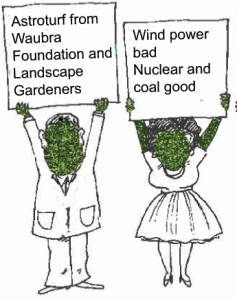
Wind farm opposition groups such as the Waubra Foundation are prone to making extreme statements about wind turbines such as this from their senate inquiry submission “…characteristic symptom patterns have been reported at distances up 10km away from the nearest wind turbine.” Infrasound is blamed and understandably people get concerned.
So where does this idea come from? The Senate inquiry gives us the answers. Submissions represent a global who’s who in the debate on wind farms and health. Often information provided to support the wind farms-cause-health-problems idea actually demonstrates the opposite. Continue reading
Electric cars no help to environment, if powered by coal [or nuclear] fired electricity
 Electric cars make more emissions unless green-powered, SMH, December 4, 2012 VICTORIAN motorists who switch to an electric car can expect to produce less than half the greenhouse gas emissions than they would if driving a petrol-powered car – but only if they run it on 100 per cent green power, government research has found. If they don’t they will generate more emissions.
A new electric car run on renewable energy can also take as little as three years to recoup the carbon emissions generated in its manufacture, according to new evidence from the Victorian government’s electric vehicle trial.
The five-year trial, which is at its halfway point, is being held in the expectation that Victorians will switch to electric cars in their thousands in coming years, even though the number currently in use here is only 100 or so.
The Department of Transport expects plug-in cars will make up a quarter of new vehicle sales in Victoria by 2020. But an analysis of cars participating in the trial has found it is essential to charge them from renewable energy sources such as wind and solar power to achieve any environmental good.
Victoria’s dependence on brown coal for energy is so high that any electric car that ran off the electricity grid would generate even more carbon emissions than one running on petrol…… http://www.theage.com.au/victoria/electric-cars-make-more-emissions-unless-greenpowered-20121203-2ar3x.html#ixzz2E9HnUt8N
France’s new nuclear reactor – spiralling costs, repeated delays
The spiralling costs at Flamanville, and at another EPR being built by French engineering company Areva in Finland, have raised questions about the viability of nuclear power.
“If there’s anywhere that the EPR should be built on time and on budget it surely must be France,” said Dr Paul Dorfman, founder of the Nuclear Consulting Group. “The fact that it hasn’t been has profound implications for nuclear new build in the UK.”

 EDF plant cost rises damp nuclear hopes Ft.com, By Guy Chazan and James Boxell, 3 Dec 12 EDF, the French utility, said the cost of its new nuclear power station in northern France had increased by a third, raising fears that its planned UK plant may also be vulnerable to a similar budget blowout. But EDF Energy, the company’s UK subsidiary, insisted that the cost issues in Flamanville, Normandy, would have no bearing on its plans for Hinkley Point in Somerset.
The site on the Cotentin Peninsula, one of the most closely watched engineering projects in Europe, is the first nuclear power station in France for 15 years. The European pressurised reactor is a third-generation design which
the state-owned utility hopes to export around the world. Continue reading
Audio: report on the real impact of the Fukushima nuclear disaster
 AUDIO: UN expert:Japan’s view on Fukushima too optimistic http://www.radioaustralia.net.au/international/2012-12-03/un-expertjapans-view-on-fukushima-too-optimistic/1055192 3 December 2012, The United Nations’ special rapporteur on the right to health, Anand Grover, says the Japanese government should consult more with local communities to assess the real impact of the Fukushima nuclear disaster.
Mr Grover has just returned from an 11 day visit to Japan to assess the state of health in those areas affected by the incident and examine the effectiveness of government actions to deal with the aftermath. Continue reading
1 This month
7 April – WEBINAR – Australia and the Doomsday Clock – Preventing nuclear war through NoFirstUse and other policies
Online | Tuesday April 7, 4:00-5:30pm, Australian Eastern Time / 8:00-9:30am Central Europe Time
– Access the registration link
15 April – Zoom –Nuclear Power is Not the Solution
Apr 15, 2026 01:00 AM in Canberra, Melbourne, Sydney

Join the International Physicians for the Prevention of Nuclear War (IPPNW) on Tuesday, April 14th for a timely webinar exploring the risks associated with nuclear power and challenging the myth that it offers a simple, safe, carbon-free solution to the climate crisis

21 April Webinar: No Nuclear Weapons in Australia
Start: 2026-04-21 18:00:00 UTC Canberra, Melbourne, Sydney (GMT+10:00)
End: 2026-04-21 19:30:00 UTC Canberra, Melbourne, Sydney (GMT+10:00)
Event Type: Virtual
A virtual link will be communicated before the event.
Host Contact Info: australia@icanw.org

of the week – Australians for War Powers Reform (AWPR)
To see nuclear-related stories in greater depth and intensity
 Antinuclear