Senate inquiry finds that “infrasound” from wind turbines is not a problem at all
higher sound levels were recorded with turbines turned off versus when the turbines were running. A strong indication that the origin of most infrasound and low-frequency noise was the wind itself which was slowed by running turbines…….
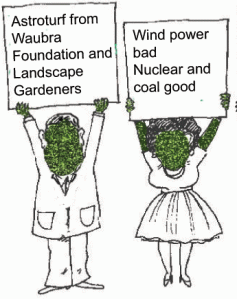 Wind turbine infrasound: What’s all the noise about?, REneweconomy, By Richard Mackie 4 December 2012 On Wednesday the Senate inquiry into excessive noise from wind farms released their report. The inquiry was supposed to focus on audible noise but debate strayed into concerns that wind turbines can cause health problems by producing infrasound (sound of a frequency so low that it is normally inaudible) and low frequency noise.
Wind farm opposition groups such as the Waubra Foundation are prone to making extreme statements about wind turbines such as this from their senate inquiry submission “…characteristic symptom patterns have been reported at distances up 10km away from the nearest wind turbine.” Infrasound is blamed and understandably people get concerned.
So where does this idea come from? The Senate inquiry gives us the answers. Submissions represent a global who’s who in the debate on wind farms and health. Often information provided to support the wind farms-cause-health-problems idea actually demonstrates the opposite.
Take for example Figure 1, presented by Steven Cooper of the Acoustics
Group in senate inquiry submission no. 142. The Acoustics Group is
used by opponents to wind farms in support of their submissions
opposing proposed wind farms including: the Flyers Creek wind farm
project in New South Wales and the Stony Gap and Hallet 3 projects in
South Australia.
In presentations promoted by Senators Xenephon and Madigan, Cooper has
quickly flashed through this graph and others in order to bolster the
case that wind turbines could be causing health problems. I went to
his presentation in Bacchus Marsh on 13th of June this year and
witnessed this. Rather strangely, Cooper refused to provide a copy of
his presentation even though he had just publicly presented it,
despite requests from many members of the audience. What’s the secret?
Particularly when Cooper goes to great lengths to say that “If there
is potential for an industry to jeopardise the welfare, health or
safety of the public, or affect the well being of the community I am
duty bound to identify those issues under the Code of Ethics of the
Australian Acoustical Society.” (inquiry submission no. 142)…..
higher sound levels were recorded with turbines turned off versus when the turbines were running. A strong indication that the origin of most infrasound and low-frequency noise was the wind itself which was slowed by running turbines…….
Infrasound from wind turbines is extremely unlikely to cause health
problems, however wind turbines do on occasion cause annoyance due to
audible noise. For example Van den Berg (2006) discusses a ‘beating’
phenomenon at one wind farm which could be amplitude modulation
misinterpreted as an infrasound issue. Such phenomenon have resulted
in changes to wind turbine noise standards in order that residents
around wind farms are protected. For example the updated New Zealand
Noise Standard 6808:2010 address amplitude modulation. Responsible
changes are made to genuine problems. Those concerned about wind
turbine noise should focus on audible noise and need not work
themselves into a worry about infrasound.
http://reneweconomy.com.au/2012/wind-turbine-infrasound-whats-all-the-noise-about-28735
No comments yet.
1 This month
7 April – WEBINAR – Australia and the Doomsday Clock – Preventing nuclear war through NoFirstUse and other policies
Online | Tuesday April 7, 4:00-5:30pm, Australian Eastern Time / 8:00-9:30am Central Europe Time
– Access the registration link
15 April – Zoom –Nuclear Power is Not the Solution
Apr 15, 2026 01:00 AM in Canberra, Melbourne, Sydney

Join the International Physicians for the Prevention of Nuclear War (IPPNW) on Tuesday, April 14th for a timely webinar exploring the risks associated with nuclear power and challenging the myth that it offers a simple, safe, carbon-free solution to the climate crisis

21 April Webinar: No Nuclear Weapons in Australia
Start: 2026-04-21 18:00:00 UTC Canberra, Melbourne, Sydney (GMT+10:00)
End: 2026-04-21 19:30:00 UTC Canberra, Melbourne, Sydney (GMT+10:00)
Event Type: Virtual
A virtual link will be communicated before the event.
Host Contact Info: australia@icanw.org

of the week – Australians for War Powers Reform (AWPR)
To see nuclear-related stories in greater depth and intensity
 Antinuclear
Leave a comment