Few Australians realise that the Federal Government is about to abandon environmental protection
 Fox, meet hen house. At a meeting this week the Federal Government will further its plan to hand over its environmental oversight and protection responsibilities to the State Premiers.
Where does this crazy idea come from? The Business Council of Australia. Why? Because states have a terrible record of protecting our most important national treasures and the Business Council wants a blank permission slip to mine, log, or develop wherever they like. If it weren’t for the protection of the Federal Government, we would have lost places like the Great Barrier Reef, the Franklin River, the Daintree Rainforest and Fraser Island a long time ago.
Most Australians have no idea this is even happening, much less what it could mean for the places we love. But we can change that. By increasing public awareness about all that’s at stake, we can counter the influence of the Business Council at Friday’s COAG and back in the politicians who want to protect the places and species that belong to all Australians.
That’s why we’re taking out a full page ad in The Australian on the day of the COAG meeting, asking the Prime Minister and Environment Minister Tony Burke to step up to their responsibilities, not hand them over to Barry O’Farrell, Campbell Newman and the other State Premiers.
http://www.getup.org.au/keep-federal-govt-enviro-powers
It beggars belief that the Prime Minister would want to hand over power to the States at a time like this: former NSW government ministers are being investigated for multi-million dollar corruption in relation to Hunter Valley mining licenses. Queensland’s Campbell Newman is trying to allow giant coal ports inside the Great Barrier Reef. And in Tasmania, miners want to dig up the ancient rainforests of the Tarkine.
Experts are already lining up to call this a really bad idea. Sir David Attenborough joined 500 of the world’s leading conservationists in an open letter to Julia Gillard, urging her to reconsider1. Former Federal Court judge Murray Wilcox has called the move “an extremely backward step” and says, “I’m just staggered, frankly, that it’s being given serious consideration.”2 Every environmental group in the country agrees with them.
Here’s why: state governments don’t exactly have a great track record with environmental protection. They’re too dependent on royalties from major projects like coal seam gas, mining and development. They have a direct incentive to push approvals through quickly and deal with the fall-out later. Don’t let them get away with it: click here to chip in to increase public pressure and hold them accountable. Continue reading
Toro Energy gives Dr Vanessa Guthrie the poisoned uranium chalice
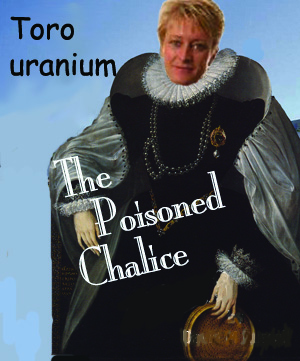 It looks as if Toro Energy, with its planned uranium mine Wiluna, Western Australia might be following an Australian tradition – of giving “the poisoned chalice” to a woman.
Australia’s had quite a history of giving women impossible jobs – I’m thinking mainly here of some State Premiers – Carmel Lawrence, Joan Kirner, Kristina Keneally. But it can happen in industry, too.
At Toro Energy, Dr Vanessa Guthrie, with a background in environmental sustainability, joins nuclear enthusiast Dr Erica Smyth. Smyth has been advocating nuclear power for Australia, nuclear powered desalination plants, and she presided over Toro’s propaganda campaign, with Doug Boreham preaching low level radiation as beneficial to health.
“There are serious flaws in the state assessment process and the studies Toro provided to the State Government. The project is a long way from being approved and the company faces serious financing constraints.
“Under new mine closure guidelines Toro has to find 100% of the mine closure costs in order to get approval to mine. So Toro needs $150 million to close a mine even before it has raised the $300 million to open it. The combination of a uranium price in free-fall and rising mine costs make this project increasingly unviable.” – Mia Pepper
Toro Energy’s uranium mining push comes as proven miners, including BHP Billiton and Cameco, defer or get out of planned uranium projects in WA. – Christina Macpherson
Women lead in ASX first, The Age, Peter Ker, December 5, 2012 THE branding is positively male, but the executive ranks of Toro Energy are about to take on a feminine look. In what is believed to be a unique set of circumstances in Australia, Toro will soon have women occupying both the chief executive and chairman roles, after announcing the departure of long-serving chief executive Greg Hall on Tuesday.
The situation will be formalised on February 8, when Dr Vanessa Guthrie replaces Mr Hall in running the company that is close to developing Australia’s next uranium mine.
Her chairman will be Erica Smyth, who has led the Toro board for more than three years. While it is difficult to be certain, most gender diversity experts believe the change will make Toro the only ASX-listed company to boast the female quinella. Continue reading
Doctors raise concerns about sloppy radiation science
 5 Dec 12, The Medical Association for Prevention of War (MAPW) – the Australian branch of a Nobel Peace Prize winning public health organisation – has called for increased transparency and robust science in medical presentations on radiation health issues.
The call follows concerns raised earlier this year when junior uranium company Toro Energy promoted the fringe scientific view that exposure to low-level radiation is harmless. Toro Energy has sponsored speaking visits to Australia by Canadian scientist Dr Doug Boreham, who argues that low-level radiation is actually beneficial to human health. Attached is a letter signed by 45 doctors deploring the use of junk science to lower occupational health and safety standards. Continue reading
In France, wind energy clearly beats nuclear on cost
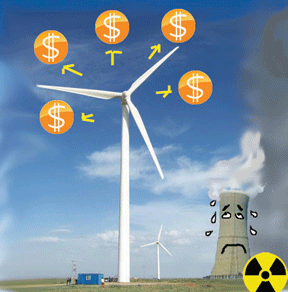 With capital costs now more than €5,000 per kW ($6,400 per kW), EDF’s announcement doesn’t bode well for reactor proposals in Ontario, Canada, the US, and in Great Britain….
The French renewables industry was quick to denounce the cost overruns, saying that renewables are cheaper.
SER noted that wind in France is paid only €0.08 per kWh ($0.10 per kWh) and clearly competitive with new nuclear.
At the windiest sites, wind generation is paid as little as €0.03 per kWh ($0.035 per kWh) in years ten through fifteen, a fraction of the cost of new nuclear in France
Wind energy now cheaper than nuclear in France  http://reneweconomy.com.au/2012/wind-energy-now-cheaper-than-nuclear-in-france-92181 REneweconomy, By Paul Gipe 5 December 2012 Liberation reports that for the second time in a little more than a year the cost of a new reactor under construction at Flamanville, France has risen dramatically.
VIDEO: Kewaunee nuclear reactor shutdown – the first of many in USA?
 Gundersen: The dominoes are starting to fall in U.S. — I think we’ll see quite a few nuclear plants shutting down permanently (VIDEO) http://enenews.com/gundersen-dominoes-starting-fall-quite-nuclear-plants-shutting-down-permanently-video
December 4th, 2012
Title: Nuclear Energy Information Service Q&A
Author: chicagomultikulti
Date: December 1, 2012
Nuclear Expert Arnie Gundersen, Fairewinds Energy Education: The Kewaunee plant in Wisconsin, it’s a 600 megawatt plant, a single unit plant and the owner of the plant has decided that it makes no economic sense to run it so they’ll be shutting down.
The dominoes are starting to fall, small single unit reactors like Oyster Creek, Vermont Yankee and others. The commercials pressures on them to keep them running, especially in light of Fukushima modifications, I don’t think Kewaunee will be the only plant to shut down. I think we’ll see quite a few.
Contrary to industry propaganda – mining is NOT an ideal job for Aboriginal people
Aboriginal people would prefer to have jobs that “heal the land”, not dig it up.
To say that he [Andrew Forrest] will get more jobs in mining is the answer, is really only the answer for the mining sector – not Aboriginal people.”
 Indigenous mining jobs push misguided, spokesman says, Australian Mining, 4 December, 2012 Cole Latimer The mining industry’s drive to increase the number of Indigenous Australian in resources work is ‘misguided’ according to Indigenous spokesperson David Collard.
His comments came yesterday at an Indigenous Business, Enterprise and Corporations Conference at UWA, where Collard singled out Fortescue’s Andrew Forrest’s Aboriginal employment drive, according to The West.
It comes only days after the chair of Australian Indigenous studies at the University of Melbourne, Marcia Langton, stated that the mining industry is helping to pull many Indigenous people out of poverty…… Continue reading
South Australia ahead in renewable energy
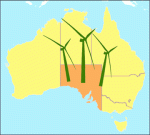 SA a leading light in renewable energy, Climate Commission says http://www.adelaidenow.com.au/sa-a-leading-light-in-renewable-energy-climate-commission-says/story-e6frea6u-1226530337471
December 05, 2012 SOUTH Australia is lighting the way to a brighter future powered by renewable energy, the Climate Commission says.A free public forum tonight at Adelaide High School will discuss the Commission’s recent report Generating a Renewable Australia.
Chief commissioner Professor Tim Flannery said SA had pioneered wind energy in Australia and solar thermal technology was likely to be the next big thing, cementing SA’s position as a leading state.
“We will at some point see a 100 per cent renewable future, not just for Australia but for the planet,” he said.
“It’s really the speed of the transition, from where we are now to a fully renewable future, that’s going to dictate whether we see warming beyond the dangerous threshold.”
Register for a free seat online at www.climatecommission.gov.au or by phone on 02 6159 7624.
Key points from the Solar Power Australia 2011-12 report,
 The report reiterates the busting of the solar is for the rich myth. Over half of system buyers earn less than $100,000 annually and more than a quarter earned less than $65,000 per annum.
Solar Power Australia 2011-12 Report Highlights http://www.energymatters.com.au/index.php?main_page=news_article&article_id=3498, by Energy Matters, 5 Dec 12, The Clean Energy Council has released its Solar Power Australia 2011-12 report, which states solar panel installations now represent 3.2% of all current electricity generation capacity in Australia.
The CEC report describes 2011 as “prophetic in terms of the industry’s impact on where Australia’s electricity industry is headed.”
Other key points from the report: Continue reading
Exceptional sea level rise on the Perth coastline.
Perth’s sea levels on the rise, Dec 05, 2012 WA Today In 2011, Sea levels on the Perth coastline are rising at three times the global average, the latest State of Australian Cities report shows.
In a statistic that federal Infrastructure Minister Anthony Albanese described as “disturbing” and “extraordinary”, readings since 1993 have indicated sea levels are rising by between nine and 10 millimetres per year. The global average is around three millimetres per year…….
http://www.watoday.com.au/wa-news/perths-sea-levels-on-the-rise-20121204-2asue.html#ixzz2EEy5FBXH
1 This month
7 April – WEBINAR – Australia and the Doomsday Clock – Preventing nuclear war through NoFirstUse and other policies
Online | Tuesday April 7, 4:00-5:30pm, Australian Eastern Time / 8:00-9:30am Central Europe Time
– Access the registration link
15 April – Zoom –Nuclear Power is Not the Solution
Apr 15, 2026 01:00 AM in Canberra, Melbourne, Sydney

Join the International Physicians for the Prevention of Nuclear War (IPPNW) on Tuesday, April 14th for a timely webinar exploring the risks associated with nuclear power and challenging the myth that it offers a simple, safe, carbon-free solution to the climate crisis

21 April Webinar: No Nuclear Weapons in Australia
Start: 2026-04-21 18:00:00 UTC Canberra, Melbourne, Sydney (GMT+10:00)
End: 2026-04-21 19:30:00 UTC Canberra, Melbourne, Sydney (GMT+10:00)
Event Type: Virtual
A virtual link will be communicated before the event.
Host Contact Info: australia@icanw.org

of the week – Australians for War Powers Reform (AWPR)
To see nuclear-related stories in greater depth and intensity
 Antinuclear