Australian govt promotes uranium industry – regardless of safety and weapons proliferation issues
Australian governments and uranium companies could help to break the vicious cycle by making uranium exports conditional on adequate safety standards and proper regulation – but they don’t.
Even more troubling is the willingness of successive Australian governments to turn a blind eye to weapons proliferation concerns in North Asia.
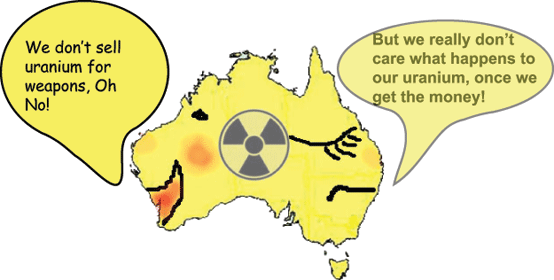
How can we trust nuclear, if we can’t trust its operators? http://www.thepunch.com.au/articles/how-can-we-trust-nuclear-if-we-cant-trust-its-operators/ by Jim Green 13 DEC Whether it’s nuclear safety or weapons proliferation, the federal government (and the Opposition and the mining companies) can be safely relied upon to exacerbate problems with irresponsible uranium export policies.
Widespread safety breaches and proliferation concerns in North Asia are recent manifestations of the problem. In May, five
engineers were charged with covering up a potentially dangerous power failure at South Korea’s Kori-I reactor which led to a rapid rise in the reactor core temperature. The accident occurred because of a
failure to follow safety procedures. A manager decided to conceal the
incident and to delete records, despite a legal obligation to notify
the Nuclear Safety and Security Commission.
In October, authorities temporarily shut down two reactors at separate
South Korean nuclear plants after system malfunctions. In November, a
major scandal was revealed involving the systematic use of forged
quality and safety warranties for nuclear reactor parts such as fuses,
switches, heat sensors, and cooling fans. The current total stands at
8601 reactor parts, 10 firms and six reactors. Plant owner Korea Hydro
and Nuclear Power has acknowledged possible bribery and collusion by
its own staff members as well as corruption by firms supplying reactor
parts.
Inadequate and compromised regulation has been a factor behind the
problems in South Korea’s nuclear industry – just as it was a key
factor behind the Fukushima disaster in Japan..
The International Energy Agency (IEA) said Seoul needs to rebuild
public trust by boosting transparency and improving regulation.
According to the IEA, “recent incidents at Korean nuclear facilities
should serve as a timely reminder to the government that the nuclear
regulatory authority must maintain an enhanced profile, be
well-resourced and able to take independent decisions.”
There is a recurring patterns: inadequate regulation and inadequate
nuclear safety practices lead to accidents and scandals; public
controversy and media interest ensue; expressions of sorrow and
promises of reform are solemnly offered; then it’s business as usual
as soon as the public and media interest die down.
Australian governments and uranium companies could help to break the vicious cycle by making uranium exports conditional on adequate safety standards and proper regulation – but they don’t.
They do nothing except react with mock indignation at any suggestion
that their silence and inaction makes them partly culpable for
inadequate safety standards and inadequate regulation in uranium
customer countries, and for the accidents that inevitably follow such
as the Fukushima disaster.
Even more troubling is the willingness of successive Australian governments to turn a blind eye to weapons proliferation concerns in North Asia. In 2004, South Korea disclosed information about a range
of illegal secret nuclear weapons research over the preceding 20
years.
The Board of Governors of the International Atomic Energy Agency
(IAEA) described South Korea’s secret nuclear research as a matter of
“serious concern” – but did nothing about it.
The Howard government didn’t even voice concern let alone take any
action despite the fact that Australian uranium has been exported to
South Korea since 1986 and may have been used in the illegal research.
Now, South Korea wants to develop uranium enrichment technology in
violation of its commitments under the 1992 Joint Declaration on the
Denuclearization of the Korean Peninsula.
South Korea has no legitimate need for enrichment technology (there is
ample global enrichment capacity) and there are serious proliferation
concerns as enrichment provides a direct route to nuclear weapons
material in the form of highly-enriched uranium.
Will Canberra permit enrichment of Australian uranium in South Korea?
Expect uranium miners BHP Billiton and Energy Resources of Australia
to inform the decision. Don’t expect proliferation concerns or common
sense to inform the decision.
Australia also fuels proliferation tensions in North Asia by allowing
Japan open-ended permission to separate and stockpile weapons-useable
plutonium produced from Australian uranium.
The issue has resurfaced in recent months with another round of
mouthing-off by Japan’s nuclear hawks. Japan’s defence minister,
Satoshi Morimoto, said that Japan’s nuclear power program is “taken by
neighboring countries as having very great defensive deterrent
functions”. Former defence minister Shigeru Ishiba recently said:
“Having nuclear plants shows to other nations that Japan can make
nuclear weapons.”
Japan’s plutonium program demonstrably fans regional proliferation
tensions. A March 1993 diplomatic cable from then US Ambassador
Armacost in Tokyo posed these questions: “Can Japan expect that if it
embarks on a massive plutonium recycling program that Korea and other
nations would not press ahead with reprocessing programs? Would not
the perception of Japan’s being awash in plutonium and possessing
leading edge rocket technology create anxiety in the region?”
Since 1993, Japan’s plutonium stockpile has grown and regional
tensions have worsened. Yet Australia has never once refused Japan (or
any other country) permission to separate and stockpile plutonium
produced from Australian uranium, even though bilateral agreements
give Australia the right to do so.
An argument could be made in support of Australia’s uranium industry
if our export policies resulted in better safety standards and reduced
proliferation tensions around the world. But Australia turns a blind
eye to poor safety practices and contributes to proliferation tensions
through irresponsible uranium export policies.
Given that sad reality, and given that uranium accounts for a
minuscule 0.02 percent of Australian jobs and a paltry 0.21 percent of
export revenue, there’s a strong case for leaving it in the ground.
No comments yet.
1 This month
7 April – WEBINAR – Australia and the Doomsday Clock – Preventing nuclear war through NoFirstUse and other policies
Online | Tuesday April 7, 4:00-5:30pm, Australian Eastern Time / 8:00-9:30am Central Europe Time
– Access the registration link
15 April – Zoom –Nuclear Power is Not the Solution
Apr 15, 2026 01:00 AM in Canberra, Melbourne, Sydney

Join the International Physicians for the Prevention of Nuclear War (IPPNW) on Tuesday, April 14th for a timely webinar exploring the risks associated with nuclear power and challenging the myth that it offers a simple, safe, carbon-free solution to the climate crisis

21 April Webinar: No Nuclear Weapons in Australia
Start: 2026-04-21 18:00:00 UTC Canberra, Melbourne, Sydney (GMT+10:00)
End: 2026-04-21 19:30:00 UTC Canberra, Melbourne, Sydney (GMT+10:00)
Event Type: Virtual
A virtual link will be communicated before the event.
Host Contact Info: australia@icanw.org

of the week – Australians for War Powers Reform (AWPR)
To see nuclear-related stories in greater depth and intensity
 Antinuclear
Leave a comment