Resuscitation of uranium market unlikely, despite Japan’s election result
 Australia’s uranium lobby, ever ready to clutch at straws, already sees the Japanese election result as the signal for the salvation of that tottering industry.
There are many factors that make it unlikely that the poll result does mean resuscitation for the global nuclear industry.
In Japan, anti-nuclear opinion remains widespread. The nuclear regulator will not even start inspecting the shut-down reactors until June 2013. The LNG fuel supply is taking over in a big way in Japan. Renewable energy is developing there, (though the new government may succeed in stifling it). The Fukushima radiation problem does not go away.
Japan is not the be-all and end -all of nuclear power. The USA is more like that. USA has by far the greatest number of commercial (and military) nuclear reactors. Their commercial reactors are aging, and no sign of progress in new ones. USA – the world leader in nuclear power, has the potential to join China, as world leader in renewable energy.
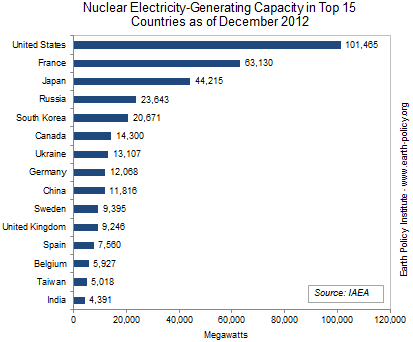
Europe’s nuclear industry is well in decline, as Germany succeeds with renewable energy, and France wrestles with the difficult action of reducing its expensive dependence on its aged nuclear power fleet.
UK is in a very confused situation, as companies struggle to finance UK’s grand plan for new nuclear, and the government produces new, rather hidden, subsidies for this.
China’s much touted nuclear industry is slow to get going. (They’re not stupid. They see the problems elsewhere, and they’re racing ahead with renewables)
As for Asian, and Middle East countries – well, they saw what happened to Iraq – without nuclear weapons, and what is likely to happen , similarly, to Iran – so they want nuclear power -(the essential fore-runner to nuclear weapons).
So – why does Australia even want to sell uranium, increasing nuclear weapons proliferation – even if the uranium market does return from the grave? Christina Macpherson, 18 Dec 12
Japanese nuclear restart is very problematic, and Fukushima tragedy is not over
“People who voted for the LDP are supporting their economic-stimulus measures, not nuclear power policy,”
“Even for the LDP it will be difficult to gain support from residents living near nuclear stations for restarting them, as the tragedy in Fukushima is not over,”

 Nuclear Stock Rally in Japan Ignores Public Opposition, Bloomberg News By Yuriy Humber, Anna Kitanaka and Aya Takada December 17, 2012 Japanese power-company stocks that rallied after the pro-nuclear energy Liberal Democratic Party was elected may struggle to sustain gains because of public opposition to restarting atomic plants……
“Just because politicians say they want to restart reactors doesn’t mean they will actually be able to do it,” said Ayako Sera, a market strategist at Sumitomo Mitsui Trust Bank Ltd. in Tokyo, which has about $400 billion in assets. ….
Any plans to restart reactors will need approval from the Nuclear Regulation Authority, which is investigating six atomic plants on concern they were built on active fault lines. Japanese law states reactors cannot be built on active faults, indicating the plants may need to be decommissioned.
“Proving safety is going to be really hard,” Sera said. Continue reading
Asahi Shimbun finds that anti nuclear feeling strong in Japan, despite poll results
Exit poll: Anti-nuclear votes spread across the board http://ajw.asahi.com/article/0311disaster/fukushima/AJ201212170097 Ballots cast by people who advocate scrapping nuclear power ended up being spread among the various parties, meaning that anti-nuclear entities failed to gain seats, an Asahi Shimbun exit poll shows.
The Asahi Shimbun approached voters nationwide who had cast their ballots in the Dec. 16 Lower House election to find out if they supported “scrapping nuclear power immediately, “gradually phasing out nuclear power altogether” or “not pursuing zero nuclear power.”
Fourteen percent chose scrapping nuclear power immediately, and 64 percent picked gradually phasing out nuclear power altogether.
Voters opposed to nuclear power cast ballots across a wide range of parties in the proportional representation system.
This was because parties other than the Liberal Democratic Party advocate a break with nuclear power to a certain extent. Fifteen percent of the respondents said they do not want to pursue zero nuclear power.
The LDP has been a strong supporter of nuclear power. Yet, the party was supported by 16 percent of those who said they want to scrap nuclear power immediately, and 28 percent of those who said they supported gradually phasing out nuclear power altogether. This suggests voters made choices based also on issues other than on nuclear energy.
Of those who do not want to pursue zero nuclear power, 43 percent voted for the LDP. Continue reading
Lynas in Malaysian court tomorrow over its confused and contradictory radioactive wastes plans
 Lynas will be in court in Malaysia on 19 December. The Save Malaysia Stop Lynas (SMSL) campaigners
  will be appealing against the Kuantan High Court decision to lift its stay on the company being able to exercise its rights to proceed under the temporary licence.
The toxic waste that’s not in Australia’s backyard http://aliran.com/11005.html 18 Dec 12, Australian-owned company Lynas is quietly shipping rare earth to a processing plant in Malaysia – without a firm plan in place to dispose of dangerous radioactive waste. Wendy Bacon reports.
 If a manufacturing plant involving radioactive materials moved into your community, one of the first things you would ask is, “what’s going to happen to the waste?”
This is exactly how residents of Kuantan on Malaysia’s east coast reacted when the Australian company Lynas announced plans to build Lamp, the world’s biggest rare earth processing plant in their area.
Several years later, they have no clear answer. Indeed last week, while the plant that will use concentrate imported from Lynas’s rare earth mine at Mount Weld in Western Australia was finally ramping up for production, the Malaysian government and the company were in direct conflict about what would happen to the waste. Continue reading
A nuclear comeback is not to happen soon in Japan
Japan Shifts to LNG Dependency from Nuclear, Eyes US Fuel, Energy Tribune, December 17, 2012Liquefied Natural Gas (LNG) purchase, a post-Fukushima item in Japan’s imports list that sent country’s foreign trade figures to their first deficit in 38 years in 2011, will continue dominating the country’s energy near future, as officials confirm that they are in LNG trade talks with the U.S., not a traditional supplier. Qatar and Australia seem to be maintaining their top supply positions to the Japan with new deals, the country’s Nuclear Policy Unit has said.
Before the devastating earthquake and subsequent tsunami on May 11, 2011, Japan was planning to increase nuclear power’s share in its energy bucket to 50 percent as of 2030, from 26 percent at the time.
Today, the revised plans vary from zero to a maximum 25 percent of nuclear, the Nuclear Policy Unit Cabinet Secretariat Yoshinori Tanaka told journalists in Tokyo on Dec. 13.
Along with purchases from Qatar and Australia, the country is looking to buy LNG from the U.S., he also revealed. However, other officials have stated that the U.S. is primarily considering meeting its domestic demand first.
A new Japanese strategy document prioritizes renewables, but such projects will take time to fill the significant energy gap in Asia’s second largest economy.
Japan, which was once energy self-sufficient, this year and in 2011 bought large amounts of LNG, along with coal and oil, to meet the gap that emerged after the closure of its nuclear facilities, the assistant press secretary of the Japanese Foreign Ministry, Masaru Sato, told the Hürriyet Daily News……
The country’s newly founded Nuclear Regulation Authority, a governmental body focusing exclusively on nuclear safety, will start inspecting nuclear plants to restart operations only in June 2013, showing that a nuclear comeback is also not on the agenda in the immediate short term…..http://www.energytribune.com/68237/japan-shifts-to-lng-dependency-from-nuclear-eyes-us-fuel
Australian uranium miners jubilant at Japan’s election results
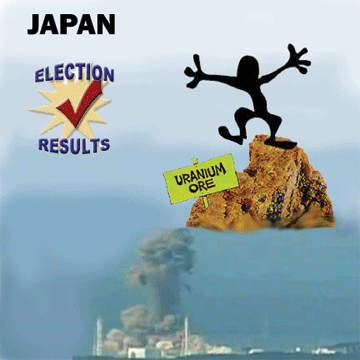 Producers bullish on Japanese demand The Age, December 18, 2012 Paddy Manning Greg Hall, managing director of junior Toro Energy, said Japan had been spending an additional $US100 million a day on extra coal, oil and gas, which represented a ”very, very high cost”.
After the weekend’s election, he said the country now had the political will to restart its reactors. A new independent safety
authority would be in place by April and Japan’s nuclear power capacity would be restored through 2013-15……..
Paladin Energy chief John Borshoff predicted Germany, too, would eventually return to the nuclear power fold. ”Germany can’t survive on a no-nuclear basis with all the countries…. Mr Borshoff said it was impossible for Japan to do without 27 per cent of its electricity-generating capacity.
”We’ve been working on the basis the nuclear programs will resume in some modified form. Germany have set
an irreversible path but I believe in eight-10 years they’ll be back on the drawing board.”
UBS resources analyst Glyn Lawcock welcomed the Japanese news saying it had been a ”torrid” 18 months for uranium markets since the closure of the Fukushima Daiichi reactor after last year’s Japanese earthquake and tsunami.
New South Wales’ toxic radioactive waste by another name is still toxic radioactive waste
But the new plan involves reclassifying most of the contaminated earth as ”restricted solid waste”, allowing it to be trucked to Kemps Creek.
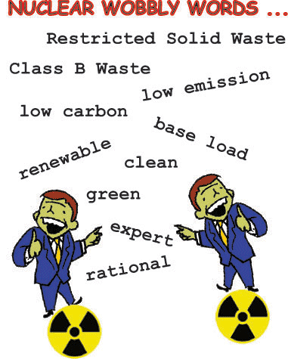 The Labor MP for Auburn, Barbara Perry, told Parliament in June that the move to reclassify the contaminated earth as restricted but non-hazardous was ”clever spin”.
Based on a series of tests by ANSTO, government and independent scientists, the detection of some hazardous radioactive material seems likely.
Uranium smelter’s legacy moves on, SMH December 16, 2012 Ben Cubby THE controversial clean-up of a radioactive site in Hunters Hill is set to begin early next year, with any hazardous waste to be moved from the harbourside suburb to Lidcombe, the NSW government says.
The contaminated properties in Nelson Parade – once the site of a uranium smelter – have been a thorn in the side of residents and governments for nearly a century.
After years of denials from successive governments about the extent of the contamination, the clean-up will now be extended to include suspected radioactive hot spots in neighbouring backyards and at the harbour foreshore.
The Premier, Barry O’Farrell, all but ruled out dumping the contaminated dirt at a Kemps Creek waste facility in western Sydney last year, in the face of protests from Penrith residents and councillors. Continue reading
Japan’s Nuclear Village wins out in election results
Far Right Dinosaur Party Wins Japan Elections http://rense.com/general95/farright.html By Richard Wilcox 12-16-12 Looking over the results on the TV here in Japan, the far right CIA created and sustained “Liberal Democratic Party” (LDP) which ruled Japan since WWII is back in power, BIG TIME. They won almost all the seats. The only other parties to win numerous seats are almost or just as far right and as pathologically fueled by power.
All of these parties are captured by the Nuclear Mafia and fiercely devoted to the continuation of nuclear power, if not the development of nuclear weapons to boot. Don’t ask me why the Japanese vote for these nuts and if you ask folks, “why?” they like a certain candidate, they are at a loss to give a reason and smile with embarrassment.
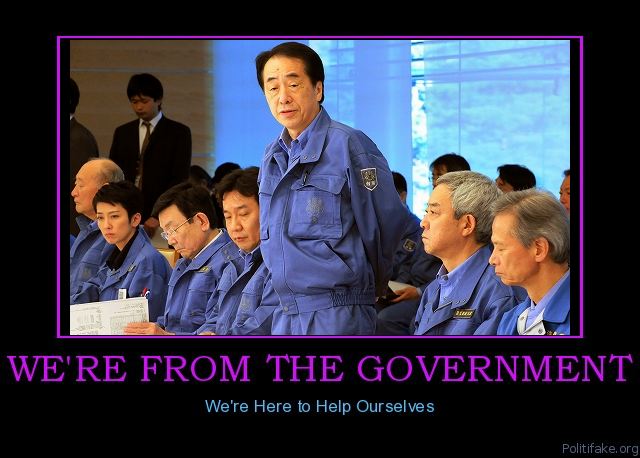
I guess the LDP pay off certain voting sectors with construction projects and kickbacks since they have a pile of stolen money hiddenaway.
Of course, the system is rigged so that only big money candidates can get enough votes. Also, culturally, Japanese tend to support the utmost superficial and glib politicians in a battle of form over substance. Same as USA! Japanese have forgotten about the nuclear disaster thanks to media manipulation so there has been no referendum on nuclear policy.
There are intelligent and sincere political parties and candidates in Japan but they get no-head way, because they are too principled and lack the funds, and the system is set up to block their progress (sounds like USA again, aka Ron Paul). Only the most cheeky and shameless people ascend to power.
Any of the mildly progressive or anti-nuclear power parties took a few pitiful token seats, which are probably in the restroom of theParliament building– the toilet seats.
Look for some of Japan’s nuclear power plants to start up next year, fast and furious, devil take the hindmost. To paraphrase the punk rock band the Sex Pistols: Never Mind The Earthquakes.
Disappointment for Japan’s anti nuclear party as Liberal Democratic Party returned to power
 The anti-nuclear Tomorrow Party – formed just three weeks ago _captured just nine seats, according to NHK. Party head Yukiko Kada said she was very disappointed to see LDP, the original promoter of Japan’s nuclear energy policy making a big comeback.
Japan Elections 2012: LDP Wins Majority In Parliamentary Elections HUFFINGTON POST, By MALCOLM FOSTER 12/16/12 TOKYO — Japan’s conservative Liberal Democratic Party returned to power in a landslide election victory Sunday after three years in opposition, according to unofficial results,….
The victory means that the hawkish former Prime Minister Shinzo Abe will get a second chance to lead the nation
after a one-year stint in 2006-2007. He would be Japan’s seventh prime minister in six-and-a-half years.
In the first election since the March 11, 2011, earthquake, tsunami and nuclear disasters, atomic energy ended up not being a major election issue even though polls show about 80 percent of Japanese want to phase out nuclear power…….
LDP, the most pro-nuclear power party, had 118 seats before the election. A new, staunchly anti-nuclear power party won just nine seats, according to NHK.
In the end, economic concerns won out, said Kazuhisa Kawakami, a political science professor at Meiji Gakuin University.
“We need to prioritize the economy, especially since we are an island nation,” he said. “We’re not like Germany. We can’t just get energy from other countries in a pinch.”….. Continue reading
Kyoto protocol still the world’s only climate change treaty
But there are some good news stories from the latest Kyoto round….
Australia is doing right by the Kyoto protocol. But we must run faster up the down escalator…..
The issue should be beyond politics.
 The road to a living planet still passes through Kyoto http://www.smh.com.au/opinion/editorial/the-road-to-a-living-planet-still-passes-through-kyoto-20121216-2bhgo.html December 17, 2012 THE world won’t come to an end this Friday, despite the Mayans’ prognostications. Not only that, it will be reborn 11 days later. Yes, on January 1, the second phase of the Kyoto protocol comes into force.
Kyoto is still the world’s only climate change treaty but, while only seven years old, it already looks a bit old hat.
Kevin Rudd signed up for Australia five years ago this month. Things haven’t got much better for the present Prime Minister, or the treaty. Russia, Japan, Canada and New Zealand declined to agree to a second commitment period under the protocol. Yes, even Japan doesn’t love Kyoto. Continue reading
Native Title rejected by Githabul because it will further coal seam gas mining
Ms Gloria Williams spokeswoman of Githabul said that the Native Title agreement is being wrongly used to allow coal seam gas interests into the region.
Aboriginal people reject Native Title over coal seam gas http://www.coalguru.com/australia/aboriginal_people_reject_native_title_over_coal_seam_gas/6062 17 Dec 12, ABC News cited members of the Githabul people as saying that the coal seam gas issue is forcing them to reject their Native Title claim.
An application by the New South Wales Aboriginal Land Council for gas prospecting in the Tweed and Byron Shires, includes areas covered by the Githabul Native Title claim of 2007. The claim is more than 6000 square kilometer in size. Continue reading
Windy Flinders Island aims for 100% renewable energy
 Flinders Island’s windy future http://www.abc.net.au/news/2012-12-16/flinders-island27s-windy-future/4430334 Dec 16, 2012 Flinders Island in Bass Strait plans to produce all its power from renewable energy sources.
The plan to put up three or four wind turbines and a mini hydro storage system would cost up to $25 million.
A privately-run turbine is already producing 25 per cent of the island’s energy.
Flinders Island Council general manager Raoul Harper said residents wanted to make that 100 per cent. “Being in the top five wind resource areas on the planet the concept of continuing to burn diesel to power the island does seem absurdreally,” he said.
In the long run Mr Harper said the project would be cost effective because the government would no longer need to pay Hydro Tasmania $3 million a year to supply diesel. The council is seeking Federal Government funding through its new
renewable energy agency.

Ionising radiation shown to lead to thyroid cancer

Fingerprint of radiation exposure discovered in thyroid cancer http://www.healthcanal.com/cancers/17423-Fingerprint-radiation-exposure-discovered-thyroid-cancer.html 25/05/2011 Neuherberg,- Scientists from the Helmholtz Zentrum München have discovered a genetic change in thyroid cancer that points to a previous exposure of the thyroid to ionising radiation. The gene marker, a so-called „radiation fingerprint“ was identified in papilliary thyroid cancer cases from Chernobyl victims, but was absent from the thyroid cancers in patients with no history of radiation exposure. The results are published in the current issue of PNAS. Continue reading
Record low electricity generation prices from wind power
Wind farms set record low generation prices, SMH, December 16, 2012 Four energy developers agreed to sell power from 10 proposed wind farms in Brazil at the cheapest rates ever.
Enerfin Sociedad de Energia SA, Renova Energia SA, EGP- Serra Azul and Bioenergy Geradora de Energia Ltda. won contracts to sell electricity to distributors for an average price of 87.94 reais ($41) a megawatt-hour, Brazil’s national energy agency Empresa de Pesquisa Energetica said in an e-mail yesterday. (Australian wholesale prices are about $50 per megawatt-hour, including the $23 carbon tax per tonne.)
“This is definitely the cheapest wind energy in the world,” Maria Gabriela da Rocha Oliveira, a Sao Paulo-based analyst with Bloomberg New Energy Finance, said in a telephone interview. It’s 12 per cent lower than the August 2011 auction that yielded an average price of 99.58 reais a megawatt-hour. That was the lowest price in the world for wind power then and the least expensive power in Brazil, beating natural gas and hydroelectricity….. http://www.smh.com.au/business/carbon-economy/wind-farms-set-record-low-generation-prices-20121216-2bh4z.html#ixzz2FLfka1Ga
Electricity from nuclear energy declining, but electricity from wind energy increasing
 While the news may have the nuclear industry crying in its beer, the renewable energy picture is a much rosier one.
Wind power (which is actually a form of solar power) is also certainly making its mark; including in Australia. Nearly a quarter of South Australia’s electricity came from wind farms during the 2011-12 financial year.
Nuclear Power Is Just So Passé by Energy Matters, 16 Dec 12 In a bit of welcome news, it appears nuclear energy based electricity generation has been flat and will likely reduce in the years ahead.
According to the Earth Policy Institute, nuclear electricity-generating capacity has actually fallen 5 percent between
2006 – 2011 and is likely to drop off further as nuclear power plants are decommissioned faster than new ones are built….. “The average age of nuclear reactors operating today is 27 years; the 142 reactors that have already retired were just 23 years old on average when they closed. Many nuclear reactors have been granted operating extensions, usually for 20 years, beyond their typical design lifetime of 40 years,” says the Institute. Continue reading
1 This month

of the week – Australians for War Powers Reform (AWPR)
To see nuclear-related stories in greater depth and intensity
 Antinuclear