Why nuclear power is utterly incapable of tackling climate change
 Despite the events in Fukushima, which many observers consider a
disaster, nuclear still gets a look in as a policy response to climate
change. Most of the commentary surrounding the release of the White
Paper focused on the favoritism or otherwise shown for nuclear power,
and public advocates like Barry Brook still poke their head up and
shout “NUCLEAR” from time to time. …… anyone seriously advocating
nuclear power as a policy response to global warming in Australia
doesn’t understand the problem……
the simple energy cost of production against the time it takes to generate that much electricity. Often called energy payback. The graphic below plots “energy return on investment” for various sources,
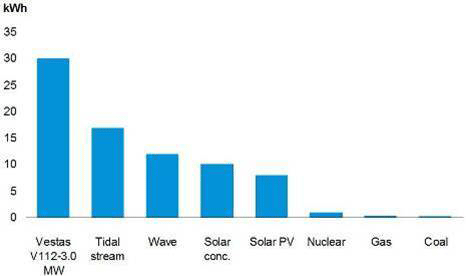
The Offshore Valuation: A valuation of the UK’s offshore renewable
energy resource. Published in the United Kingdom 2010 by the Public
Interest Research Centre. ISBN 978-0-9503648-8-9
http://www.offshorevaluation.org PE (2006)
If the answer is nuclear you don’t understand the question, evcricketenergy, 2 Jan 12
“…. Eligibility criteria are the must haves; if you are
selecting a new machine to generate electricity “does it generate
electricity” is the obvious one…
Merit criteria are what you use to split all of the options that pass.
Say you’re comparing a diesel or natural gas engine to power a remote
site, a merit criterion could be “is fuel available all year round?”
In this post I will focus on the eligibility criteria for powering
Australia while reducing the greenhouse gas emissions associated with
electricity production. I will spend a long time arguing that, no,
nuclear should not be considered, because it is utterly incapable of
solving the problem. In later posts I will discuss the merit criteria,
where again nuclear falls down….. Continue reading
Australian government considering changes to communications and privacy laws
Australia’s electronic spy agency, the Defence Signals Directorate, (DSD) is Australia’s equivalent to America’s National Security Agency( NSA) and has no qualms advertising its twin missions: “One is collecting foreign intelligence by interception. The other is working to stop people doing the same to us,” Burgess says….. The ordinarily shadowy DSD has published a detailed study on its top 35 cyber “mitigation strategies”.
Under Operation Australia, which has protested new data retention proposals, Anonymous shut down more than 10 Australian government sites, including ASIO’s, in July last year using denial of service attacks.
ASIO advocates reforms to communications and privacy laws to provide basic cyber-insurance.
Attorney-General Nicola Roxon has referred the proposals to the Parliamentary Joint Committee on Intelligence and Security.

It’s global cyber war out there, Financial Review, Christopher Joye, 2 Jan 13,
“..Australia’s most experienced spy master, the director-general of ASIO, David Irvine, has a lot on his mind
…… with the privatisation of so many utilities over the past three decades, government has unwittingly delegated national security to business.
This is why ASIO believes national security reforms need to be made to the regulations governing essential infrastructure, including telecommunications.
“The more rocks we turn over in cyberspace, the more we find . . . the internet and increased connectivity has expanded infinitely the opportunities for [these threats]”, Irvine says. Continue reading
Rebirth of Japan’s nuclear industry is unlikely, despite pro nuclear government
the landscape of the nuclear village has changed. Previously, decision makers agreed on policies behind the scenes. This is no longer the case.
The new NRA chairman, Shunichi Tanaka, even contradicted Motegi on the same day. He said it would not be possible to get the security standards of all reactors up to standard within three years. Tanaka did not even think it was necessary to share these ideas with the prime minister himself but rather did so in an interview with the Japanese newspaper Asahi Shimbun.
Profitability is a tall order. During the election campaign, Abe expressed the opinion that Japan could not afford the  nuclear shutdown for purely economic purposes. However, staying with nuclear power could also cost the country dearly.
 No return to Japan’s ‘nuclear village’, Deutsche Welle. 1 Jan 2013,
Japan’s new government has no plans for a switch-off of nuclear power.
However, stringent security regulations and public opinion mean any
radical rebirth of the country’s atomic industry seems unlikely. Continue reading
Spying operations targeted Australian businesses
BHP and Rio’s networks were infiltrated by Chinese hackers. The campaign also expanded to both companies’ advisers.
The Wikileaks cables revealed that BHP boss Marius Kloppers told a US consul-general in Melbourne that he was so fearful of Chinese spying that he shifted his export contracts to market prices because arms-length negotiations were impossible
 It’s global cyber war out there, Financial Review, Christopher Joye, 2 Jan 2013, “:……….OPERATION AUSTRALIA There are a range of cyber-menaces that keep Australia’s spooks awake at night. The first is the usual state-on-state espionage. When officials refer to the “big C”, they are not talking about cancer.
Notwithstanding rhetoric from businesses keen to promote prosperous relations with the Middle Kingdom, the national security community says China is responsible for cyberthefts of Australian assets at every imaginable level. Continue reading
1 This month

of the week – Australians for War Powers Reform (AWPR)
To see nuclear-related stories in greater depth and intensity
 Antinuclear