Why nuclear power is utterly incapable of tackling climate change
 Despite the events in Fukushima, which many observers consider a
disaster, nuclear still gets a look in as a policy response to climate
change. Most of the commentary surrounding the release of the White
Paper focused on the favoritism or otherwise shown for nuclear power,
and public advocates like Barry Brook still poke their head up and
shout “NUCLEAR” from time to time. …… anyone seriously advocating
nuclear power as a policy response to global warming in Australia
doesn’t understand the problem……
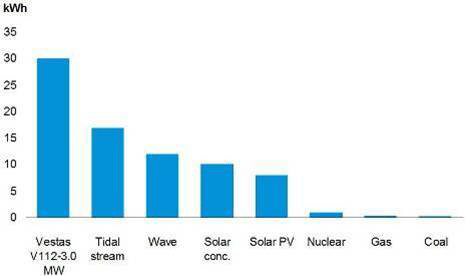
the simple energy cost of production against the time it takes to generate that much electricity. Often called energy payback. The graphic below plots “energy return on investment” for various sources,
The Offshore Valuation: A valuation of the UK’s offshore renewable
energy resource. Published in the United Kingdom 2010 by the Public
Interest Research Centre. ISBN 978-0-9503648-8-9
http://www.offshorevaluation.org PE (2006)
If the answer is nuclear you don’t understand the question, evcricketenergy, 2 Jan 12
“…. Eligibility criteria are the must haves; if you are
selecting a new machine to generate electricity “does it generate
electricity” is the obvious one…
Merit criteria are what you use to split all of the options that pass.
Say you’re comparing a diesel or natural gas engine to power a remote
site, a merit criterion could be “is fuel available all year round?”
In this post I will focus on the eligibility criteria for powering
Australia while reducing the greenhouse gas emissions associated with
electricity production. I will spend a long time arguing that, no,
nuclear should not be considered, because it is utterly incapable of
solving the problem. In later posts I will discuss the merit criteria,
where again nuclear falls down…..
Despite the events in Fukushima, which many observers consider a
disaster, nuclear still gets a look in as a policy response to climate
change. Most of the commentary surrounding the release of the White
Paper focused on the favoritism or otherwise shown for nuclear power,
and public advocates like Barry Brook still poke their head up and
shout “NUCLEAR” from time to time. …… anyone seriously advocating
nuclear power as a policy response to global warming in Australia
doesn’t understand the problem……
how appropriate is nuclear power as a response to climate change?
The warnings we routinely ignore from the International Panel on
Climate Change are unequivocal; everyone must reduce their CO2
emissions by 40% by 2020 and by +90% by 2050. Nuclear power in
Australia should only be considered within this context, because if
you don’t care about climate change then we might as well burn all the
coal we have. And we have a lot.
What happens then if we decide on the 1st of January 2013 that we are
going to go nuclear and start construction on the same day?
There are two things to consider when analysing the impact on
emissions a new build can contribute; how quickly can you build it and
how long will it take to pay back the emissions from the construction
phase?
Build times vary, depending on your source, but there are a few builds
underway to provide some signposts.
In 2009 the UK government decided to build 10 plants. That is just
actual power plants, they already have an established nuclear power
industry and will be able to leverage some skills and infrastructure
that Australia doesn’t have. I’m having trouble finding references on
construction time, but this is indicative “Ministers hope to
fast-track the construction of the new plants so that some can be
producing energy by as early as 2018.” Nine years from “yes we’re
doing this” to electricity. Other similar builds in Georgia (US),
France, China and Finland are on track for about 8-9 years as well.
Electricity production would commence in 2022 in the Australian
scenario. Two years after our emissions should be 40% less.
Any low emissions technology now has to start saving tonnes of
greenhouse gas to earn back the construction emissions. It won’t be
making a positive contribution to greenhouse gas mitigation until it
has saved more tonnes than it cost to build….
A reasonable proxy then is the simple energy cost of production
against the time it takes to generate that much electricity. Often
called energy payback.
The graphic below plots “energy return on investment” for various
sources, which is an analog for energy payback. It is the ratio of
electricity generated over the lifetime of the plant and the energy
used in construction and operation. Higher numbers mean shorter
payback.
The Offshore Valuation: A valuation of the UK’s offshore renewable
energy resource. Published in the United Kingdom 2010 by the Public
Interest Research Centre. ISBN 978-0-9503648-8-9
http://www.offshorevaluation.org PE (2006)
I haven’t seen Australian figures for this and would be interested to
see them done, but other sources support the values above. Converting
these to energy payback puts wind at 6 months to 2 years and solar at
1.5 to 5 years. As these are renewables their output will of course
depend on their location.
It should be clear by now that if your goal is to reduce emissions as
quickly as possible the best way to achieve that is using renewables.
Nuclear power actually cannot contribute in the next 15 years. And
that’s from the start of construction. One expects that overcoming the
public opposition to nuclear, and getting it onto the political agenda
will take years on its own.
Advocating for nuclear power in Australia is advocating to do nothing
about our emissions until almost 2030. Wind, solar and energy
efficiency are reducing our emissions right now and will continue to
do so.
The very reasonable point has been raised elsewhere that the above
does not address the long term scenario; could nuclear contribute
substantially in the 2050 scenario?
The incredibly thorough UMPNER review, released in 2007 doesn’t offer much hope:
The greenhouse gas emission reductions from nuclear power could reach
8 to 17 per cent of national emissions in 2050.
So if we abandoned the 2020 target of a 40% reduction, went nuclear
and held out hope for hitting the 90% by 2050 target, we would also
fail fairly spectacularly. Further, if we miss the 2020 target we also
need to offset those additional emissions in later years.
So if your answer is nuclear, you don’t really understand the
question. http://evcricketenergy.wordpress.com/2013/01/01/if-the-answer-is-nuclear-you-dont-understand-the-question/
No comments yet.
1 This month

of the week – Australians for War Powers Reform (AWPR)
To see nuclear-related stories in greater depth and intensity
 Antinuclear
Leave a comment