India’s nuclear reactors, unreliable, unsafe, but human life is cheaper
Most of India’s 20 reactors are on the list of the most unreliable 50 in the world and are being monitored by the IAEA,
When life is cheaper than nuclear power, ” Jan 7, 2013, By Dilnaz Boga | Place: Mumbai | Agency: DNAPoonam Hambire, a resident of Ghivali village, 12km from Boisar in Thane district, is at the forefront of the anti-nuclear agitation against the Tarapur Atomic Power Station (TAPS). “Women have to come forward as false cases are slapped against the male protesters in Tarapur,” she alleges.
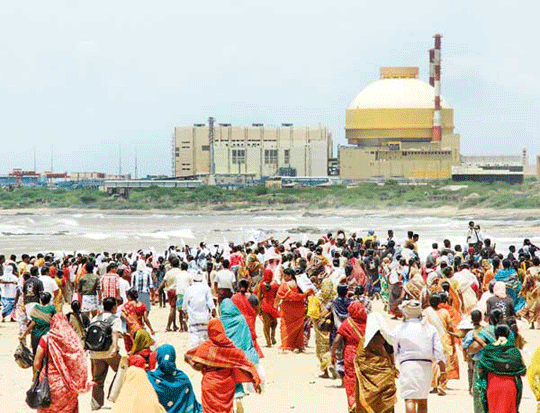
Her village lies within the 1.6km radius around one the country’s oldest nuclear reactors built by General Electric in the 1960s. It’s the same model as Japan’s Fukushima reactor. The effects of radiation are obvious in every home not only in Ghivali but also in the neighbouring villages.
At Hambire’s home, her eight-year-old nephew’s garlanded photo adorns the wall. “He died of lung cancer, but we couldn’t get his medical reports from the government heath centre. It’s hard to talk about it as his father who is employed at the plant will lose his job. None of the sick villagers get their medical papers,” she claims.
Grievances galore
Most of India’s 20 reactors are on the list of the most unreliable 50 in the world and are being monitored by the IAEA, says former navy captain Dr Buddhi Subbarao, who has a PhD in nuclear technology from IIT-B and is an advocate in the Supreme Court.
The decommissioning cost of a nuclear reactor (about $300 million-5.6 billion) is more than the cost of construction and commissioning. That’s why TAPS hasn’t been decommissioned despite the American manufacturers’ advice to the government to do so in 1995, Subbarao adds.
Ramakrishna Tandel, secretary, Maharashtra Machimar Kruti Samiti, who has led the fishermen’s community in the area for years, says, “The mangroves have dried due to the hot water released from the plant’s cooling system. We have found boiled fish 2km away from shore. The breeding patterns of the fish have also changed and our businesses have collapsed.”
“Forget listening to our grievances, they don’t even let us stand at the gate. We are sandwiched between TAPS and the sea. Earlier, we had 28 boats, and 10 families would live off each boat. Now, we have just one,” he adds. The government has proposed 14 more nuclear plants in the area.
The discharge has increased considerably after TAPS 3 and 4 started, say villagers. The adjoining sea and creek continue to bear the brunt and many species of fish have diminished completely. Chronic illnesses are on the rise, observes environmentalist Girish Raut.
All nuclear-spent fuel from India is being brought to BARC, Tarapur, for reprocessing and later, cooling, storing and intermediate burial-storage, amounting to high concentration of nuclear activity material in Tarapur. Tandel explains that NPCIL has no evacuation routes for the villagers in case of emergency, or even any medical facilities, food or a shelter plan. Also, residents of Palghar and Dahanu are also at high risk. “Hence, we are opposing the expansion of the facility and the port that Jindal is going to build here,” says Tandel.
Every fortnight, the authorities take samples of soil and water for testing from the villages in the plant’s vicinity, but the results are never shared with the inhabitants…. “Labourers and contractuals are appointed from the roadside. There is no proper health procedure. They die on the roadside after their contracts are through…. Scientist Dr V Pugazhenthi, who had conducted a survey in Chinchani village, 8km from the plant two years ago, said cases of neuroblastoma can be attributed to radiation. “Even 40km away from the plant cases of unexplained anaemia, Down’s Syndrome, tumours, high rate of abortions and miscarriages and multiple myeloma are seen. http://www.dnaindia.com/mumbai/report_when-life-is-cheaper-than-nuclear-power_1786292
No comments yet.
1 This month
7 April – WEBINAR – Australia and the Doomsday Clock – Preventing nuclear war through NoFirstUse and other policies
Online | Tuesday April 7, 4:00-5:30pm, Australian Eastern Time / 8:00-9:30am Central Europe Time
– Access the registration link
15 April – Zoom –Nuclear Power is Not the Solution
Apr 15, 2026 01:00 AM in Canberra, Melbourne, Sydney

Join the International Physicians for the Prevention of Nuclear War (IPPNW) on Tuesday, April 14th for a timely webinar exploring the risks associated with nuclear power and challenging the myth that it offers a simple, safe, carbon-free solution to the climate crisis

21 April Webinar: No Nuclear Weapons in Australia
Start: 2026-04-21 18:00:00 UTC Canberra, Melbourne, Sydney (GMT+10:00)
End: 2026-04-21 19:30:00 UTC Canberra, Melbourne, Sydney (GMT+10:00)
Event Type: Virtual
A virtual link will be communicated before the event.
Host Contact Info: australia@icanw.org

of the week – Australians for War Powers Reform (AWPR)
To see nuclear-related stories in greater depth and intensity
 Antinuclear
Leave a comment