Hotter world climate is the background to Australia’s unprecedented heat wave
‘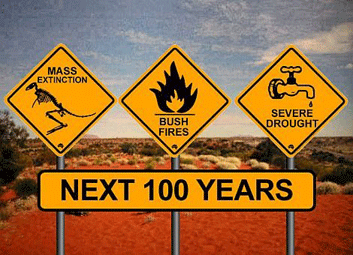 ‘Clearly, the climate system is responding to the background warming trend. Everything that happens in the climate system now is taking place on a planet which is a degree hotter than it used to be.’’As the warming trend increases over coming years, record-breaking heat will become more and more common, Dr Jones said.
While temperatures vary on a local and regional scale, globally it has
now been 27 years since the world experienced a month that was colder
than average
Get used to record-breaking heat: bureau,
http://www.theage.com.au/environment/climate-change/get-used-to-recordbreaking-heat-bureau-20130108-2cet5.html#ixzz2HXDV5Yj7
January 9, 2013 Ben Cubby Environment Editor Temperatures off the charts as Australia turns deep purple
US posts year of record high temperatures The heatwave that has scorched the nation since Christmas is a taste of things to come, with this week’s records set to tumble again and again in the coming years, climate scientists said.
The hottest average maximum temperature ever recorded across Australia – 40.33 degrees, set on Monday – may only stand for 24 hours and be eclipsed when all of Tuesday’s readings come in. Previously, thatrecord had stood since December 21, 1972.
‘The current heatwave – in terms of its duration, its intensity and its extent – is now unprecedented in our records,’’ the Bureau of Meteorology’s manager of climate monitoring and prediction, David Jones, said.
‘‘Clearly, the climate system is responding to the background warming trend. Everything that happens in the climate system now is taking place on a planet which is a degree hotter than it used to be.’’As the warming trend increases over coming years, record-breaking heat will become more and more common, Dr Jones said.
‘‘We know that global climate doesn’t respond monotonically – it does
go up and down with natural variation. That’s why some years are
hotter than others because of a range of factors. But we’re getting
many more hot records than we’re getting cold records. That’s not an
issue that is explained away by natural variation.’’
Australia’s climate is based on an interplay of many factors including
regional and local weather patterns, El Nino and La Nina climate
cycles and the Indian Ocean dipole, all superimposed on the greenhouse
gas-driven warming trend.
While temperatures vary on a local and regional scale, globally it has
now been 27 years since the world experienced a month that was colder
than average.The impacts of the rising heat on farming, food, water
and human health have been studied closely for years, and the trends
being played out now mirror those laid out years ago in projections by
the Bureau of Meteorology, the CSIRO and the Garnaut climate change
review.
They include heightened bushfire risk, rising sea levels affecting
infrastructure and houses all along the coast and, by the end of the
century, massive cuts in food production in the Murray-Darling Basin.
According to a peer-reviewed study by the Australian-based Global
Carbon Project, global average temperatures are on a trajectory to
rise a further four to six degrees by the end of this century, with
that rise felt most strongly over land areas. It would be enough to
tip Tuesday’s over-40 temperatures over much of mainland Australia
very close to 50 degrees in some parts.
“Those of us who spend our days trawling – and contributing to – the
scientific literature on climate change are becoming increasingly
gloomy about the future of human civilisation,’’ said Liz Hanna,
convener of the human health division at the Australian National
University’s Climate Change Adaptation Network.
‘‘We are well past the time of niceties, of avoiding the dire nature
of what is unfolding, and politely trying not to scare the public. The
unparalleled setting of new heat extremes is forcing the continual
upwards trending of warming predictions for the future, and the
timescale is contracting.’’
Around the world, 2013 could be the hottest ever recorded by modern
instrumentation, according to a recent study by Britain’s Met Office.
It said that, based on the rising background warming trend, 2013 will
be 0.43 degrees to 0.71 degrees hotter globally than the average
temperature between 1961 and 1990, with a ‘‘best fit’’ of 0.57 degrees
warmer.
If that turns out to be accurate, 2013 would surpass the previous
record, held jointly by 2005 and 2010.
The Met Office findings are considered telling in the climate science
community, because 2013 is set to be a relatively ‘‘neutral’’ year,
without a strong El Nino warming cycle to push temperatures up.
The Australian heatwave, which is exceptional, is a continuation of
the record-breaking temperatures seen across much of Australia since
September, according to the special climate statement issued by the
bureau on Tuesday.
The last four months of 2012 were the hottest on record, albeit by
just 0.01 of a degree. ‘‘This event is ongoing with further
significant records likely to be set,’’ the statement said.
No comments yet.
1 This month
7 April – WEBINAR – Australia and the Doomsday Clock – Preventing nuclear war through NoFirstUse and other policies
Online | Tuesday April 7, 4:00-5:30pm, Australian Eastern Time / 8:00-9:30am Central Europe Time
– Access the registration link
15 April – Zoom –Nuclear Power is Not the Solution
Apr 15, 2026 01:00 AM in Canberra, Melbourne, Sydney

Join the International Physicians for the Prevention of Nuclear War (IPPNW) on Tuesday, April 14th for a timely webinar exploring the risks associated with nuclear power and challenging the myth that it offers a simple, safe, carbon-free solution to the climate crisis

21 April Webinar: No Nuclear Weapons in Australia
Start: 2026-04-21 18:00:00 UTC Canberra, Melbourne, Sydney (GMT+10:00)
End: 2026-04-21 19:30:00 UTC Canberra, Melbourne, Sydney (GMT+10:00)
Event Type: Virtual
A virtual link will be communicated before the event.
Host Contact Info: australia@icanw.org

of the week – Australians for War Powers Reform (AWPR)
To see nuclear-related stories in greater depth and intensity
 Antinuclear
Leave a comment