Climate predictions coming true: Australia should lobby UN for action
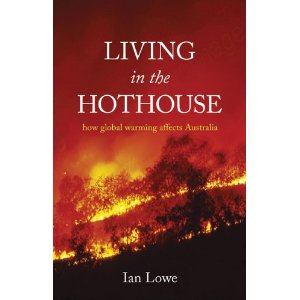 It’s happening – just like climate scientists said it would, January 14, 2013, The Age, Ian Lowe
We should use our UN position to press for urgent global action.
“…….Of course, it has always been hot in Adelaide in summer. There have been days over 40 degrees every year since we abandoned the old Fahrenheit scale that gave us more impressive readings of over 100 degrees. Tasmania is recovering from dreadful fires and the heatwave in New South Wales is producing bushfire conditions described as catastrophic. Again, there have been bad bushfire seasons in the past.
No one extreme event is by itself an indication of climate change. However, we should recognise that the overall pattern of more frequent and more severe extreme events is exactly what climate scientists have been warning about for 25 years.
When I wrote Living in the Hothouse in 2005, the publisher put a striking picture of the 2003 Canberra fires on the cover. He explained his thinking to me. The science is telling us that such events, historically happening once in 100 years, would now happen much more often. That is what global warming is doing. It is increasing the probability of extreme events such as the 2009 Victorian Black Saturday fires or the current conditions in NSW.
For decades now, the insurance industry has recognised the reality of climate change and its costs. As one executive told me at the 1997 Kyoto conference: ”We see the evidence in the red ink on our balance sheet, the result of rapidly increasing property insurance payouts.”
In 1997, most commercial sectors were in denial about climate change, as the fossil fuel industries and their political supporters still are. But those who collect hard data on the consequences of extreme events already knew what was happening.
As Australia recovers from the events of last week, we face a future of increasing average temperatures and more severe extreme events: heatwaves, bushfires, cyclones, floods. It is getting harder to accept the obfuscation and delaying tactics of the fossil fuel interests and their supporters. Some are still saying they doubt the science, even though it has been correctly predicting what would happen for 25 years.
It is a question of risk. Even if we thought there was still some doubt about the science, how much should we be prepared to gamble on the hope that it might be wrong? Nobody would get into a car if they knew there was a 90 per cent chance its brakes or steering would fail and risk their life. Few would be prepared to accept a 10 per cent chance. Even the prime minister warned people in Tasmania of the likely consequences of failing to take concerted action to slow climate change. But we don’t yet have a policy response that reflects the urgency of the situation.
We now have a modest price on releasing greenhouse gases into the atmosphere, but it should be increased to a level that would drive investment into clean energy supply technologies. We have a target of getting 20 per cent of our electricity from renewables by 2020, but we could do much more with policies to support solar and wind energy. We aim to reduce our national greenhouse gas pollution by a totally inadequate 5 per cent by 2020, whereas we should have a target that reflects the urgency of the situation. We are still exporting hundreds of millions of tonnes of coal and planning to open new large export coal mines, as if we just didn’t know that the coal will be burnt and accelerate climate change. A visitor from another galaxy would conclude that we just did not understand the risks we are taking, as if we were all too stupid to have listened to our best atmospheric scientists.
We are now on the UN Security Council, an opportunity to influence global events. As well as getting our own house in order, we should be urging the world to respond. We face a bleak future otherwise
Military exercises will go ahead on Aboriginal land, if landowners can be bribed
 the project had been frustrated by another
Aboriginal group, the Kokatha, who have objected to the land use under
heritage provisions.
It is understood the commonwealth will offer the Kokatha $2 million to
compensate them for their concerns over the land use, which if
accepted will allow the ILUA to proceed.
Warring remote clans delay expansion of military training area BY:
SARAH MARTIN : The Australian January 14, 2013
THE creation of one of Australia’s largest military training areas in
South Australia’s outback has been delayed by up to five years because
of a territorial war between two Aboriginal groups.
The Cultana training area near Port Augusta, 300km north of Adelaide,
was to be tripled in size to 1600sq km by 2009 to allow for live
firing exercises for a full battle group. The area, which resembles
the terrain of Afghan battlefields, was also intended to host training
exercises for the Army’s 7th Royal Australian Regiment Battle Group,
which relocated to the Edinburgh base in Adelaide’s north from Darwin
in 2011.
However, a delay in finalising the Indigenous Land Use Agreement for
the expansion has pushed the completion date to beyond next year. Continue reading
Fukushima; NHK Documentary “Lives Slipped Away”
Fukushima; NHK Documentary “Lives Slipped Away” http://www.youtube.com/watch?feature=player_detailpage&v=cfsevdMsfHg#t=2747s
“…”We have set a terrible precedent for the rest of the nation and for any town in the world where nuclear plants are located,” said Katsutaka Idokawa, the mayor of Futaba, one of two towns straddled by the devastated Fukushima facility. “I see this disaster as a meltdown of Japan itself.”…” (Quote from AP article below.)

MissingSky101 Duration 45 mins Jan 12, 2013
Lives Slipped Away
The 50 Patients of Futaba Hospital
In the three days after the nuclear accident, more than 200 bed-ridden elderly people were stranded at the Futaba Hospital and attached old people’s home in the town of Okuma, Fukushima Prefecture, and 50 died during the exhausting evacuation operation. Those 50 deaths have shocked hospital and care home operators across the country and posed hard new questions for Japan as a land of frequent natural disasters.
Air date 1/11/2013
How much support can medical staff provide when they become victims of disaster?
“We medical workers can’t help more patients if we don’t survive. First and foremost, our own survival is critical”.
Yasushi Kamada, NHK Reporter: What should we do to save the most vulnerable among us in the event of a disaster?
How far should we risk our lives to save others?
We may not have much time left until the next catastrophe occurs.
Recommendation to keep Australia’s Renewable Energy Target, including Small Scale Scheme
 Small-scale Renewable Energy Scheme (SRES) to be retained and improved Whilst the CCA recognises that merging the LRET with the SRES may be cost-effective, the CCA recommends keeping the two schemes separate as it considers that there are less disruptive ways of addressing concerns over costs.
Australia: Renewable Energy Target to be maintained http://www.mondaq.com/australia/x/215886/Renewables/Renewable+Energy+Target+to+be+maintained13 January 2013Article by Elisa De Wit and Florence Riviere
Following the stakeholder consultation in October 2012, the Climate Change Authority (CCA) has recently released its final report (Report) on the Renewable Energy Target (RET).
The CCA has recommended that the key elements of the RET be retained. This recommendation is based on the CCA’s view that the RET has a continuing role to play in supporting investment in renewable generation in an uncertain policy environment. Instead of challenging the existence or the substance of the RET, the Report focuses on ways to improve the RET.
No changes to key elements Continue reading
1 This month
7 April – WEBINAR – Australia and the Doomsday Clock – Preventing nuclear war through NoFirstUse and other policies
Online | Tuesday April 7, 4:00-5:30pm, Australian Eastern Time / 8:00-9:30am Central Europe Time
– Access the registration link
15 April – Zoom –Nuclear Power is Not the Solution
Apr 15, 2026 01:00 AM in Canberra, Melbourne, Sydney

Join the International Physicians for the Prevention of Nuclear War (IPPNW) on Tuesday, April 14th for a timely webinar exploring the risks associated with nuclear power and challenging the myth that it offers a simple, safe, carbon-free solution to the climate crisis

21 April Webinar: No Nuclear Weapons in Australia
Start: 2026-04-21 18:00:00 UTC Canberra, Melbourne, Sydney (GMT+10:00)
End: 2026-04-21 19:30:00 UTC Canberra, Melbourne, Sydney (GMT+10:00)
Event Type: Virtual
A virtual link will be communicated before the event.
Host Contact Info: australia@icanw.org

of the week – Australians for War Powers Reform (AWPR)
To see nuclear-related stories in greater depth and intensity
 Antinuclear