In Malawi Australian uranium company Paladin accused of poor corporate responsibility
Paladin, Malawi given 14 days to renegotiate uranium deal, by Charles Kufa, Nyasa Times, 14 Jan 13, Malawi’s opposition Peoples Transformation Party (Petra) has added its voice to the concerns raised by African Forum and Network on Debt and Development (AFRODAD) that the government of Malawi had made a bad choice of project given the absence of transparency and accountability in the deal.
PETRA president Kamuzo Chibambo tol d reporters in Blantyre on Monday that his party has given Paladin and President Joyce Banda’s administration 14 days to explain why the uranium mining deal can’t be renegotiated for the benefit of Malawians……
He demanded that the government should renegotiate for at least a 40% stake and selling rights in the next 14 days…..
He also asked the government to tell measures it has put in place to avoid pollution seeping into Lake Malawi…..
A representative of the CSOs Moses Mkandawire said “We would like paladin to declare all what it has sold. The government also should declare all what it has received from the uranium project since it started.
He said that they had also performed poorly in the area of corporate responsibility.
As CSOs he said, another deal should be made possible for the benefit of Malawians who are the real owners of the resources. http://www.nyasatimes.com/malawi/2013/01/14/paladin-malawi-govt-given-14-day-ultimatum-to-renegotiate-uranium-deal/
Queensland’s Premier Newman shows his ignorance about climate science
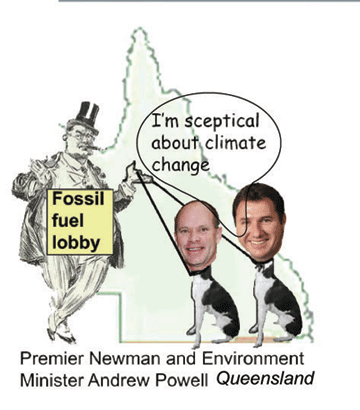 Climate change talk ‘convenient’: Newman THE AUSTRALIAN AAP January 14, 2013 Qld premier Campbell Newman (R) says it’s “convenient” to blame climate change for the bushfires. Source: AAP
THE Queensland premier says it’s “very convenient” to blame climate change for conditions that have always occurred in Australia. Campbell Newman made the comment after federal Nationals Leader Warren Truss said it was “utterly simplistic” to draw a link between climate change and Australia’s recent heatwave and bushfire crisis.
But last week, the federal government’s Climate Commission said the heatwave and bushfires had been exacerbated by global warming.
On Monday, Mr Newman was asked if he believed there was a link between the bushfires, the heatwave and climate change.
“It’s very convenient to blame things that have happened in this country for millennia on climate change,” he replied…….
“I believe we can leave to the experts to make the debate about whether that’s the case….
“The Climate Commission says climate change is making heatwaves more frequent and making it more likely they will stay for longer,” The Australian Conservation Foundation spokesman Tony Mohr said in a statement. “The same body of climate experts expects extreme fire danger days to rise more than 15 per cent in most of eastern Australia.” http://www.theaustralian.com.au/news/breaking-news/climate-change-talk-convenient-newman/story-fn3dxiwe-1226553573449
See these videos – rising sea levels – effect on Australia’s coastal cities
 (VIDEOS) Rising seas may put $300b of property at risk: scientists http://www.abc.net.au/news/2013-01-
 14/how-will-rising-seas-impact-australia/4460688 Jan 14, 2013
How is climate change expected to impact on different parts of Australia? This is the first of a five-part series in which environment reporter Sarah Clarke sets out to provide answers. Climate scientists are urging Australian authorities – and residents – to prepare for rising sea levels that could put about $300 billion worth of commercial property, infrastructure and homes at risk.
The United Nations’ chief science body will meet in Hobart tomorrow for the latest round of talks before the release of its fifth major climate paper in September.
More than three-quarters of Australians live near the ocean, and Alan Stokes from the National Sea Change Taskforce says sea-level rises will challenge many Australians’ beachfront lifestyles.
View sea-level rise maps
The Federal Government has developed a series of initial sea-level rise maps to show climate change’s potential impact in key urban areas.
You can explore maps for the following regions:
Rising sea levels are making Australia’s coastal groundwater salty
 Do you want salt with that? http://www.abc.net.au/rural/sa/content/2013/01/s3669334.htm By Nikolai Beilharz, 14 January 2013 Farmers are being warned not to draw too much fresh water out of coastal aquifers, because they could become inundated with salt water.
The National Centre for Groundwater Research and Training says that two thirds of groundwater aquifers in Australia are at moderate to high risk of saltwater intrusion.
Associate professor at Flinders University Adrian Werner, says it’s a growing problem that has the potential to get worse.

USA nuclear power plants at risk of huge floods predicted
Gundersen: US nuclear plants at risk of ‘flood of biblical proportions’? — “They’re not designed against biblical floods” (AUDIO) Nuclear Expert Arnie Gundersen, Fairewinds Energy Education: AAt the Ft. Calhoun plant [in case of an upstream dam failure] we’re looking at 35 feet more water than there was in the flood 18 months ago. […]
January 13th, 2013
Title: Repairs at Four Nuclear Reactors Are So Expensive That They Should Not Be Restarted
Source: Fairewinds Energy Education
Date: January 13, 2013
Nuclear Expert Arnie Gundersen, Fairewinds Energy Education: At the Ft. Calhoun plant [in case of an upstream dam failure] we’re looking at 35 feet more water than there was in the flood 18 months ago. […]
Dr. [Bernard] Shanks has a quote […] he said that if an upstream dam were to fail it would cause a flood of biblical proportions. These plants are not designed against biblical floods. These plants were right at their limit 2 years ago.
According to Dr. Shanks and many other geologists and hydrologists, the condition of the upstream dams is suspect.
Full program here
Cutting carbon emissions will prevent much of adverse effects of global warming
“This research helps us quantify the benefits of limiting temperature rise to 2 degrees C and underlines why it’s vital we stick with the U.N. climate change negotiations and secure a global legally binding deal by 2015,” said Edward Davey, Britain’s Secretary of State for Energy and Climate Change.
 Climate change damage can be limited by carbon cuts: study, SMH, January 14, 2013
The world could avoid much of the damaging effects of climate change this century if greenhouse gas emissions are curbed more sharply, research shows.
The study, published in the journal Nature Climate Change, is the first comprehensive assessment of the benefits of cutting emissions to keep the global temperature rise to within 2 degrees Celsius by 2100, a level which scientists say would avoid the worst effects of climate change.
It found 20 to 65 per cent of the adverse impacts by the end of this century could be avoided. Continue reading
2012 the hottest and most extreme weather year on record
The weather reports are in. 2012 was the hottest and the most extreme year on record in many places. IHT Rendezvous 14 Jan 13, While parts of China are enduring the harshest winter in 30 years, the Antarctic is warming at an alarming rate. In Australia, out of control bushfires are partially the result of record-breaking weather (new colors were added to weather forecast maps, to account for the new kind of heat). In the United States, where Hurricane Sandy devastated parts of New Jersey and New York and where extreme drought still lingers in the Midwest, the average temperature in 2012 was more than a whole degree Fahrenheit (or 5/9 of a degree Celsius) higher than average – shattering the record.
Waste of money – nuclear power research and development
 Money spent on nuclear energy is wasted http://www.mlive.com/opinion/saginaw/index.ssf/2013/01/letter_terry_t_crevia.html TERRY T. CREVIA, Jan. 14 Associated Press article “Training under way for new nuclear plant operators” shows the continued attempt to resurrect nuclear energy in the United States, despite its dismal track record of being too costly, too dangerous and inefficient.
Safety training is just one of the gaps in the nuclear energy fiasco. There are just too many problems with nuclear energy besides personnel training for it to continue to receive the tens of billions of dollars in government subsidies and additional financing for cost over-runs. Continue reading
In Western Australia it’s the battler households taking up solar panels
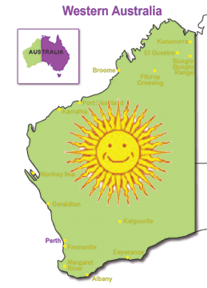 Battler Households Driving Western Australia’s Solar Uptake http://www.energymatters.com.au/index.php?main_page=news_article&article_id=3550 by Energy Matters, 15 Jan 13, In Western Australia, like elsewhere in the nation, solar power uptake isn’t being driven by the rich, but by the mortgage belt. Western Australia now boasts over 100,000 rooftop solar panel arrays across Perth and the South West.
According to The West Australian, figures provided by Synergy show the southern suburb of Canning Vale had highest number of solar panel installations (2239) as of December 19, followed by Thornlie (1513), Baldivis (1376), Willetton (1299) and Ellenbrook (1198).
None of Perth’s affluent suburbs featured in Synergy’s top 20 list of solar panel installations in Western Australia.
The results again bust the myth that solar rebates and subsidies have primarily benefited the wealthy. Western Australia’s experience has been repeated throughout the country.
In an analysis of solar energy systems installed under the Renewable Energy Target carried out last year by REC Agents Association (RAA); the Association found suburbs with the highest solar uptake were typically in the outer metropolitan mortgage belt.
The Clean Energy Council’s Solar Power Australia 2011-12 report states over half of solar households have an annual income of less that $100,000 annually and more than a quarter earn less than $65,000 a year.
Solar panel uptake is being driven primarily by ongoing and substantial electricity price rises.
According to solar provider Energy Matters, a 3kW solar power system installed in Perth will generate more than 12kWh a day on average. Based on the price of a good quality system supplied and installed by the company; the electricity produced will work out to cost under 6c per kilowatt hour over the life of the system – far cheaper than retail rates.
Households in Western Australia can also benefit from the state’s feed in tariff that pays 8 – 50c per kilowatt hour for surplus electricity exported to the mains grid, depending on location. Solar feed in tariff incentives are also available in other states; but with the price of electricity so expensive now the focus is increasingly on self-consumption.
1 This month
7 April – WEBINAR – Australia and the Doomsday Clock – Preventing nuclear war through NoFirstUse and other policies
Online | Tuesday April 7, 4:00-5:30pm, Australian Eastern Time / 8:00-9:30am Central Europe Time
– Access the registration link
15 April – Zoom –Nuclear Power is Not the Solution
Apr 15, 2026 01:00 AM in Canberra, Melbourne, Sydney

Join the International Physicians for the Prevention of Nuclear War (IPPNW) on Tuesday, April 14th for a timely webinar exploring the risks associated with nuclear power and challenging the myth that it offers a simple, safe, carbon-free solution to the climate crisis

21 April Webinar: No Nuclear Weapons in Australia
Start: 2026-04-21 18:00:00 UTC Canberra, Melbourne, Sydney (GMT+10:00)
End: 2026-04-21 19:30:00 UTC Canberra, Melbourne, Sydney (GMT+10:00)
Event Type: Virtual
A virtual link will be communicated before the event.
Host Contact Info: australia@icanw.org

of the week – Australians for War Powers Reform (AWPR)
To see nuclear-related stories in greater depth and intensity
 Antinuclear