Australian government colluded with Britain to refuse diagnosing Aboriginal Maralinga test victims

a detailed description of how nuclear authorities denied diagnosis for decades, “lost” medical records, when diagnosis of survivors was made 3 decades after the event, the event which caused the symptoms was not referenced and specifically in relation to recurrent local radiation injury to skin, which can become a chronic and cyclic event, outbreaks of symptoms recurring in cycles over decades. This is diagnosed in at least some cases, one specifically known to me, not as local radiation injury (beta burn) but as psoriasis.
It is an easy thing to deny diagnosis, as was done – affected people asked for diagnosis in 1953 and later and doctors in Australia REFUSED to give a diagnosis.
Now, in 2013, British authorities claim nothing can be proven to show it is liable for the suffering and death it visited by its actions and in concert with Australian authorities upon Aboriginal people
Aboriginal Truth Buried Under Atomic Fudge, Paul Langley’s Nuclear history Blog, 19 Jan 13 The refusal of British authorities to acknowledge that British nuclear weapon testing in Australia in the 1950s and related “minor trials” which continued into the 1960s (including some which contravened the spirit if not the bones of the LTBT) and the Operation Brumby “cleanup” which resulted in a worsened situation of contamination on Aboriginal land.
For many years a sign on the road from Maralinga to Oak Valley warned people to stay in their vehicles.
On this same land Aboriginal people hunted and hunt and gather.
A Vulcan bomber fired a loaded but disarmed nuclear missile over the Maralinga Range. The missile overshot its target, resulting in the missile disintegrating and spreading plutonium dust over a wide area off of the Range.
In the 1980s the Adelaide Advertiser reported on the discovery of plutonium in the Oak Valley school yard and buildings. The white teachers refused to work and returned to Adelaide. The people of Oak Valley had to continue to live there. Continue reading
Radiation levels more than 2500 times over limit, in Fukushima fish
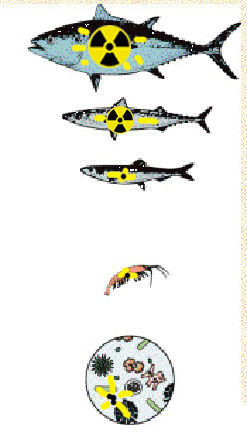 Record high radiation level found in fish http://www.news.com.au/breaking-news/world/record-high-radiation-level-found-in-fish/story-e6frfkui-1226557111874#ixzz2IRxmSfvD January 19, 2013
Tokyo Electric Power Co (TEPCO) said caesium equivalent to 254,000 becquerels per kilogram – or 2540 times more than the government seafood limit – was detected in a “murasoi” fish.
The fish, similar to rockfish, was caught at a port inside the Fukushima plant, a TEPCO spokesman said.
The Fukushima Daiichi nuclear plant was battered by a towering tsunami following a huge earthquake on March 11, 2011, causing reactor meltdowns which spewed radioactive contamination into the atmosphere.
Fishing around Fukushima was halted and the government banned beef, milk, mushrooms and vegetables from being produced in surrounding areas.
World Economic Forum (WEF) Global Risks Report 2013 – environment the basis of the economy
Reports Reiterate Link Between Environment and Economy http://www.enn.com/ecosystems/article/45486 18 Jan 13, Two new reports reiterate the scientific veracity of anthropogenic climate change while reinforcing the interconnectedness of the economy and the environment. The World Economic Forum (WEF) Global Risks Report 2013 clearly points to the interrelationship between the environment and the economy. (Diagram on left illustrates the true basis of the economy – on the right, the false basis.
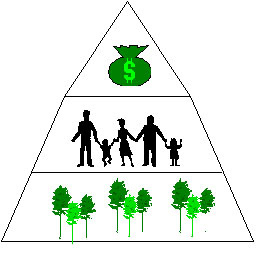
A draft of the third National Climate Assessment Report indicates that climate 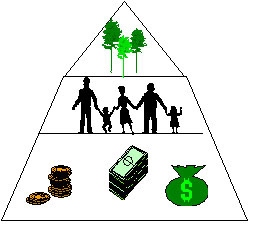 change is both an environmental and economic issue. The draft report was prepared by a federal committee and offers a comprehensive analysis of the latest and best peer-reviewed science on the extent and impacts of global warming on the US. The report restates the fact that climate change will have a wide range of impacts ranging from agriculture to water.
The draft report was prepared by a Federal Advisory Committee known as the “National Climate Assessment and Development Advisory Committee” (NCADAC). The report was mandated by Congress in 1990 with the passage of the Global Change Research Act, which requires that a national climate assessment be conducted every four years and the results be issued to the President and Congress. As a consequence of the 1990 legislation, the US Global Change Research Program was formed, which is an inter-governmental body involving 13 federal agencies and departments.
The 2013 NCADAC report, which engaged more than 240 authors, indicated that one of the salient reasons given for the rapidly changing climate is the copious burning of fossil fuels. Following two consecutive years of extreme weather, the report makes the connection between the increased incidence and severity of extreme weather and anthropogenic climate change. Continue reading
Screenzone proud to have David Bradbury’s nuclear/uranium films
 ON THE FRONTLINE: A ScreenZone interview with David Bradbury, 15 Jan 13 ScreenZone is proud to have renowned Australian documentary filmmaker David Bradbury join our catalogue, with a number of his award-winning and important films taking centre stage. Bradbury’s films have been shown on all the major Australian commercial and public broadcast networks as well as globally. He has won countless international film festival prizes and been the winner of five AFI awards and two Academy Award nominations (Frontline, which profiled war cameraman Neil Davis, and Chile: Hasta Cuando?, on the brutal military dictatorship of General Pinochet).
Currently sourcing funding for an ambitious and strategic three-part documentary showing the relationship between Australian minining, depleted uranium (DU) fallout and the Indian nuclear program, Bradbury continues to fight on the frontline, using the power of media and documentary film to show the world the truth, and empower individuals into collective action. You can help by donating via The Frontline Film Foundation: http://www.frontlinefilmfoundation.org/friend.htm a registered charity with tax deductible status that is committed to making environmentally aware and consciousness-raising films. And stay tuned for the crowdsourcing campaign in 2013 to further engage with the power of activist filmmaking via: https://www.facebook.com/FrontlineFilmFoundation http://screenzone.wordpress.com/2013/01/03/on-the-frontline-a-screenzone-interview-with-david-bradbury/
Need for vigilance regarding medical radiation
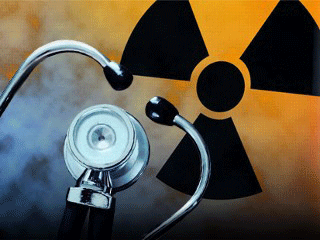 Recent evidence on the risks of very low-level radiation, Dr Ian Fairlie, January 17, 2013 ”…...2. Medical Exposures Most exposures from medical diagnostic procedures are relatively low, and although their collective doses are increasing in most developed countries, in almost all cases they are justified by their clinical benefits. Nevertheless there have been a score or so of articles in scientific journals in recent years expressing concern about the risks of increased doses from CT scans, especially to children. Even the WHO has issued a draft report expressing the need for more vigilance. Continue reading
China the major shareholder in Western Australia’s new uranium exploration company Zeus
China backs new WA uranium play Nick Sas, The West Australian January 18, 2013, China Inc has joined WA’s uranium hunt, with the State-backed China Metallurgical Geology Bureau revealed as the major shareholder in new uranium explorer Zeus Resources.
In a deal that ignores the gloom surrounding Australia’s limp initial public offering market, Zeus will hit the boards on Monday after successfully raising $13.5 million to jump-start its uranium exploration projects scattered around WA…… China National Nuclear Corporation chairman said last year it would speed up investments in overseas uranium mining exploration, with a particular focus on Australia and Africa, in order to meet the energy company’s growing demand for uranium.
In March last year China Guangdong Nuclear Power Group completed the $2.2 billion takeover of WA’s Extract Resources, which owns the Husab uranium asset in Namibia…. http://au.news.yahoo.com/thewest/business/a/-/wa/15872030/china-backs-new-wa-uranium-play/

Despite the sorry state of uranium market, Campbell Newman backing uranium for Queensland
 Uranium mining boost for north-west Queensland, says Campbell Newman,
PROEDGE Wire, January 17, 2013 by Jeff Altman
January 17, 2013 (Source: News.com.au) — Uranium mining would provide
a boost to jobs and investment in Queensland’s north west, Premier
Campbell Newman said.
Visiting the mining centre of Mt Isa, Premier Newman said the
recommencement of uranium mining would unlock opportunities.
The strategy to restart mining is currently being investigated by an
implementation panel chaired by Central Highlands councillor Paul
Bell.
Mr. Newman said Queensland’s known uranium deposits were worth about
$10 billion, of which more than $8 billion is in north-west
Queensland.
However, exports of uranium from Australia are currently less than $1
billion a year and the industry is in a state of confusion with China
forging ahead with nuclear energy but other nations questioning it….
http://proedgewire.com/green-energy-press/uranium-mining-boost-for-north-west-queensland-says-campbell-newman/
The nuclear week that was, in Australia
 Nothing changes. In the 1950s, the Australian government allowed Britain to secretly test atomic bombs in South Australia. Today, The Australian government is again allowing Britain to secretly test in South Australia its 21st Century killing machines, the Taranis military drones.
Military testing – also in SouthAustralia. The Australian govt is said to be offering Aboriginal people, the Kokatha, $2 million to stop objecting to live firing in war games on their land
Australia’s unelected politician, Foreign Minister Bob Carr, gets my 2012 prize for hypocrisy in orchestrating votes for Australia’s seat on the UN Security Council. First, bribe other countries with the promise to increase funding for overseas aid. And, arrange to sell uranium to United Arab Emirates, so they vote for Australia. Having attained the UN seat, you then withdraw the funds for overseas aid. But you still will sell uranium to UAE, and Carr even hints at later taking back their nuclear wastes.
Australian government planning new submarines: they will not be nuclear powered.
ERA gearing up to start a new mine Ranger 3 Deeps tunnel apparently not needing a full Environmental Impact Statement (EIS), despite Ranger’s long history of leaks, spills and breaches
The ugly Australians? Malawi’s opposition Peoples Transformation Party (Petra) and the African Forum and Network on Debt and Development (AFRODAD) call for a better deal for Malawi between Australian uranium miner Paladin‘s and the Malawi government. on environmental and economic grounds.
Climate change. Despite compelling evidence, endorsed by reputable science bodies worldwide, Australia’s Liberal politicians, especially Campbell Newman, and the Murdoch press, continue to promote climate denialism. The newspaper THE AUSTRALIAN is prominent in this bias, but has had to admit its recent error about sea level rise.
Australia’s future submarines will not be nuclear ones
Nuclear not an option for next generation of submarines BY:PAUL DIBB :The Australian
- January 18, 2013
LATER this year, the government will make a decision to narrow the choice for Australia’s future submarines. Contrary to opinions expressed in The Weekend Australian (“Past sub mistakes make a case for going nuclear”, January 5-6) the preferred option will certainly not be a nuclear submarine. Continue reading
France’s war in Mali: it’s really all about uranium
Although Niger has been France’s primary uranium trading partner in the region, investors are currently estimating 5,200 tonnes of untapped uranium sources in Mali, making the requirements of a favourable government and a suppressed civil society all the more urgent.
The curbs on civil liberties in the West which the so-called War on Terror forces upon citizens is part of the same struggle that activists in West Africa are fighting against uranium mining corporations
 Blood for Uranium: France’s Mali intervention has little to do with terrorism http://ceasefiremagazine.co.uk/blood-uranium-frances-mali-intervention-terrorism/ Adam Elliott-Cooper looks at the geo-strategic and economic interests shaping the current French intervention in Mali. 17 Jan 13, France opened 2013 with a series of airstrikes on Northern Mali to prevent “the establishment of a terrorist state”. At the time of writing, 11 civilians (including two children) have been killed, and according to the UN, an estimated 30,000 have been displaced. The morbid irony of the France’s leaders bombing people in order to prevent a “terrorist state” appears to be lost on them, but this may be due to their eyes being on something far more important – Mali’s economy. (Picture: Activists in Niger protesting uranium mining company AREVA)
New evidence on the health effects of very low level ionising radiation
 Taken together, the new studies indicate that our current understandings about radiation risks, especially in infants and children, may be incorrect and they may need to be revised upwards. In particular, the current adult (absolute) ICRP risk for fatal cancer of 5% per Sv and the ICRP’s use of a dose and dose-rate effectiveness factor (DDREF) look increasingly out of date.
The new studies also mean that our public radiation limits and constraints may need to be revised.
Recent evidence on the risks of very low-level radiation, Dr Ian Fairlie, January 17, 2013
“…… 4. Leukemias near Nuclear Power Stations
The final area is exposures from nuclear power stations.
Readers will be aware of my lectures showing that about 40 studies worldwide indicate increased leukemia risks among children within 5 km of nuclear power plants (NPPs). In particular, the important 2008 KiKK case-control study (discussed in Fairlie, 2009), which was commissioned by the German Government, found large increases in the risks of child leukemias and embryonal cancers near all German NPPs. This authoritative report led to geographical studies sponsored by the governments of France, UK, Switzerland and Germany. These have now been published and all four had similar findings, ie 30% to 40% increases in child leukemias near NPPs – see table from Körblein and Fairlie (2012) which contains the references to these four government studies.
Table: Studies of observed (O) and expected (E) childhood leukemias (under 5 year olds) within 5 km of NPPs
| Dataset | O | E | SIR=O/E | 90% CI | one-sided p-value |
| Germany | 34 | 24.1 | 1.41 | 1.04-1.88 | 0.0328 |
| Great Britain | 20 | 15.4 | 1.30 | 0.86-1.89 | 0.1464 |
| France | 14 | 10.2 | 1.37 | 0.83-2.15 | 0.1506 |
| Switzerland | 11 | 7.9 | 1.40 | 0.78-2.31 | 0.1711 |
| Pooled | 79 | 57.6 | 1.37 | 1.13-1.66 | 0.0042 |
The important point here is that most scientists think that radiation exposures to local residents from NPPs are extremely small. Indeed, many nuclear scientists remain in denial about the relationship between proximity to NPPs and child leukemias despite the bountiful clear evidence which exists. Yet the evidence of child leukemias near NPPs fits well with the evidence emerging from background radiation and medical radiation. Continue reading
Murdoch press – THE AUSTRALIAN – caught out on climate change error
 The Australian corrects the record on climate change Crikey, CATHY ALEXANDER | JAN 17, 2013
The national broadsheet has issued a correction for a recent story which claimed rising sea levels were “not linked to warming”. Read what was in the story, and what was wrong with it, here.
The Australian has issued a rare correction on climate change, for a story which claimed rising sea levels were “not linked to warming”.
The story, which appeared under an “exclusive” tag on Tuesday and was written by environment editor Graham Lloyd, was based on a recent scientific paper in the Journal of Climate. Lloyd wrote that “the latest science on sea level rises has found no link to global warming”.
Crikey read the research paper, looked into Lloyd’s three articles on the subject, and highlighted inaccuracies in the way the research was presented(read Crikey’s stories here and here). A correction appeared in The Australiantoday, and the original story has been taken down….
The Australian has been criticised in the past for running stories which some perceive as misrepresenting the science on anthropogenic climate change, but it has rarely issued corrections on its climate change stories.http://www.crikey.com.au/2013/01/17/the-australian-corrects-the-record-on-climate-change/
Mining companies turn to solar power, to cut costs
perhaps the most important news from an Australian perspective has been the move by mining companies to adopt solar technologies to reduce their dependence on fossil fuels, particularly diesel, and to keep a lid on their soaring energy costs.
The development of off-grid solar projects, particularly with remote and mining communities, is expected to be a central theme of the newly established Australian Renewable Energy Agency
a “huge opportunity” in the replacement of expensive diesel, both in remote and off-grid areas, and the fringe-of-grid areas
 Miners embrace solar power – as a cost saving measure REneweconomy, By Giles Parkinson 18 January 2013 The New Year is barely more than two weeks old, and already solar is grabbing headlines: China has confirmed it expects to install 10GW of solar in 2013, a development that would take its total installed capacity close to 50GW by 2015, and well beyond the most optimistic forecasts of 100GW by 2020 if the growth rate continues to expand.
Elsewhere, the Middle East expects to intall 3GW of solar by 2015, the state of New York has announced a$1.5 billion extension to its solar program, France doubled its solar targets to 1GW, India is about to tender 1GW of projects, Warren Buffett has invested another $2.5 billion in solar projects, Italy and Spain have set new solar generation records, and Germany increased its solar production by 45 per cent after adding another 7.3GW of capacity. Continue reading
Even so called “harmless background radiation” shown to be, in fact, harmful
Recent evidence on the risks of very low-level radiation, Dr Ian Fairlie, January 17, 2013“…….I’ve previously shown that a great deal of evidence supports the LNT hypothesis and indicates radiation effects well below 100 mSv.
But in recent months, a flurry of epidemiological studies go further than merely refuting ill-informed articles. They indicate adverse effects to people exposed to very low doses from medical CT scans and other clinical procedures; to infants living near nuclear power stations; and to Chernobyl clean-up workers. They even reveal adverse effects from background radiation to which all of us are exposed.
Together they reveal a pattern of higher-than-expected risks from very low exposures to radiation.
1. Background Radiation
Perhaps the most eye-opening of the recent studies concern background radiation. Most people think that background radiation levels (typically 2 to 3 mSv per year) are very low and are of little concern. But recent authoritative studies clearly indicate that background radiation is not harmless. Continue reading
Australia’s potential for concentrated thermal solar power
 Around 40% of Australian renewable energy could be generated by wind farms but the real key to success would be the enormous empty landscape of the interior with the high levels of solar power it receives.
An example of suitable technology is the Gemasolar power station in Spain which is a 19.9MW plant expected to generate 110 GWh per year. The plant’s molten storage tank allows for independent electrical generation for up to 15 hours. Although solar power in Australia could be produced from solar PV arrays on buildings, most of the country’s solar power could come from concentrated solar power (CSP) plants similar to that in Spain.
A 100% renewable energy grid could create at least 80,000 jobs during construction and 45,000 in operation. 30,000 jobs would also be created in manufacturing assuming half the plant was made in Australia itself.
Australia could be self-sufficient in renewable energy within 10 years http://www.renewableenergymagazine.com/article/australia-could-be-selfsufficient-in-renewable-energy-20130117 Robin Whitlock, 17 January 2013 A new report published by the Energy Research Institute of the University of Melbourne finds that existing renewable energy could wean the country off fossil fuels
Australia is currently the world’s largest exporter of coal and also has one of the highest global greenhouse gas emissions rates per capita. The country has, until fairly recently, been particularly obstinate in its resistance to tackling climate change. The University of Melbourne report says that with the right political will Australia’s enormous renewable potential could be harnessed within a decade, creating thousands of new jobs and making the country carbon neutral. Continue reading
1 This month
Chernobyl: The Lost Tapes – A good documentary on Chernobyl on SBS available On Demand for the next 3 weeks– https://www.sbs.com.au/ondemand/tv-program/chernobyl-the-lost-tapes/2352741955560
15 April – Zoom –Nuclear Power is Not the Solution
Apr 15, 2026 01:00 AM in Canberra, Melbourne, Sydney

Join the International Physicians for the Prevention of Nuclear War (IPPNW) on Tuesday, April 14th for a timely webinar exploring the risks associated with nuclear power and challenging the myth that it offers a simple, safe, carbon-free solution to the climate crisis

21 April Webinar: No Nuclear Weapons in Australia
Start: 2026-04-21 18:00:00 UTC Canberra, Melbourne, Sydney (GMT+10:00)
End: 2026-04-21 19:30:00 UTC Canberra, Melbourne, Sydney (GMT+10:00)
Event Type: Virtual
A virtual link will be communicated before the event.
Host Contact Info: australia@icanw.org

of the week – Australians for War Powers Reform (AWPR)
To see nuclear-related stories in greater depth and intensity
 Antinuclear