Michael Anderson on Aboriginal people and Australia’s lack of democracy
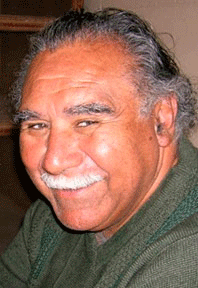 They are welfare dependent and have to accept loss of income if they don’t bow to the rules of the government. That happens while they make billions and billions from mining on Aboriginal land. Just look at the Northern Territory, where most Aboriginals live, and its special conditions as federal territory. It is the only place in the world where a state directly operates an industry to gain communal assets, often without even allowing negotiations with Aboriginal locals. Democracy does not apply to Aboriginal people,
‘Democracy does not apply to Aboriginal people’, New Internationalist,
22 Jan 13, This year’s Australia Day, one of the world’s longest
occupation protests turns 40. Activists of the Aboriginal Tent Embassy
in Canberra have been fighting for acknowledgement, sovereignty and
self-determination of their peoples ever since.
Michael Anderson, Aboriginal rights activist and former ambassador of the Embassy, talks to Christoph Behrends about past and current struggles – and the offering of a peace pact.
Question: Michael, you’ve been one of the initiators of the Aboriginal Tent Embassy that has been residing in front of the Old Parliament House for 40 years. What comes to your mind when you think about 27 January 1972?
If you go back in history, there have been a lot of wars fought within this country. But Australia suppresses these facts This day is still very clear in my mind. The day before, the Prime Minister stated they would lease land to Aboriginal and Torres Strait Islander peoples instead of giving us land rights. As a consequence, we decided to put up a permanent camp in Canberra. Within our discussions we became aware that we need a political entity, an embassy, to gain sovereignty. It was a period of not knowing what the future would bring, but knowing what we wanted…..
Question: In 1995 the National Heritage Trust listed the Aboriginal Tent Embassy as the ‘only location that represents Aboriginal Peoples in their political struggle’. Was that occasion important for the movement? It was important that they recognized that we have a legitimation, and it also symbolized a milestone in Aboriginal affairs in Australia’s history……
Socially our people are totally demoralized. Continue reading
Chief Executive Officer of the Gandangara Land Council, Jack Johnson, against NSW Land Council
Jack Johnson lashes NSW Land Council National Indigenous Times, 23
Jan 13 The New South Wales Aboriginal Land Council (NSWALC) has
recommended a consultancy firm allegedly linked to the New South Wales
Labor Party mining corruption scandal and also linked to an Aboriginal
death in custody be appointed by the New South Wales Government to
investigate Gandangara Local Aboriginal Land Council.
Chief Executive Officer of the Gandangara Land Council, Jack Johnson
has made the claim… (subscription only)
http://www.nit.com.au/news/2331-jack-johnson-lashes-nsw-land-council.html
Chairman of Mutawintji land council opposes uranium mining in Western New South Wales
 NSW prospectors await uranium riches, 21 JAN 2013,
BILL CODE, SBS“…….There’s no doubt that talk on uranium
mining in western NSW is still in its very early stages.
But in the area, there are some traditional owners of the land who are
far from convinced of its benefits.
Wilcannia lies on the banks of the Darling River east of Broken Hill.
These days, many traditional owners from Western NSW live here.
One of them is William Bates, a man who fought against uranium mining
in South Australia in the early 1980s.
He’s the chair of Broken Hill’s neighbouring Mutawintji land council.
Because of the nascent stage of development, whether there’s uranium
under that arid piece of NSW taken up by the indigenous-run national
park is not certain, but he is sure the prospectors will come knocking
sooner or later.
‘I’m against it because it’s not safe, mining companies are always
stuffing up’ he says when I pull up in Wilcannia on a scorching
afternoon. ‘They might have an accident.’…
Australia’s Foreign Minister in denial on India’s non-proliferation record – Greens
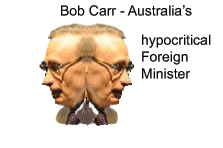 Australian Greens spokesperson for nuclear policy Senator for Western Australia Scott Ludlam. 22 January 2013 Foreign Minister Bob Carr’s defence of India’s non-proliferation record defies belief as well as history the Australian Greens said today.
“It is ridiculous for Bob Carr to defend India’s non-proliferation record when India produced plutonium for weapons in 1974 from a Canadian-supplied reactor it pledged to use only for ‘peaceful purposes’.
“The Foreign Minister has forgotten that Australia played a leading in role in establishing the Nuclear Supplies Group in direct response to this duplicity.
“The Foreign Minister has also forgotten that K. Subrahmanyam, former head of the national security advisory board in 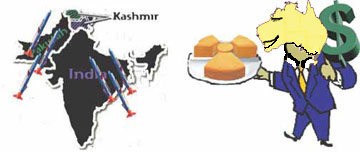 India, said in 2005: ‘Given India’s uranium ore crunch and the need to build up our … nuclear deterrent arsenal as fast as possible, it is to India’s advantage to categorise as many power reactors as possible as civilian ones to be refuelled by imported uranium and conserve our native uranium fuel for weapons-grade plutonium production’. Clearly, Australian uranium would boost India’s nuclear weapons capacity.
“Rather than a fine non-proliferation record, India has a history of illicit nuclear procurement, has inadequate nuclear export controls, does not allow IAEA inspections of all of its nuclear plants, refuses to sign the Comprehensive Test Ban Treaty, continues to expand its nuclear arsenal and missile capabilities, and actively contributes to the sub-continent being host to the most precarious nuclear stand-off in the world.
“India is also dangerous for peaceful anti-nuclear protesters, five of whom have been murdered since 2010 in the struggles against the nuclear industry in Koodankulam (Tamil Nadu), Jaitapur (Maharashtra) and Gorakhpur (Haryana).
“By pouring uranium into this country, Australia would fuel regional nuclear dangers and encourage an industry that India’s own Auditor General has strongly condemned, given there is no national policy on nuclear and radiation safety and that supervision of licensing, registration of nuclear radiating machines and sites, inspections, monitoring, policy development and safety standards, emergency response and verification of the disposal of nuclear waste are all sub-standard.
“Australia selling uranium to India is also a violation of the 1995 NPT Review and Extension Conference commitment to require full-scope safeguards as a condition of supply, and of our obligations under Article IV of the Treaty of Rarotonga which obliges signatories to not supply equipment or material to countries no under full scope safeguards. India is not under full scope safeguards.
“Given these facts on the ground, any uranium deal Australia does with India would be a reckless denial of safety, security and regulatory problems. The Foreign Minister is in denial if he thinks all is well in India, or that the Joint Standing Committee on Treaties will simply rubber stamp an agreement that overturns long-held Australian nuclear policy.”
1 This month
Chernobyl: The Lost Tapes – A good documentary on Chernobyl on SBS available On Demand for the next 3 weeks– https://www.sbs.com.au/ondemand/tv-program/chernobyl-the-lost-tapes/2352741955560
15 April – Zoom –Nuclear Power is Not the Solution
Apr 15, 2026 01:00 AM in Canberra, Melbourne, Sydney

Join the International Physicians for the Prevention of Nuclear War (IPPNW) on Tuesday, April 14th for a timely webinar exploring the risks associated with nuclear power and challenging the myth that it offers a simple, safe, carbon-free solution to the climate crisis

21 April Webinar: No Nuclear Weapons in Australia
Start: 2026-04-21 18:00:00 UTC Canberra, Melbourne, Sydney (GMT+10:00)
End: 2026-04-21 19:30:00 UTC Canberra, Melbourne, Sydney (GMT+10:00)
Event Type: Virtual
A virtual link will be communicated before the event.
Host Contact Info: australia@icanw.org

of the week – Australians for War Powers Reform (AWPR)
To see nuclear-related stories in greater depth and intensity
 Antinuclear