Will USA go ahead re-licensing nuclear reactors, while awaiting new Waste Confidence Rule?
The court disapproved of the NRC’s continued relicensing of nuclear facilities based on the assumption of a long-term geologic repository that in reality did not exist – and the NRC said it was suspending licensing pending a new rule – but now regulators say they don’t anticipate the denial or even the delay of any reactor license application while they await the new waste confidence decision [PDF, pp. 49-50].
In fact, the NRC has continued the review process on pending applications, even though there is now no working Nuclear Waste Confidence Decision (NWCD) – something deemed essential by the courts – against which to evaluate new licenses.
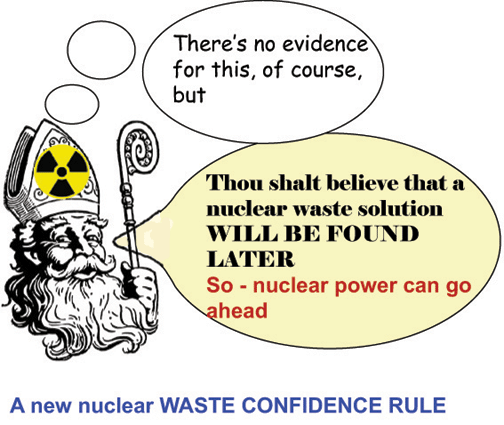
The NRC is looking for a way to permit the continued operation of the US nuclear fleet – and so, the continued manufacture of nuclear waste – without an answer to the bigger, pressing question
 Seventy Years of Nuclear Fission, Thousands of Centuries of Nuclear Waste ,25 January 2013 By Gregg Levine, Truthout Lack of Permanent Spent Fuel Storage Looms Large
“……….When a US Court of Appeals ruled in June that the Nuclear Regulatory Commission (NRC) acted improperly when it failed to consider all the risks of storing spent radioactive fuel onsite at the nation’s nuclear power facilities, it made specific reference to the lack of any real answers to the generations-old question of waste storage:
[The Nuclear Regulatory Commission] apparently has no long-term plan other than hoping for a geologic repository…. If the government continues to fail in its quest to establish one, then SNF (spent nuclear fuel) will seemingly be stored on site at nuclear plants on a permanent basis. The Commission can and must assess the potential environmental effects of such a failure.
The court concluded the current situation – in which spent fuel is stored across the country in what were supposed to be temporary configurations-“poses a dangerous long-term health and environmental risk.”
The decision also harshly criticized regulators for evaluating plant relicensing with the assumption that spent nuclear fuel would be moved to a central long-term waste repository.
A Mountain of Risks
The Nuclear Waste Policy Act set in motion an elaborate process that was supposed to give the US a number of possible waste sites, but, in the end, the only option seriously explored was the Yucca Mountain site in Nevada. After years of preliminary construction and tens of millions of dollars spent, Yucca was determined to be a bad choice for the waste. As I wrote in April of last year: “[Yucca Mountain’s] volcanic formation is more porous and less isolated than originally believed – there is evidence that water can seep in, there are seismic concerns, worries about the possibility of new volcanic activity, and a disturbing proximity to underground aquifers. In addition, Yucca mountain has deep spiritual significance for the Shoshone and Paiute peoples.”
Every major Nevada politician on both sides of the aisle has opposed the Yucca repository since its inception. Senate Majority Leader Harry Reid has worked most of his political life to block the facility. And with the previous NRC head, Gregory Jaczko, (and now his replacement, Allison Macfarlane, as well) recommending against it, the Obama administration’s DOE moved to end the project.
Even if it were an active option, Yucca Mountain would still be many years and maybe as much as $100 million away from completion. And yet, the nuclear industry (through recipients of its largesse in Congress) has challenged the administration to spend any remaining money in a desperate attempt to keep alive the fantasy of a solution to their waste crisis.
Such fevered dreams, however, do not qualify as an actual plan, according to the courts.
The judges also chastised the NRC for its generic assessment of spent fuel pools, currently packed well beyond their projected capacity at nuclear plants across the United States. Rather than examine each facility and the potential risks specific to its particular storage situation, the NRC had only evaluated the safety risks of onsite storage by looking at a composite of past events. The court ruled that the NRC must appraise each plant individually and account for potential future dangers. Those dangers include leaks, loss of coolant, and failures in the cooling systems, any of which might result in contamination of surrounding areas, overheating and melting of stored rods, and the potential of burning radioactive fuel – risks heightened by the large amounts of fuel now densely packed in the storage pools and underscored by the ongoing disaster at Japan’s Fukushima Daiichi plant.
Indeed, plants were neither designed nor built to house nuclear waste long-term. The design life of most reactors in the United States was originally 40 years. Discussions of the spent fuel pools usually gave them a 60-year lifespan. That limit seemed to double almost magically as nuclear operators fought to postpone the expense of moving cooler fuel to dry casks and of the final decommissioning of retired reactors……..
The court disapproved of the NRC’s continued relicensing of nuclear facilities based on the assumption of a long-term geologic repository that in reality did not exist – and the NRC said it was suspending licensing pending a new rule – but now regulators say they don’t anticipate the denial or even the delay of any reactor license application while they await the new waste confidence decision [PDF, pp. 49-50].
In fact, the NRC has continued the review process on pending applications, even though there is now no working Nuclear Waste Confidence Decision (NWCD) – something deemed essential by the courts – against which to evaluate new licenses.
The period for public comment on the scope of the waste confidence decision ended January 2, and no more scoping hearings are planned. There will be other periods for civic involvement – during the environmental impact survey and rulemaking phases – but with each step, the areas open to input diminish. And the current schedule has the entire process greatly accelerated over previous revisions.
On January 3, a coalition of 24 grassroots environmental groups filed documents with the NRC [PDF] protesting “the ‘hurry up’ two-year timeframe” for this assessment, noting the time allotted for environmental review falls far short of the 2019 estimate set by the NRC’s own technical staff. The coalition observed that two years was also not enough time to integrate post-Fukushima recommendations, and that the NRC was narrowing the scope of the decision – ignoring specific instructions from the appeals court – in order to accelerate the drafting of a new waste-storage rule.
Speed might seem a valuable asset if the NRC were shepherding a Manhattan Project-style push for a solution to the ever-growing waste problem – the one that began with the original Manhattan Project – but that is not what is at work here. Instead, the NRC, under court order, is trying to set the rules for determining the risk of all that high-level radioactive waste if there is no new, feasible solution. The NRC is looking for a way to permit the continued operation of the US nuclear fleet – and so, the continued manufacture of nuclear waste – without an answer to the bigger, pressing question…… http://truth-out.org/news/item/14065-seventy-years-of-nuclear-fission-thousands-of-centuries-of-nuclear-waste
1 Comment »
Leave a comment
1 This month

of the week – Australians for War Powers Reform (AWPR)
To see nuclear-related stories in greater depth and intensity
 Antinuclear
http://www.forbes.com/sites/jeffmcmahon/2013/01/28/deferring-recycling-u-s-to-bury-almost-all-existing-nuclear-waste/
28th Jan 2013
In a study completed late last year, Oak Ridge officials determined that the U.S. is at least 20 years away from large-scale reprocessing of used nuclear fuel, if it decides to pursue such technologies. By then, they estimate, nuclear plants will have generated another 40,000 metric tons of spent fuel.
“Based on the technical assessment, about 68,450 (metric tons) or about 98 percent of the total current inventory by mass, can proceed to permanent disposal without the need to ensure retrievability for reuse or research purposes,” Oak Ridge officials conclude in a report issued late last year.
LikeLike