In depth look at plan for Ranger 3 Deeps Underground Mine- submission from Environment Centre Northern Territory
 A case in
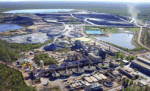
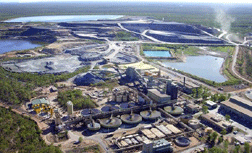
 point is the estimated one billion litres of tailings water that ERA and CSIRO believe now sits in a
growing plume underneath the Tailings Storage Facility. The water is highly contaminated process
water. A full EIS is required to examine the legal requirement for ERA to remove the plume and
treat the area to a state consistent with the World Heritage values immediately adjacent to the
mine to allow the project area to be incorporated back into Kakadu.
Submission to Ranger 3 Deeps Project underground uranium mine referral
Energy Resources of Australia Ltd/Mining/at existing Ranger uranium mine in Alligator
Rivers Region/NT/Ranger 3 Deeps Underground Mine
Reference Number: 2013/6722
31 January 2013
Prepared by
 Stuart Blanch, Director, Environment Centre NT, Darwin, coordinator@ecnt.org / 0448 887 303.
The Environment Centre NT welcomes the opportunity to provide comment on the referral.
We make the following comments:
1. The Ranger 3 Deeps Project is proposed by Energy Resources of Australia (ERA) to be built inside
the World Heritage listed Kakadu National Park and surrounding internationally recognised
Ramsar wetlands of the Alligators Rivers Region. By its very nature is is a highly risky project over
the long term, given the need to manage radioactive contamination for thousands of years. The
Ranger Uranium Mine has already created very substantial long term waste management issues
over the past three decades of operation, and remains a highly controversial project in the eyes
of many Territorians and Australians.
The proposed mine is a nuclear action under the Environment Protection and Biodiversity
Conservation Act (Cth) (EPBCA). However it also poses a risk to various other Matters of National
Environmental Significance including 14 threatened species, 20 migratory species and a National
Heritage Place. ERA’s view that only one MNES, namely nuclear actions, are likely to be impacted
is fanciful and disingenuous (p81). Clearly the existing water management issues caused by three
decades of mining, let alone an even larger process water inventory, pose a significant risk to
downstream Ramsar wetlands and World Heritage values should there be an uncontrolled
discharge into Magela Creek or ongoing lateral spread of the groundwater plume underneath the
tailings dam.
Full EIS’s are regularly conducted under the EPBCA for mines that entail much less risk to species,
places and values which are legally recognised under federal environmental law and attract
protection under international agreements.
2. Underground mining at Ranger has never been subject to an EIS, and was not addressed in the
Fox Inquiry. Accordingly, the first assessment of underground mining at the site warrants a high level of assessment.
3. The proposal should be assessed through an Environmental Impact Statement rather than a
Public Environmental Review. A full EIS is necessary to address the complex nature of the project,
the significant risks to Matters of National Environmental Significance, and the need to
undertake substantial community consultation.
4. Piecemeal assessment of projects to avoid an appropriate level of regulatory scrutiny
undermines the intended role of environmental assessment under the EPBCA. We note ERA’s
failure to publicly commit to undertaking a full EIS, which stands in stark contrast to other miners
proposing less risky ventures in the Territory. This indicates a lack of commitment to proper
environmental practice, and goes to the character of the company. ERA should not be allowed to
undermine the environmental assessment process in an attempt to gain a quick approval,
downplay risks, and avoid scrutiny.
5. We regret that the Ranger 3 Deeps Exploration Decline was not required to be subjected to an
EIS, or even a PER, in 2011. In our view the significant degree to which the proposed Ranger 3
Deeps project relies on the decline substantiates our previous assessment that the decline was
the de facto commencement of a mining operation, and should have been assessed as a
controlled action. It was clearly part of a larger action that warranted thorough environmental
assessment. The failure to assess the decline to be a controlled action elevates the importance of
the Ranger 3 Deeps project to be subject to a full EIS.
6. We are not convinced ERA can complete mining Ranger 3 Deeps by January 2021, as required
under the current section 41 Authority. The resource is likely to be much larger than 34,000
tonnes of uranium oxide, which alone will be a very significant challenge to mine and process
within the timeframe. ERA has publicly stated its desire to continue mining on the Ranger lease
post 2021. We expect ERA to exert significant pressure on regulators and Mirarr Traditional
Owners to obtain a new Authority to extend the life of the mine beyond 2021, should the Ranger
3 Deeps project proceed and be profitable. This makes it imperative that the project be subject
to a very thorough and well consulted EIS.
7. The Ranger Uranium Mine has a very long history of spills, leakage, and infrastructure failure.
The Environment Centre NT disputes ERA’s claim it has a satisfactory record of environmental
management (p81). Merely listing the relevant compliance and regulatory regimes does not
constitute a record of good management. ERA rightly acknowledge that their reporting
requirements are comprehensive, and they have in the past reframed the long list of
environmental incidents diligently recorded by regulators as evidence of the level of monitoring
and reporting the mine is subject to. It is true that the threshold of recording identified incidents
is low, so it is therefore useful to have a number of selective surveys of ERAs extensive history of
environmental incidents. The 1996 SSCUMM Inquiry (Senate Select Committee on Uranium
Mining and Milling) noted dozens of infringements of Ranger’s Environmental Requirements
(Appendix 2.9). Appendix 6 of the 2003 report from the Senate Environment, Communications,
Information Technology and the Arts Standing Committee’s ‘Inquiry into Environmental
Regulation of Uranium Mining’ compiled incidents recorded in sources including the OSS annual
reports and bi-annual reports to ARRAC; ERA’s annual environmental management reports; the
Jabiluka EIS; and the Ranger Tailings Corridor review, conducted by SKM in 2000, commissioned
by OSS.
The report of October 2003 of the Senate Inquiry into the regulation of uranium mining
concluded that “changes in were necessary in order to protect the environment and its
inhabitants from .serious or irreversible damage” (p ix). In relation to the quality of regulatory
oversight the Inquiry stated “The Office of the Supervising Scientist (now the Supervising Scientist
Division or SSD) argued that the fact that there have been no prosecutions of Energy Resources of
Australia Ltd (ERA) was proof of the success of the regulatory framework. Given the more than
110 incidents at Ranger and numerous breaches of Environmental Requirements, the Committee
considers this logic to be flawed” (p x).
More recently, the 2005 House Committee on Industry and Resources Inquiry into the
development of non-fossil fuel energy industries in Australia received a submission from the
Gundjeihmi Aboriginal Corporation, which included a selection of the more significant of the 196
incidents which had been reported to that point.
8. Under the initial authorisation for Ranger Uranium Mine, the Ranger Project Area must be
rehabilitated to a fit state for re-incorporation of the lease into Kakadu. Although ERA, through
their operations, and the regulators, through their monitoring priorities, often seem to treat the
project area as a sacrifice zone, this was certainly not the attitude in which the initial
authorisation was granted. This is certainly not the view or the expectation of community
environment organisations, key stakeholders and the wider community. Neither is this
perspective supported by the Commonwealth’s Environmental Requirements as specified in the
Authorisation. Should Ranger 3 Deeps proceed, this would make rehabilitation even more
challenging, particularly should the mine not be allowed to extend operations beyond 2021. ERA
has not publicly released a mine rehabilitation plan and key associated documents (eg cf
Hollingsworth and Meek, 2003, regarding landform reconstruction post-mine closure, listed on
page 84 of the referral), and fails to explain in the referral document how it intends to
rehabilitate the project area by 2026 in the event that Ranger 3 Deeps is approved. A case in
point is the estimated one billion litres of tailings water that ERA and CSIRO believe now sits in a
growing plume underneath the Tailings Storage Facility. The water is highly contaminated process
water. A full EIS is required to examine the legal requirement for ERA to remove the plume and
treat the area to a state consistent with the World Heritage values immediately adjacent to the
mine to allow the project area to be incorporated back into Kakadu.
February 1, 2013 -
Posted by Christina Macpherson |
environment, Northern Territory, politics, uranium
No comments yet.
 A case in
  Stuart Blanch, Director, Environment Centre NT, Darwin, coordinator@ecnt.org / 0448 887 303.
 Antinuclear
Leave a comment