Something Australia can be proud of – beautiful Koongarra preserved from uranium mining
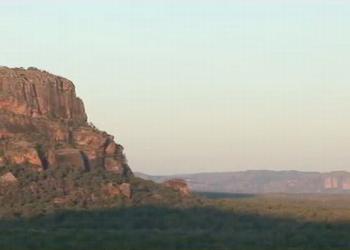 Australia Places Aboriginal Land in Park to Bar Uranium Mining http://ens-newswire.com/2013/02/07/australia-places-aboriginal-land-in-park-to-bar-uranium-mining/ CANBERRA, Australia, February 7, 2013 – After 34 years of campaigning to keep uranium mining out of his ancestral land of Koongarra, Djok Senior Traditional Owner Jeffrey Lee sat in the House of Representatives Wednesday to watch this land be protected forever.
Environment Minister Tony Burke introduced a bill to repeal the Koongarra Project Area Act – a 1979 law excluding Koongarra from the original boundaries of Kakadu National Park because of its potential to be the site for a uranium mine.
“In 2010, the Government promised Mr. Lee that we would incorporate Koongarra into Kakadu National Park, to ensure that the threat of mining was banished forever,” Burke said. Koongarra is an area of native woodland of great environmental and cultural significance, now incorporated within the boundaries of Kakadu National Park. Kakadu is located within the Alligator Rivers Region of the Northern Territory of Australia, 171 kilometers southeast of the territorial capital, Darwin.
The Koongarra uranium deposit is estimated at about 14,000 tonnes. Mining companies, most recently the French company AREVA, have been trying to mine the deposit for decades despite the opposition of traditional owners. Continue reading
President Obama’s feet of clay: his murderous drone operations above the law
Mr. Obama has argued that he can kill Americans whose deaths he believes will keep us all safer, without any due process whatsoever. No law authorizes that.
Did you consent to a government that can kill whom it wishes?

 NAPOLITANO: Obama demands unquestioning acceptance of his ability to kill http://www.washingtontimes.com/news/2013/feb/7/obama-demands-unquestioning-acceptance-of-his-
 abil/#ixzz2KLwwpcgK By Andrew P. Napolitano , February 7, 2013 Drone strikes are legal, but the research is confidential Earlier this week, the government sent a summary of its legal memos on presidential use of drones to kill persons overseas — even Americans — to an NBC newsroom. This was done after more than a year of stonewalling federal judges and ordinary citizens who sought the revelation of the government’s secret legal research justifying the president’s use of drones. The administration claimed the research was so sensitive and so secret that it could not be revealed without serious consequences.
This revelation will come as a great surprise, and not a little annoyance, to U.S. District Court Judge Colleen McMahon, who heard many hours of oral argument during which the government predicted gloom and doom if its legal research were subjected to public scrutiny. She very reluctantly agreed with the feds, but told them she felt caught in “a veritable Catch-22,” because the feds have created “a thicket of laws and precedents that effectively allow the executive branch of our government to proclaim as perfectly lawful certain actions that seem on their face incompatible with our Constitution and laws, while keeping the reasons for their conclusion a secret.”
She was writing about President Obama killing Americans and refusing to divulge the legal basis for claiming the right to do so. Now we know that basis.
The undated and unsigned 16-page document leaked to NBC refers to itself as a Department of Justice white paper. Its logic is flawed, its premises are bereft of any appreciation for the values of the Declaration of Independence and the supremacy of the Constitution, and its rationale could be used to justify any breaking of any law by any “informed, high-level official of the U.S. government.” Continue reading
The frightening ignorance of Australia’s Liberal/National Party about the science of climate change
 It would be tempting to think that this was just Barnaby Joyce, and attacking renewables with his incoherent gusto would have been laughable – were it not for the fact that he will be a senior minister in an Abbott government, and that his views are shared by the likes of Abbott, finance spokesman Andrew Robb, treasurer in waiting Joe Hockey, and the energy spokesman Ian Macfarlane – and dozens of others.
the Coalition continues to speak from a position of ignorance – or possible from regulatory capture from the industry incumbents.
Barnaby Joyce’s renewables target: 100% ignorance REneweconomy, By Giles Parkinson 7 February 2013 We are barely a week into this seven-and-a-half month election campaign, and it is already clear that the “alternative” government of Tony Abbott is out on a seek and destroy mission on any policy that might serve to promote the development of renewable energy, in particular those emerging renewables that will seal the fate of the incumbent coal generators.
First it was the promise to repeal the carbon price, then the ambiguity over the renewable energy target, and then the attempt to neuter the Clean Energy Finance Corporation even before it was up and running. Then they unleashed Barnaby Joyce in The Senate.
“What is this insane lemming-like desire to go to renewables going to do to our economy?” Joyce told the Senate, before veering off into a rant about wind farms in every back garden, how they were expensive, didn’t work half the time, and will never replace coal, gas, hydro or nuclear.
Again, he betrayed the reason for his antipathy to renewables – the climate, he said, had barely changed despite the introduction of the carbon price six months ago – repeating the idiotic statement made by Tony Abbott in his first address of the year. Continue reading
Event – Melbourne Reflections of a Fukushima Farmer- the reality of nuclear meltdowns
 1:00 – 2.30 pm Saturday 9th of March Melbourne
Australia – ”Nobody in their right mind would be building coal-fired power plants now,”
Australia unlikely to build new coal-power stations http://www.theage.com.au/business/australia-unlikely-to-build-new-coalpower-stations-20130207-2e1c3.html#ixzz2KLzJlLdC February 8, 2013 Peter Hannam AUSTRALIA is unlikely to build new coal-fired power stations because of tumbling prices for renewable energy and the rising cost of finance for emission-intensive fuels, according to research by Bloomberg New Energy Finance.
Even without a carbon price, wind energy is now 14 per cent cheaper than a new baseload coal-fired power station and 18 per cent cheaper than a new gas one, Bloomberg New Energy Finance said.
The gap widens further when the carbon tax is added. Wind farms can now generate electricity at $80 per megawatt hour, compared with $143 per MWh for a new coal power station and $116 for a new baseload gas power station.
In Western Australia, large-scale photovoltaic (PV) power stations are already cheaper than new coal-fired generating capacity, BNEF said. ”It’s very unlikely that new coal [power stations] would be built in Australia,” said Kobad Bhavnagri, head of clean energy research for BNEF in Australia.
Aside from the carbon tax – which the Coalition has vowed to scrap if it wins the September 14 election – reputational and other risks associated with coal means developers will struggle to obtain low-cost funding for any new venture. The research included a survey of the country’s big four banks.
”Financing for coal would be made very expensive because of all the risks involved,” Mr Bhavnagri said.
BNEF estimates the cost of wind generation has fallen by 10 per cent and the cost of solar PV by 29 per cent since 2011, and further technology advances will drive prices lower.
By 2020, wind power’s cost per MWh will drop to $70 and then to $66 by 2030. The cost of large-scale solar PVs will drop to $97 for an equivalent amount of electricity and then to $87 10 years later, Mr Bhavnagri said.
The presumed advantage of gas, including its relatively low carbon emissions compared with coal, have been largely nullified by the liquid natural gas export boom, which will force prices for the fuel higher.
Demand for power, meanwhile, continues to trend lower, with use in New South Wales at 10-year lows and Victoria at eight-year lows for this time of year, according to data for the December-January period, said Mike Sandiford, director of the Melbourne Energy Institute.
Electricity demand in the National Electricity Market is running about 16 per cent short of the amount regulators in the middle of the last decade expected current levels to be.
”Nobody in their right mind would be building coal-fired power plants now,” Professor Sandiford said.
BHP getting out of coal industry in Australia?
 BHP weighs up selling coal mine stake
http://www.abc.net.au/news/2013-02-07/bhp-weighs-up-selling-coal-mine-stake/4506032
By William Rollo
Feb 7, 2013 BHP Billiton has confirmed it is considering selling off
its stake in a large coal mine complex in central Queensland.
The Gregory Crinum Complex is owned by BHP Billiton and partner Mitsubishi.
While the open-cut Gregory mine closed late last year, operations at
the underground Crinum component have continued.
BHP Billiton says a decision will not be made for another six to nine months.
Unsafe plan for nuclear weapons waste to be incorporated into consumer products
 This approach ignores the current scientific consensus that there is
NO safe level of radiation exposure.
the fundamental safety question is whether any additional radiation
exposure is safe in any meaningful sense.
This approach also fails to deal with the reality that once the
department has released radioactive materials for commercial use, it
loses almost all control over how and where they’re used, and in what
concentrations.
Multimillion Dollar Bonanza: Nuclear Waste from US Weapons Industry To
Be Sold for Profit? By William Boardman Global Research, February 05,
2013
An Energy Department plan to allow the
recycling of scrap metals emitting very low levels of radiation is
drawing opposition because of concerns about potential health hazards.
But the upside for U.S. atomic bomb-makers is that waste now requiring
costly storage could be sold for a profit.
In something of a stealth maneuver during the 2012 holiday season, the
U.S. Department of Energy set about to give every American a little
more radiation exposure, and for some a lot, by allowing manufacturers
to use radioactive metals in their consumer products – such as
zippers, spoons, jewelry, belt buckles, toys, pots, pans, furnishings,
bicycles, jungle gyms, medical implants, or any other metal or
partly-metal product. Continue reading
USA ‘s “Project No Project” reveals loss to economy from community prevention of renewables – NIMBYism
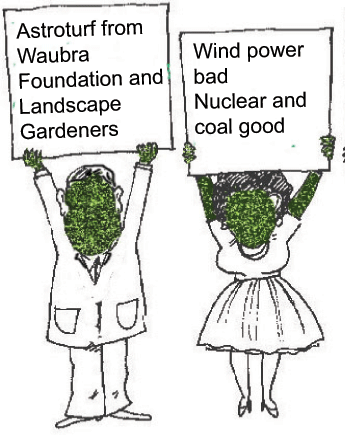
The US Chamber of Commerce put into action an initiative called
Project No Project, which looks at energy projects being delayed or
stopped entirely due to NIMBYism. Project No Project has projected
that in the short term the 351 projects the group looked at could
produce $1.1 trillion for the economy and create 1.9 million jobs a
year. Also once these projects are created and established, they are
estimated to produce $145 billion and create 791,000 jobs…..
The Real Cost of NIMBYism, Reneweable Energy Magazine Al Maiorino , 07
February 2013 All over the world renewable energy projects are being
delayed or stopped entirely due to the NIMBY or “not in my backyard”
phenomenon, this is a case that often involves people in communities
who stall developments in their areas due to a variety of reasons.
NIMBYism is not limited to the United States, it is global.
The amountof revenue and jobs that have been lost or delayed due to public opposition and protest to renewable energy projects is astounding. Continue reading
USA’s largest energy storage system for wind power
 Duke Energy completes North America’s largest energy storage system,
Renewable Energy Magazine Robin WhitlockThursday, 07 February 2013
The 36MW energy storage system will store power generated by the
nearby Notrees wind farm and became fully operational in December
The company announced plans to install large-scale energy storage
systems to service its wind farm at Notrees in late 2009, matching a
$22 million grant from the US Department of Energy (DOE).
As well as helping to meet power demand the system will also help to stabilize the frequency of electricity travelling through the power grid. DukeEnergy is currently working closely with the Energy Reliability Council of Texas (ERCOT) which will indicate whether the system shoulddispatch stored energy to increase frequency or absorb energy to decrease it. Performance data will be collected from the battery storage system by the Electric Power Research Institute (EPRI) to help assess the broader potential for deployment of storage solutions throughout the sector. Continue reading
Senator Scott Ludlam explains Clean Energy Finance Corporation funding for solar thermal energy
“We have the technology, we have the institutional set-up and now we have the funding mechanism to make [concentrated solar thermal] plants like this a reality in Australia largely in part because of the leadership shown by Senator Milne, by Adam Bandt and by our former leader, Senator Bob Brown, in bringing the Clean Energy Finance Corporation into being.
Barnaby Joyce’s renewables target: 100% ignorance REneweconomy, By Giles Parkinson 7 February 2013 “…….the most 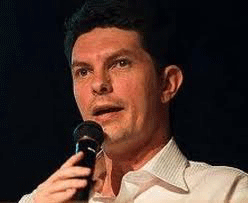 informed speech came from Ludlam (right) and it’s worth a read. We won’t republish it in entirety, but here is a good excerpt. And here is a link.
“I think that many people, when they consider solar energy, think of rooftop solar panels. That is fine. We have seen huge falls in the cost of that technology as economies of scale kick in, particularly with the research and development leadership that Australia has shown over previous years, coupled with the massive manufacturing capacity of China. This has led to huge falls in the cost of PV. For example, in Perth—the latest figures I have from last September—218 megawatts of peak electricity was generated from the rooftops of the residents of Perth.
It is interesting to note that the largest renewable energy installation in Western Australia is actually the city of metropolitan Perth. Because costs have fallen so fast—with halting policy assistance from both federal and state that comes and goes; rebates that get slashed and reintroduced, different schemes that come and go 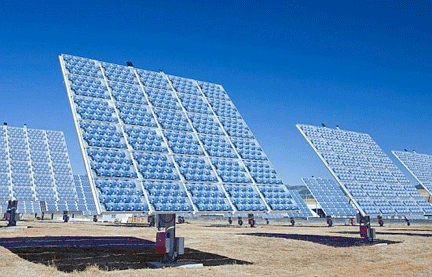 and even so people have done the right thing—we are now seeing large-scale deployment of solar energy in Western Australia and right around the world. So, PV is a big deal.
“But, what we want to raise today—and the reason the motion is worded as it is—is that there are major changes occurring in concentrating solar thermal technology which does not use photovoltaics, it does not require the rare earth minerals, it does not require advanced electronics or miniaturisation or particularly advanced manufacturing technologies. Continue reading
26 January – for Aboriginal people a day to mourn huge losses
Australia Day or Invasion Day: A Day of Contrasts Feb 7, 2013 “……..Invasion Day – A Day to Mourn Huge Losses”………As a strong contrast, 26 January is also marked and observed as the Invasion Day by the aborigines of country who live a traditional life. It represents the invasion of their land. Why should they celebrate this day or what calls for the celebration, is a pertinent question every aborigine has in his/her mind. Unanswered, it is a cause of dissatisfaction and unhappiness even today.
Aborigines of Australia call this day by different names. They are: ‘Day of Mourning’, ‘Invasion Day’, and ‘Survival Day’. As an effort to unite all aboriginals in their fight for sovereignty this day is also celebrated by many as the ‘Aboriginal Sovereignty Day’ by many people who believe in fighting back for their rights.
Why do they call it the Day of Mourning?
When the First Fleet landed in the Sydney Cove, it altered the lives of aborigines of the nation for all times to come. It was the day that saw the abduction of people, killing of local resistance and forceful eviction. They consider it as a day when they lost their land to the invaders. The darkest things of the day are the death in custody and loss of family. Basically the aborigines were stripped of all their rights. As this day represents the massacres that took place, it is a day of deep sorrow to them.
What has caused this Dissatisfaction?
Aborigines feel that:
- They were driven out of their lands
- The struggle led to killing of aboriginals
- They were not allowed to follow their customs and culture
- They were not allowed to teach their language
- They were disrespected.
The deprivation of rights and the deaths caused by this invasion is etched on the minds of the aboriginals not to view the day as a day of celebrations. The attack on their culture and lifestyle has given them the cause to display their dissatisfaction or unhappiness through various activities like re-enactments of Phillip’s landing which was accepted as part of the ceremonies for the Australia Day celebrations. The aborigine’s stage protests on this day to show their dissatisfaction staging protests to show their loss.
This day being a day of great contrasts, is both celebrated and mourned by two different groups of people of Australia. While the day represents achievements, joy and fun, it also marks the sorrow of people who were unable to exercise their rights. http://actco-australia.org/2013/02/australia-day-or-invasion-day-a-day-of-contrasts/
1 This month

of the week – Australians for War Powers Reform (AWPR)
To see nuclear-related stories in greater depth and intensity
 Antinuclear