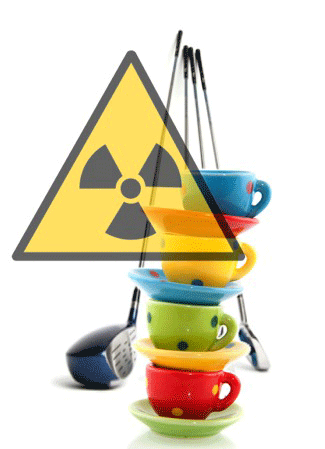
Unsafe plan for nuclear weapons waste to be incorporated into consumer products
 This approach ignores the current scientific consensus that there is
NO safe level of radiation exposure.
the fundamental safety question is whether any additional radiation
exposure is safe in any meaningful sense.
This approach also fails to deal with the reality that once the
department has released radioactive materials for commercial use, it
loses almost all control over how and where they’re used, and in what
concentrations.
Multimillion Dollar Bonanza: Nuclear Waste from US Weapons Industry To
Be Sold for Profit? By William Boardman Global Research, February 05,
2013
An Energy Department plan to allow the
recycling of scrap metals emitting very low levels of radiation is
drawing opposition because of concerns about potential health hazards.
But the upside for U.S. atomic bomb-makers is that waste now requiring
costly storage could be sold for a profit.
In something of a stealth maneuver during the 2012 holiday season, the
U.S. Department of Energy set about to give every American a little
more radiation exposure, and for some a lot, by allowing manufacturers
to use radioactive metals in their consumer products – such as
zippers, spoons, jewelry, belt buckles, toys, pots, pans, furnishings,
bicycles, jungle gyms, medical implants, or any other metal or
partly-metal product.
The Energy Dept. announced its plan in the Federal Register on Dec. 12
and invited comment for 30 days, through Jan.11. Citing its need to
address environmental concerns under the National Environmental
Protection Act (NEPA), the agency said, in part, that its plan was:
“to delegate authority to manage radiological clearance and release of
scrap metal from radiological areas to each Under Secretary for sites
under his or her cognizance
“ This Draft PEA for the Recycling of Scrap Metals Originating from
Radiological Areas analyzes the potential environmental impacts
associated with resuming the clearance of scrap metal, originating
from DOE radiological areas, for recycling pursuant to improved
procedures designed to assure that clearance for release is limited to
metals meeting stringent criteria.”
Translated from the bureaucratese, this is a proposal to lift a ban on
recycling radioactive metals left over from American bomb-making and
other nuclear activities and allow them to be used commercially with
“stringent” but largely unenforceable criteria for their use. The
initial ban was ordered in 2000, by then Secretary of Energy Bill
Richardson.
Largely ignored by mainstream media, the plan caught the attention of
an alert member of Congress, Rep. Edward Markey, D-Massachusetts, who
wrote a three-page letter to Energy Secretary Steven Chu on Jan. 11,
beginning:
“I write to convey my grave concerns regarding your December 2012
proposal to rescind the agency-wide suspension of the release of
radioactively contaminated scrap metal from Department of Energy (DOE)
facilities for purposes of recycling it into consumer products that
could ultimately by utilized by pregnant women, children or other
vulnerable populations. This proposal is unwise, and should be
immediately abandoned.”
Although Rep. Markey was writing on the date of the original deadline,
the Energy Department had invited the public to respond to an email
address that was non-functional during the first nine days of the
response period, Dec. 12-20. On Dec. 28, the department announced in
the Federal Register that the comment period was extended to Feb.
11…..
Minimizing Radiation Dangers
As is common in nuclear industry proposals of all sorts, the Energy
Department sought to assure readers of its proposal that any radiation
exposure resulting from recycling radioactive waste into the
commercial mainstream would have minimal impact on any given
individual. The article in the Journal included a chart from the
department that reinforced its claim that “would at worst expose a
person to very low levels of additional radiation.”
This approach ignores the current scientific consensus that there is
NO safe level of radiation exposure. Since there is already a
measurable level of background radiation worldwide, and since
worldwide radiation levels have increased as a result of nuclear
weapons testing and nuclear accidents like Chernobyl and Fukushima,
the fundamental safety question is whether any additional radiation
exposure is safe in any meaningful sense.
This approach also fails to deal with the reality that once the
department has released radioactive materials for commercial use, it
loses almost all control over how and where they’re used, and in what
concentrations. The same material used in a ceiling light fixture will
pose less risk than if it is used in a belt buckle of jewelry, worn
close to the skin. These uses are less dangerous than material inside
a human body, in a joint replacement or heart valve.
The issue is of global concern because other countries are recycling
their radioactive waste as well, with uncertain control and safety. As
Rep. Markey noted in his letter, “Just a year ago, Bed Bath and Beyond
recalled tissue holders made in India that were contaminated with low
levels of the radio-isotope cobalt-60 that were shipped to 200 of its
stores in twenty states.
“The Nuclear Regulatory Commission, when discussing the discovery of
the contaminated products, said that, ‘There’s no real health threat
from these, but we advise people to return them.’ “
While that may seem contradictory, it’s mainly because the choice of
the word “real” is not very accurate. It’s true that there’s no threat
of immediate injury from a low level of radiation, whereas a high
enough level will be lethal. It’s also true that there may be no
“realistic” threat from a radioactive tissue box, but that’s not the
same as “no threat,” since harm from radiation exposure is cumulative.
Rep. Markey’s letter illustrates this concern, as he notes that the
Energy Department is proposing to release contaminated metals into the
market place, as long as, quoting from the document, it “can be shown
that the release will result in less than 1 millirem (mrem) above
background to a member of the public in any calendar year.” [One
millirem is a tiny amount of radiation.]
Nevertheless, Markey expresses doubt about even this low standard: “I
believe this standard, even it were the appropriate standard, will be
impossible to assure or enforce.” [Emphasis added]
http://www.globalresearch.ca/arms-industrys-nuclear-waste-to-be-sold-for-profit-recycling-radioactive-metals-disputed/5321818
1 Comment »
Leave a comment
1 This month

of the week – Australians for War Powers Reform (AWPR)
To see nuclear-related stories in greater depth and intensity
 Antinuclear
Read “Target Isotope” for an intriguing twist on Thorium 232
LikeLike