The terminally ill global nuclear industry – theme for February 2013
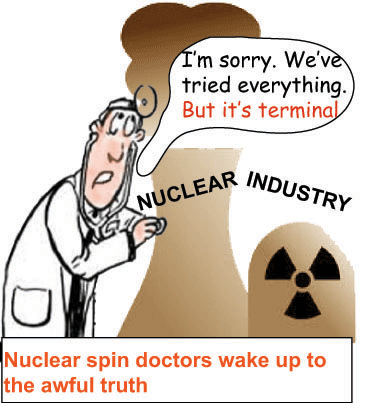 The global nuclear industry is sick, indeed, it is in palliative care. And here are 10 good reasons why: (see side bar for a little more detail on these)
1. Gloom overlies the nuclear lobby, fear of this question: the next nuclear catastrophe. Not IF it will happen, but WHEN and WHERE?
2. Aging, dangerous nuclear reactors that are too costly to make safe. .
3. “New nuclear” is a joke. The nuclear lobby will boast of so many “planned”, “proposed” reactors. But new ones actually being built? – just two and a half duds.
4 Discord and dissension in the nuclear camp. Nuclear countries cannot afford new reactors, so desperately compete to sell them to other countries.
Meanwhile nuclear companies battle it out to market their particular new gee-whiz nuclear reactor version.
5. Climate change affects nuclear reactors.
6. Nuclear weapons now out-dated. 21st Century conflict is all about  smaller, targeted
weapons, like the USA’s assassination drones. Pride and status are now the only motives for having nuclear weapons.
7. Decline in electricity use
8 Renewable energy, both centralised and small scale, is fast being developed, and widely popular (unlike nuclear).
9. Danger – whatever kind of nuclear facility – there is always the danger of accident or terrorism – they are a target for terrorists.
10 Public opinion. Worldwide – people just don’t like nuclear power.
A bit more detail on all these points – see sidebar at right
The Australian uranium industry is in a bad way – with a doubtful future
 recent steps by BHP to cuts of its uranium program — from the delay of the uranium production expansion plan at the Olympic Dam project to the selling of a large Yeelirrie deposit located in Western Australia.
Recent Ranger and Olympic Dam issues along with various problems related to notable Australian uranium projects like Angela/Pamela, Kintyre, Oban, Wiluna and Koongarra, amongst others, have also caused concerns about the future development dynamics of the local uranium industry.
Australia’s uranium industry hits turbulence Mining.com, Vladimir Basov | February 8, 2013 Recent news from Australia raises serious concerns about the future development of its domestic uranium industry. While established players are exiting the market, others are lining up to explore new areas and have made some positive moves.
Open-pit mining operations at Ranger mine were terminated at the end of November 2012. Continue reading
The United States is leading the world in a terrible direction by the use of these drones.
 The violations of national sovereignty in Yemen, Pakistan, Somalia, Sudan, Libya and now Mali are bound to spark resentment. And, indeed, evidence is that the strikes are breeding anti-American sentiment and are used as a recruiting devise for al Qaeda.
it will probably be years, even decades, before we see the most negative effects of these policies. The precedent that the Obama administration is setting should concern everyone.
The United States is leading the world in a terrible direction by the use of these drones. “The drones sound cheap and easy and save our soldiers live.” “They are our eyes in the skies.” “We have beheaded some of our worst foes.” All this may or may not be true, but ..the future is grim and diabolical
 Drones Debate: The Worst Is Yet to Come. HUFFINGTON POST, Jack Healey, 8 Feb 13, “……Broadly, the drone issue is whether the death penalty should be delivered from the sky, without trial; often in countries were the U.S. is not legally at war.
AUDIO: Earthquake, not tsunami, probably set off Fukushima nuclear disaster

as to the mystery of the reactor one building and the possibility
that it was damaged before the tsunami hit, in its report the
parliamentary panel found that there was a possibility that pipes had
burst during the earthquake causing a cooling problem.
AUDIO;Tepco lied to Fukushima meltdown investigators
http://www.radioaustralia.net.au/international/radio/program/connect-asia/tepco-lied-to-fukushima-meltdown-investigators/1085944
8 February 2013, In a further blow to its already battered
credibility, the operator of Japan’s crippled Fukushima nuclear plant
has been caught out misleading investigators appointed by the Japanese
parliament to probe the meltdowns. An audio recording reveals that a
TEPCO official gave false testimony in an apparent bid to stop an
investigation being carried out inside the shattered Reactor One
building. Continue reading
Radiation in consumer products:Australian Radiation Protection and Nuclear Safety Agency calls for comments
 Draft IAEA Safety Guide for Comment: DS458 – Radiation Protection and Regulatory Control for Consumer Products
By Judi Anderson – 08 February 2013
 The IAEA has requested comment on a draft safety guide DS458 – Radiation Protection and Regulatory Control for Consumer Products. The object of the document is to provide recommendations for the application of the requirements relating to the system of regulatory control for consumer products laid down in Radiation Protection and Safety of Radiation Sources: International Basic Safety Standards – Interim Edition (IAEA Safety Standards Series No. GSR Part 3 (Interim)).
so that we can forward a consolidated Australian response to the IAEA by the due date.
New Zealand’s proud anti nuclear history
 Flashback: When David stood up to Goliath stuff.co New Zealand, 9 Feb 13, The Dominion Post, TOM HUNT “,,,,,It may have soured our relationship with Washington and provided a dramatic end to a paradisiacal trip to Tokelau, but it certainly set Lange up as New Zealand’s David versus America’s Goliath.
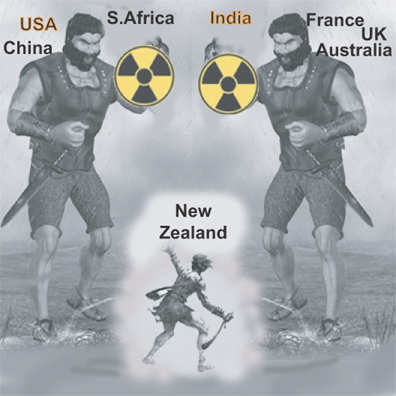
February 4, 1985 was the day the New Zealand Government backed overwhelming public anti-nuclear sentiment and effectively became officially nuclear free – even if legislation was still two years away.
”I felt so proud,” long-standing anti-nuclear protester Barney Richards said this week.
”We stood up against the most powerful nation in the world. And we had a major victory.”
He remembers a reporter travelling all the way from Britain ”to see for himself the little country that snubbed its nose to the world”. Continue reading
Australia’s uranium customer, India, developing advanced nuclear missile
 India working on advanced nuclear missile Ft.com, By Victor Mallet in New Delhi 8 Feb 13, High quality global journalism requires investment. Please share this article with others using the link below, do not cut & paste the article. See our Ts&Cs and Copyright Policy for more detail. Email ftsales.support@ft.com to buy additional rights. http://www.ft.com/cms/s/0/3e1410e0-71e9-11e2-886e-00144feab49a.html#ixzz2KQm3xYXY
India is developing a new, long-range missile capable of delivering multiple nuclear warheads to different targets, a senior defence industry official said on Friday.
The missile, dubbed the Agni VI, would have a range of 5,500-6,000 kilometres, slightly farther than the already tested Agni V, but would also have so-called MIRV capability, according to defence analysts. Only a few countries have nuclear missiles with MIRV technology, which stands for Multiple Independently Targetable Re-entry Vehicle…… http://www.ft.com/intl/cms/s/0/3e1410e0-71e9-11e2-886e-00144feab49a.html#axzz2KQlwwnG5
Decentralised solar energy – a boon for rural Argentina
In Renewable Energy in Rural Markets Project (PERMER)’s proposed scheme, photovoltaic or wind system are installed
for the user, who then pays for its operation and maintenance
dependent on their means.
“People have adapted well to technology and began to ask for solar panels instead of electricity lines,”
there [ the province of Entre Riosall] the rural schools and nearly 2,000 homes have solar panels.The impact is rewarding.

Renewable energy brings power to the rural corners of Argentina
http://www.renewableenergymagazine.com/article/renewable-energy-brings-power-to-the-rural-20130208
Cooking, heating water, or the house during
winter, reading, listening to the radio, charging your phone, using
the computer, watching TV — most people take these activities for
granted in the 21st century, but for thousands of inhabitants in
Argentina’s remote rural communities without electricity it is a
challenge. Nearly 150,000 homes still do not have this basic service,
most of them in the northern part of the country.
Since 1999, the Renewable Energy in Rural Markets Project (PERMER) has
aimed to put an end to this situation. Supported by the World Bank and
the Global Environment Facility (GEF), the initiative connects homes
and schools to clean energy sources such as solar panels and
windmills.
So far, around 25,000 residential customers and nearly 2,000 schools
have been reached, and 300 solar thermal stoves, furnaces and water
heaters have been installed. Also 2,000 users in small, isolated
communities have benefited from small power systems (generation and
distribution networks). The project has also included almost 400
public buildings, such as health centers, community centers, as well
as Gendarmerie (Police force) and National Parks Administration’s
stations. Continue reading
Renewable energy keeps getting cheaper- so expect no new coal mines
 Cheaper renewable energy will give coal a run for its money Australian Minng, 8 February, 2013 Alex Heber The falling cost of renewable energy and the increased cost of financing high emission fuels means Australia is unlikely to build new baseload power stations, according to a new report by Bloomberg New Energy Finance states.
The BNEF research found that even without a carbon price, wind energy is already 14 per cent cheaper than a new baseload coal-fired power station and 18 per cent cheaper than a new gas one.
SMH reported that the gap widened even further when the carbon tax is added. Wind farms can now generate electricity at $80 per megawatt-hour, compared with $143 for a new coal power station and $116 for a new baseload gas power station.
BNEF said that in Western Australia large-scale photovoltaic (PV) power stations are already cheaper than new coal-fired generating capacity, coming in at $157 per MWh compared with $190. Continue reading
1 This month
To see nuclear-related stories in greater depth and intensity
– go to https://nuclearinformation.wordpress.com/


 Antinuclear