The nuclear week that was, in Australia
 Once again, all the action is Australia is really about renewable energy. The nuclear/uranium lobby is very quiet – as well they might be, with the gloomy international news for their industry.
So – I might as well take this opportunity to report a little housekeeping news for my websites. They’re in a bit of peril. But I don’t really know how much, me being somewhat legally illiterate, and Luddite.
It’s a kind of tribute find myself on Roger Helbig’s “hit list” Lt. Col. RogerHelbig is part of a Pentagon disinformation campaign to prevent people from challenging the use of depleted uranium as a weapon. He specialises in discrediting some quite prestigious writers and in closing down anti nuclear websites. Yesterday Mr Helbig sent me a long email, threatening legal action, and he advised me that:
“I have already advised WordPress and I will make every possible effort to take down your WordPress blog and eliminate your ability to ever have another WordPress blog.”
Getting back to the real news:
- The Australian government has failed to exercise any duty of care, in the case of Australian citizen Ben Zygier, whoe died in gaol in Israel, in mysterious circumstances. As in the case of David Hicks, we were too scared to offend USA and Israel.
- 10 years after Australia undemocratically entered the Iraq war, highly regrded Australians now call for a Campaign for an Iraq War Inquiry – lest we make the same mistake again.
- Aboriginals’ status: Michael Anderson explains that what is needed is a Sovereign Treaty, not Act of Recognition
- Renewable Energy. Western Australian Greens release Energy 2029 – a plan for the State. Solar energy initiative in Kalgoorlie, calls for big solar initiatives solar in Port Augusta, and in Hunter Valley. Almost a million small solar panel systems in Australia. Australian solar consortium to develop 250 MW Indonesian project.
- Cameco admits that its Kintyre uranium project is not economically viable
Kow towing to USA and Israel, Australian government failed Ben Zygier, as it failed David Hicks
We failed our duty’ to Prisoner X http://www.theage.com.au/opinion/political-news/we-failed-our-duty-to-prisoner-x-20130214-2eg06.html#ixzz2L0Juuy7X February 15, 2013 David Wroe The Melbourne man dubbed ”Prisoner X” received no consular assistance from Australian officials despite the Department of Foreign Affairs and Trade having been told of his detention by Israeli authorities nearly 10 months before he killed himself in jail.
And Australia’s forgiving response to Israel’s failure to formally advise that it had jailed dual-citizen Ben Zygier could imperil other dual citizens arrested in other countries, a top international law expert says.
Foreign Minister Bob Carr revealed on Thursday that ASIO informed the department in February 2010 that Israeli authorities were holding Mr Zygier because of ”serious offences under Israeli national security legislation”. He told a Senate estimates hearing the government had ”relied on” assurances by Israel that Mr Zygier was being well treated, that his family knew of his detention and that he was getting legal representation.
Mr Varghese said because Mr Zygier was a dual national, he was ”not under the relevant conventions” and there was ”no obligation on the Israeli government to commit to prison visits”.
But Australian National University international law professor Don Rothwell said Israel had broken the international convention on consular relations – and Mr Varghese’s response could imperil other dual citizens.
”If Mr Varghese is making that concession, it’s a very significant concession with respect to every other country where Australia has dealings with dual nationals at the moment, and, in particular, China,” he said.
Senator Milne asked: ”My question is just why did the Australian government hand over the welfare of one of our citizens to the spooks? Why?”
David Hicks’ former lawyer, Dan Mori, now with the Australian firm Shine Lawyers, said Australia had failed in its basic duty to look out for one of its citizens. ”It boggles my mind that they sit back and not say, ‘He’s one of our citizens and we’re not going to have a consular visit?’ ” he said. ”You would want them to at least put eyes on them. It’s that basic service.”
In several developments on the case, senators grilled the minister and secretary over what the government knew and when.
Senator Carr’s office admitted the Minister’s incorrect statements to the ABC and Fairfax Media that his department knew nothing of the case until after Mr Zygier had died in December 2010 had been based on written advice from DFAT.
The ABC’s Foreign Correspondent sent Senator Carr’s office written questions prior to his interview for the program, which had been forwarded on to the department. Yet the department replied with incorrect answers.
Nuclear industry collapsing across Europe – Czech Republic the latest to fail
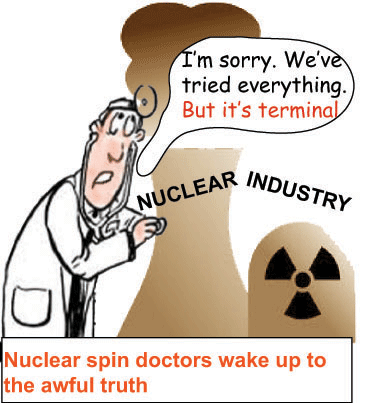 Nuclear Revival Dying in Europe as Power Prices Slump: Energy Bloomberg, By Ladka Bauerova – Feb 13, 2013 A Czech atomic-plant expansion planned near the German border had been one of the few prizes left for Europe’s nuclear-power industry after the Fukushima disaster stopped projects from Switzerland to Romania.
Russian and U.S. contractors have prepared to bid for the $10 billion contract to build two new reactors, Europe’s largest competitive tender for a nuclear project. Now a combination of cheaper European power prices and carbon credits, falling demand for electricity and concern government support may falter leaves CEZ AS’s project in doubt, analysts and investors said.
“The future of nuclear energy in Europe looks very dim indeed,” said Mycle Schneider, an independent consultant on energy and nuclear power based in Paris. “Nuclear is too capital intensive, too time-consuming and simply too risky.”Abandoning the Temelin project would deal another blow to the foundering nuclear industry in Europe, and to contractors such as Russia’s Rosatom Corp. and Westinghouse Electric Corp., after the 2011 accident at the Fukushima plant in Japan. Continue reading
Shock horror! – the end is coming for the ripoff of African countries by foreign uranium miners
 it’s not acceptable” that Niger’s most
valuable export only contributes about 5 percent to the nation’s
annual budget.
Increased revenue for Niger may come in the form of more mining
taxes, royalties or even a stake in AREVA; any of those options would
lower returns for investors and discourage future investment
Investment analysts are advising those with resource investments in
Mali to get out while they can
 Mali, Niger Unrest Highlights Need for Uranium Asset Diversification
February 14, 2013, By Melissa Pistilli Uranium Investing News
France’s military intervention in Mali, its former West African
colony, highlights industrialized nations’ supreme need to secure
access to economically strategic assets — in France’s case, uranium.
That theme will increasingly be seen playing out on the world stage
over the coming years. Continue reading
Small nuclear reactors – untested and just as costly as conventional nuclear reactors
Nuclear energy: Flexible fission, Ft.com, By Sylvia Pfeifer 14 Feb 13, At the Baltic Shipyard in St Petersburg squats the hull of the Akademik Lomonosov. It is no ordinary ship. Once it is finished in three years’ time, it will be Russia’s first floating nuclear power plant.Two reactors, similar to those used in Russia’s nuclear-powered ice breakers, will each provide 35 megawatts of power. The floating power plant is one of several planned by the Kremlin to be anchored near towns or industrial sites……
 Critics are wary, warning that floating atomic power stations would make an ideal terrorist target and be vulnerable to stormy weather and earthquakes. Others point out that even if smaller reactors had less fuel and were partly buried underground, there would be an increasing number of small facilities dotted across emerging markets, sometimes in places that lack the infrastructure to cope with emergencies….
multiple challenges remain.
There are questions over whether the regulatory regime and siting criteria should be relaxed for these reactors? There are also suggestions the plants could be run with fewer staff, helping to cut the costs even further.
Dame Sue Ion, a nuclear fuel expert and fellow at the UK’s Royal Academy of Engineering, says the first small modular reactors will, realistically, be sited on existing nuclear-licensed sites.
“It may be that the physical characteristics make it safer but you would still have to have all the safety arrangements and emergency planning in place,” she adds.
“You still have the same safety, proliferation and accident concerns,” says Doug Parr, chief scientist and policy director at campaign group Greenpeace UK. “You need capacity and supportive infrastructure to respond if there is an emergency.”
Then there is the issue of public acceptance. “To expect the general public to just accept them because they are small is pushing the point. It does not seem obvious to me,” Kevin Hesketh, senior fellow at Britain’s National Nuclear Laboratory, told an industry conference last month…….. “Licensing and public acceptance – both have to be addressed. ..
The biggest challenge facing the model is simply that no one has done it. Nuclear also has a bad record on cost. At the same time, competition from renewables, which are becoming cheaper, is growing.
Dominic Holt, associate director, nuclear advisory, at KPMG, says “none of the positives have been tested yet”. Claims of cost and programme certainty are still unproven. Analysis of a range of available data show that the “levelised cost” – per MW/hour – of SMRs is still similar to that of a large reactor…
Failure of Israel’s spy agency Mossad led to death of Australian Ben Zygier
Why Israel Couldn’t Contain Prisoner X Story, The Daily Beast, by Dan Goldenblatt Feb 14, 2013 Even with the increased flow of information about Prisoner X—Ben Zygier, aka Ben Alon, aka Ben Allen, aka…—we will probably never really know the truth. What could be the chain of events that led a good Jewish boy from Melbourne, Australia, who, it was confirmed by Israel, worked for the Mossad for 10 years, to end up as an anonymous prisoner in complete isolation in Israel’s most secure and watched prison cell? The fact that under what was supposed to be 24-7-365 observation he also succeeded to hang himself only adds to the mystery.
Prisoner X seems to have been employed by what the Guardian is calling a front company set up by Mossad in Europe that was involved in selling electronic wares to Iran and elsewhere. One needs not to be an investigative journalist or spy novelist to see a possible connection between this and a long list of unexplained explosions, highly sophisticated viruses and a long list of assassinations that have reportedly negatively affected the progress of the Iranian nuclear program.This will and may already be material for a Hollywood box office hit. However, from Israel’s point of view I would like to highlight two troubling points:
First is what appears to be a colossal failure of Israel’s crowned spook agency to understand new media and the information age. The Mossad may know how to develop sophisticated viruses that destroy uranium centrifuges and other hardware but when it comes to Twitter, Facebook and other social media, the start-up nation’s spy agency and the prime minister’s office (its direct boss) failed in a most embarrassing way and probably exacerbated the damage of the case……
The second point of concern is the reaction of some and the silence of others since the case exploded all over global and local media……
The obvious proto-fascist ultra-nationalist position of the person who used to be Israel’s first diplomat should serve as an ominous reminder of how close a reality whereby darkened windowed cars pull up to political dissident’s homes in the middle of the night, dragging us out of bed can be.
To end on a more positive note, I will carefully say that the results of the last elections have strengthened the democratic forces in Israel and reduce the chances of Israel slipping into tyranny. ……http://www.thedailybeast.com/articles/2013/02/14/why-israel-couldn-t-contain-prisoner-x-story.html
Future of Finland’s new nuclear energy now in doubt.
by the time new generation nuclear power plants are built – given an average 10-year construction period for any given nuclear power plant – the benefits of CO2-free energy production will have been overtaken by the worst of what climate change has in store.
 Finland -Olkiluoto 3’s new-generation reactor hits more delays, casting an ill light on its viability Charles Digges, 12/02-2013 http://www.bellona.org/articles/articles_2013/Olkiluoto_more_delays The troubled Olkiluoto 3 nuclear plant in Finland “is preparing for the possibility” that it will not start operating before 2016, the power utility behind the plant said Monday, adding another delay to a project that is already four years overdue.
The announcement sheds a dim light on the practicality and expense of the first-of-its kind new-generation European Pressurized reactor, which has been touted as a revolution in nuclear power production.
“This is yet another blow to the supposed nuclear renaissance,” said Bellona General Manager and nuclear physicist Nils Bøhmer. “Costly delays and millions of euro in price overruns are completely impractical, especially when compared to pursuing cheaper renewable and alternative energy sources.” Continue reading
Hear this: risk of USA or Israel pre-emptive action against North Korea
 Analyst warns of risk of nuclear war http://www.abc.net.au/news/2013-02-13/analyst-warns-of-risk-of-nuclear-war/4516940 North Korea analyst, Leonid Petrov, warns that this is a very dangerous moment for the region and he says is scared that the United States adminstation may further inflame the tensions.
No radiation detected from North Korea’s nuclear test. Australia suspends NK embassy
North Korea nuclear test: No radiation detected, BBC News, 14 Feb 13, Tensions between the two Koreas are high in the wake of Tuesday’s nuclear test. South Korean experts say they have not detected any radioactive isotopes from North Korea’s nuclear test, hampering efforts to assess the device. Eight samples had been analysed but nothing found, the Nuclear Safety and Security Commission said.
Finding certain isotopes – xenon gases in particular – would help experts determine whether a plutonium or uranium-based device was used.But a well-contained test could yield no radioactive isotopes, experts say.
South Korean planes and ships were sent out immediately after the test to collect samples, as was a Japanese plane.
“Two days since the North’s nuclear test, the commission has completed analysing eight samples, but no radioactive isotopes have been discovered as of 15:00 Thursday,” the commission said.
No changes had been recorded at 122 unmanned radiation monitoring systems across the country, it added…… The Australian government, meanwhile, has also decided to postpone a visit by North Korean diplomats exploring the possibility of reopening an embassy in the capital, Canberra, this weekend, because of the test.
“We postponed the arrival of North Korean diplomats in Australia as a gesture following this detonation,” Australian Foreign Minister Bob Carr said.
He however added that there are still plans to re-establish the embassy, saying that “there’s value in having a North Korean diplomatic presence here”.
North Korea closed its embassy there in 2008 due to financial issues. http://www.bbc.co.uk/news/world-asia-21455080
Rural Africa to get solar powered, low cost, broadband Internet Access
 Video Microsoft Providing Low-Cost, Solar-Powered Broadband Access In Africa http://www.energymatters.com.au/index.php?main_page=news_article&article_id=3595 15 Feb 13, Early this month, Microsoft Corp announced the launch of a pilot project delivering low-cost wireless broadband access in parts of Kenya via solar-powered base stations.
A project carried out in collaboration with the government of Kenya’s Ministry of Information and Communications and Indigo Telecom Ltd., the network utilizes TV white spaces to carry broadband signals to previously unserved locations near Nanyuki and Kalema. The project is the first deployment of TV white space technology in Africa.
TV white spaces are well-suited for delivering low-cost broadband access as radio signals in the TV bands can be transmitted over longer distances and penetrate more obstacles than other types of radio signals. As a result, fewer base stations are required.
Microsoft says that as television has begun to switch from analog to digital around the world, even more of this spectrum can be used to relay broadband.
More than 6,000 people will benefit from the project; which is part of theMicrosoft 4Afrika Initiative. In addition, solar power systems with deep cycle battery energy storage will be installed at local schools to supply electricity to their Information & Communication Technology (ICT) labs. Each system will generate 4.5 kilowatt hours (kWh) of energy per day, which should provide a small surplus of power above what is required for each lab.
While 4.5 kilowatt hours doesn’t sound like a great deal, it will be sufficient for students to use tablets and eReaders in the labs.
“Solar power addresses the issue of reliability in developing economies and carries low operating costs since panels last a long time and batteries can function for up to three years,” says a statement from Microsoft.
“That makes solar an increasingly affordable way to deliver power, especially in areas that lack infrastructure for both electricity transmission and broadband access.”
1 This month

of the week – Australians for War Powers Reform (AWPR)
To see nuclear-related stories in greater depth and intensity
 Antinuclear