For 75% of breast cancer patients, genetics is not a factor. Environmental causes look more likely
 This is a very important research finding. For decades, Australian women have been fed stories on how breast cancer is probably genetically caused. Each women is advised to look into the cancer background of her family. OK. Still a good idea.
So the cancer is supposed to be initiated from inside us. But how about environmental causes? How about the chemical bath in which we all swim? In food additives, in chemical sprays on fruit and vegetables. And how about ionising radiation – some from (often necessary) medical radiation, some from France’s Pacific atomic bomb testing 1960 to 1996?
We’re always being urged to donate to breast cancer research. How about some research into environmental causes of breast cancer?
 Genetics not a factor in three-quarters of breast cancer cases Herald Sun, Susie O’Brien, 16 Feb 13, FAMILY history plays no role in breast cancer in three out of four women, a shock new Victorian survey has revealed.
Analysis of the breast screens of almost 20,000 women over two decades shows 72 per cent of women who got breast cancer had no family history of the disease.
The findings contradict the popular belief that genetics plays a key role in determining which one in nine women will get breast cancer….. http://www.heraldsun.com.au/news/victoria/genetics-not-a-factor-in-three-quarters-of-breast-cancer-cases/story-e6frf7kx-1226579439609
Mystery of Ben Zygier’s death: Australia calls on Israel to explain
“I need to know what the contact was between Australian agencies and those of Israel, and I need to see what the Israelis want to tell Australia,” Carr stated. “The key is to get all the information.”“…The Haaretz newspaper reported on Friday that Israel has agreed to pay millions in compensation to Zygier’s family.
A source told the newspaper that Israel agreed to pay millions of shekels several weeks ago, after an investigation concluded that Zygier’s death had been a suicide and before the affair was exposed by the Australian media….”
Australia wants Israel to provide details on death of ‘Prisoner X’ Feb 17, 2013 PressTV Australia has called on the Israeli regime to provide details about the death of an Australian-Israeli ‘Mossad agent’ who allegedly committed suicide in an Israeli prison in 2010.
Australian Foreign Minister Bob Carr said on Sunday that the ministry was seeking answers in a “formal report” from the Tel Aviv regime over the circumstances surrounding the suspicious death of 34-year-old Ben Zygier known as ‘Prisoner X.’
On February 12, reporter Trevor Bormann revealed on Australian Broadcasting Corporation (ABC) that the prisoner who had worked for Mossad for ten years was “found hanged in a cell with state-of-the-art surveillance systems” near Tel Aviv in December 2010. Carr told reporters in Sydney that the Australian government had “asked” the Israeli regime “for a contribution to that report.”
The Australian foreign minister said Canberra wanted Tel Aviv to “submit… an explanation of how this tragic death came about.”
“I need to know what the contact was between Australian agencies and those of Israel, and I need to see what the Israelis want to tell Australia,” Carr stated. “The key is to get all the information.”
Following the ABC revelation, the Tel Aviv regime was forced to admit that Zygier had been jailed under a false identity “for security reasons” despite nearly two years of Israel’s efforts to cover up the secret.
on February 14, a report by the New York Times said Zygier was among the 26 suspects in a murder plot in which Mahmoud al-Mabhouh, a Hamas official, was tracked and killed in his hotel room hours after his arrival in Dubai, the United Arab Emirates, in January 2010.
The assassins had reportedly used fake passports from Australia, Britain, Ireland, Germany and France, among other countries.
The report added that ‘Prisoner X’ had provided the officials in Dubai with “names and pictures and accurate details” in exchange for protection.
However, the Israeli regime kidnapped him from his hideout and jailed him over treason nearly a month after the operation over the speculation that he had been on the verge of exposing Tel Aviv’s secrets about the passports. http://www.presstv.ir/detail/2013/02/17/289354/israel-should-explain-prisoner-x-death/

An insightful interview with Julian Assange – Senate candidate for Australia’s 2013 election
Set aside the cheap diatribes and what you think of Julian Assange as a person, or whether he’s done this or not achieved that. The fact is that electoral victory for him later this year would be one of those rare political miracles that make life as a citizen worth living.
 In a country weighed down by sub-standard politicians, sub-standard journalists and sub-standard freedom of information laws, the political triumph would be great. It would breathe badly-needed life into Australian democracy. And, yes, if the miracle happened, from that very moment the fun party down under would begin.
Lunch and dinner with Julian Assange, in prison, The Conversation, John  Keane, Professor of Politics at Sydney University, 18 Feb 13, Everybody warned this would be no ordinary invitation, and they were right. Three hundred metres from Knightsbridge underground station, just a stone’s throw from fashion-conscious Harrods, I suddenly encounter a wall of police…..Through a set of double doors, I’m confronted by more police officers, this time armed, with meaner faces…… The silver-haired “high-tech terrorist” (Joe Biden’s description) appears quietly,…. Calm, witty, clear-headed throughout, he’s in a talkative mood. But there’s no small talk….
Mining billionaire Andrew Forrest fights Cauldron Energy for uranium mining rights
Billionaire Miner Fights Rivals to Halt Digs on His Ranch. Business Week. By Elisabeth Behrmann and Joe Schneider on February 17, 2013 Andrew Forrest, Australia’s richest man who made his fortune digging up iron ore, is fighting bids to exploit the mineral wealth under his own half-a-million acre family ranch in the nation’s remote northwest outback.
Forrest, 51, founder and executive chairman of Fortescue Metals Group Ltd., the biggest seller of high-yield debt in the mining industry, sued to block attempts to search for uranium on his Minderoo ranch and last month failed in a bid to halt sand mining on the property….
“In Australia, by law, you only own the top meter, everything underneath, that is owned by the people of Australia,” Peter Strachan, a resources analyst at Perth-based StockAnalysis, said in a phone interview. “If someone puts in a request to explore on your land, you have to deal with that and make sure you’re compensated for access.”…..
Forrest is also fighting on a second legal front. Cauldron Energy Ltd., chaired by another mining entrepreneur, Tony Sage, applied for exploration licenses over some of Minderoo on April 4 for its Yanrey uranium project. Forrest & Forrest filed objections on May 8. A hearing date hasn’t been set yet………http://www.businessweek.com/news/2013-02-17/billionaire-miner-fights-rivals-to-halt-digs-on-his-ranch
North Eastern Japan forests and rural industry damaged by Fukushima radiation

In forests and villages near the Chernobyl nuclear power plant in present-day Ukraine, where explosions and fires almost 27 years ago caused a widespread release of radioactive fallout, “hot” mushrooms remain a symbol of persistent environmental contamination.
 Fukushima radiation threatens to wreak woodland havoc BY WINIFRED BIRD THE JAPAN TIMES, 17 FEB 13, “…..“Log-grown mushrooms were a symbol of safe, chemical-free food. That’s been turned upside down,” said the stocky, self-assured farmer. “I can’t sell my products with pride anymore.”
Meanwhile, the future of the wild plants, animals, and insects in the coppiced oak woodlands where he used to cut logs for the shiitake crop are also threatened.
The same is true throughout northeastern Japan. Because mushrooms are more prone than other crops to absorb the radioactive cesium spread by the disaster, growers continue to suffer even in areas where other farmers have returned to business-as-usual. And because mushroom production is closely entwined with a certain type of forested habitat, troubles in the industry presage ecological as well as human impacts…… Continue reading
Huge USA rally urging Obama to act on climate change
 US protesters urge Obama to act on climate http://www.news.com.au/breaking-news/world/us-protesters-urge-obama-to-act-on-climate/story-e6frfkui-1226579935196#ixzz2LC6PreLO news.com.au by: Chantal Valery From: AAP February 18, 2013 TENS of thousands of protesters have gathered in Washington to urge President Barack Obama to take concrete measures to fight global warming.
Waving banners and signs with slogans like “What will be your climate legacy?” the protesters called on Obama to reject the Keystone XL pipeline that would bring oil from Canada to Texas, and order the Environmental Protection Agency (EPA) to set carbon standards for power plants.
“It’s time for the country to wake up; the US has been dragging its feet too long,” said Mimi Body, one of the protesters on Sunday.
The event was organised by local and national environmental groups, including the Sierra Club, under an umbrella group named Forward on Climate. The Sierra Club said that 30,000 demonstrators were at the event. “It’s a big deal because the world is watching us,” said Canadian-born actress Evangeline Lilly, star of TV’s Lost.
“We want to challenge President Obama to be a main actor as opposed to being a puppet of the big oil companies,” Lilly told AFP. “It’s about telling him his speech did not fall on deaf ears.” Organisers claim the event will be the largest climate rally in US history, and includes protesters who have arrived aboard buses from 28 states.
The president mentioned climate change during his inauguration speech in January, and in Tuesday’s State of the Union he vowed to take action “for the sake of our children and our future” if Congress fails to do so. Celebrities who have signed a petition supporting the protesters include Alec Baldwin, Susan Sarandon, Morgan Freeman, Robert Kennedy Jr and Yoko Ono.
The rally comes after the United States last year endured record high temperatures and lengthy droughts, as well as superstorm Sandy, which devastated the New York-New Jersey coastline.
USA’s 70,000 tons of spent nuclear fuel – with nowhere to go
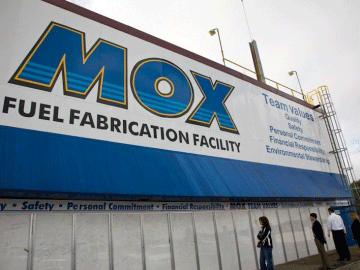
“It also ups the ante for reactor accident danger, as in the case of Fukushima, because MOX fuel has plutonium in it.”
“…So-called MOX fuel, short for mixed-oxide, is used in nuclear warheads and usually consists of a mix of plutonium and uranium.
The stock of used nuclear fuel currently held at 79 temporary locations in 34 US states “is massive, diverse, dispersed, and increasing,” according to the Oak Ridge report…”
RT 02 February, 2013
With two decades to go before it can reprocess spent nuclear fuel, the US will have to bury nearly 70,000 tons of it, a research lab reports. It comes after Congress and the Obama administration defunded a planned nuclear waste repository in 2011.
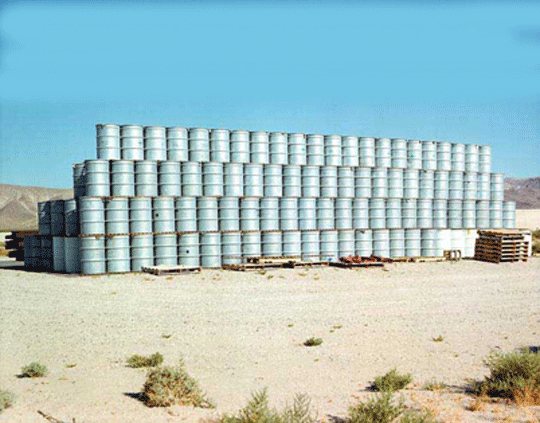
The Oak Ridge National Laboratory, a facility that does research for the Department of Energy (DOE), said that “about 68,450 [metric tons] or about 98 percent of the total current inventory by mass, can proceed to permanent disposal without the need to ensure retrievability for reuse or research purposes” in its report, published near the end of 2012. The rest of the waste, the report said, could be kept available for research on fuel reprocessing and storage.
The report was fairly obscure until being cited in a DOE document that showed plans to find a new permanent waste dump after Congress and the Obama administration cut funding for the Yucca Mountain repository in 2011.
Reprocessing has little support in Washington due to concerns that spent fuel could fall into the wrong hands. Nevertheless the DOE started looking into reprocessing methods in 2005.
But following the March 2011 disaster at Japan’s Fukushima Daiichi nuclear power plant, US officials became wary of recycling radioactive waste. The Blue Ribbon Commission on America’s Nuclear Future, co-chaired by Energy Secretary Steven Chu, said that “no currently available or reasonably foreseeable reactor and fuel cycle technology developments — including advances in reprocessing and recycling technologies — have the potential to fundamentally alter the waste management challenges the nation confronts over at least the next several decades, if not longer” in a report. Continue reading
1 This month
Chernobyl: The Lost Tapes – A good documentary on Chernobyl on SBS available On Demand for the next 3 weeks– https://www.sbs.com.au/ondemand/tv-program/chernobyl-the-lost-tapes/2352741955560
15 April – Zoom –Nuclear Power is Not the Solution
Apr 15, 2026 01:00 AM in Canberra, Melbourne, Sydney

Join the International Physicians for the Prevention of Nuclear War (IPPNW) on Tuesday, April 14th for a timely webinar exploring the risks associated with nuclear power and challenging the myth that it offers a simple, safe, carbon-free solution to the climate crisis

21 April Webinar: No Nuclear Weapons in Australia
Start: 2026-04-21 18:00:00 UTC Canberra, Melbourne, Sydney (GMT+10:00)
End: 2026-04-21 19:30:00 UTC Canberra, Melbourne, Sydney (GMT+10:00)
Event Type: Virtual
A virtual link will be communicated before the event.
Host Contact Info: australia@icanw.org

of the week – Australians for War Powers Reform (AWPR)
To see nuclear-related stories in greater depth and intensity
 Antinuclear