VIDEO: Australia’s nuclear test veterans call for justce

‘‘We were human guinea pigs,’’
VIDEO, GALLERY: Victims of atomic tests want justice http://www.theherald.com.au/story/1317774/video-gallery-victims-of-atomic-tests-want-justice/?cs=12 IN his log book for October 3, 1952, former HMAS Murchison chief petty officer John Quinn noted the following: ‘‘Atomic bomb exploded on HMS Plym.’’
The log book recorded the facts of the first of 12 British atomic tests in Australia in the 1950s, but this week Mr Quinn, 86, of Shoal Bay, recounted the emotion of that day on an Australian frigate in the waters of Monte Bello. Continue reading
Ben Zygier was betrayed
Ben Zygier didn’t betray his country. Ben Zygier was betrayed. Between his two home countries, he was placed in a situation he couldn’t deal with.
Israel allowed itself to cross three boundaries: a Mossad man was asked to retain Australian citizenship – leading to a dual-loyalty dilemma; the identity that he was instructed to use as a cover was his real Australian identity; and, worst of all, he was sent to operate in his homeland.
The prime minister must send a letter to the Zygier family – that have been broken by their son’s breakdown – saying, “Your son was not a traitor.”.
 Ben Zygier was no traitor, he was betrayed, Haaretz, 22 Feb 13, By Sefi Rachlevsky He wanted to contribute to Israel and did not mean to betray both his homelands, or his father for that matter. Israel cast him into a situation from which he could only be liberated by death..
… The fundamentals of its [Israel’s]power have not changed since David Ben Gurion established them: might, the support of friendly powers, the mobilization of world Jewry that can also influence their home countries, and the memory of the Holocaust. But the Zygier affair highlights how in an existential moment, Israel isn’t “only” immoral, but tramples arrogantly over these fundamentals without observing any boundaries…..
Fukushima a disaster like none other – a turning point in world history
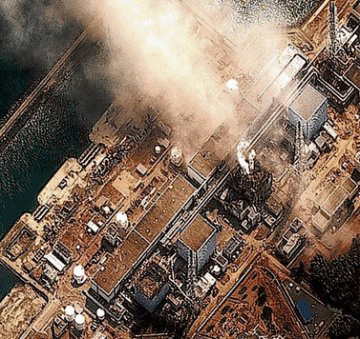 Academic Journal: Fukushima catastrophe becoming turning point in world history — “Its long-term impact and meaning are impossible to repress” Title: Thinking after Fukushima. Epistemic shift in social sciences
Source: Asia Europe Journal,
February 20th, 2013
Title: Thinking after Fukushima. Epistemic shift in social sciences
Source: Asia Europe Journal, Volume 11, Issue 1, pp 65-78
Author: Alain-Marc Rieu
Date: March 2013
The Fukushima catastrophe is a turning point in the conception, role and management of technology in industrial societies. As did Hiroshima (on another dimension) after 1945, the Fukushima nuclear accident questions and transforms established conceptions and values concerning the relations between technology, politics, industry, society and the environment. It has become impossible to think after Fukushima as we did before. This catastrophe initiates a major epistemic and conceptual shift with long-term consequences. […]
More than a year after the catastrophe, the time has come to evaluate its historical meaning. Fukushirna is not a disaster like others. This is the reason why it is becoming a turning point in world history: relations between technology, politics, industry, society and ecology are forever transformed. Its long-term impact and meaning are impossible to repress: wherever they live, people will never see and understand nuclear energy and nuclear industry as they did before […]
Read the article here
Youtube: Aboriginal Jeffrey Lee defeated nuclear giant AREVA – to preserve beautiful Koongarra
 Successful World Heritage Listing of Koongarra, NThttp://www.youtube.com/watch?feature=player_embedded&v=csRwbt9Fug0
Jeffrey Lee speaking about his country, Koongarra, NT http://www.youtube.com/watch?feature=player_embedded&v=izRf3dv9BWc
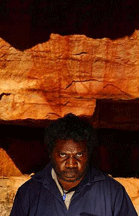 Lee could have become one of Australia’s richest men if he had allowed the French nuclear energy giant to mine the 12.5-kilometer mineral lease.
FORSAKING RICHES, ABORIGINAL LAND OWNER HALTS NUKE GIANT’S URANIUM MINE http://www.worldcrunch.com/tech-science/forsaking-riches-aboriginal-land-owner-halts-nuke-giant-039-s-uranium-mine/kakadu-northern-territory-areva-uranium/c4s10983/#.USfUBx1wpLs A 30-year battle ends in victory for owners of land that French energy giant Areva wanted to mine for uranium. LE MONDE (France), ABC NEWS, THE AGE, ENVIRONMENTAL NEWS SERVICE (Australia) Worldcrunch DARWIN – French nuclear energy giant Areva had big ambitions for this Australian uranium deposit: 14,000 tons of uranium, worth $2 billion, reports Le Monde. 21 Feb 2013
But now, it’s worth nothing, thanks to the tireless efforts of the land’s original owners – the Djok aboriginal clan. This month, Australian Environmental Minister Tony Burke started the process to incorporate the deposit into a national park, effectively putting an end to Areva’s mining ambitions. For decades, says Australia’s ABC news, Lee, the last remaining traditional owner of the Koongarra uranium deposit, in Australia’s Kakadu National Park, has been refusing to allow the deposit to be mined.
Areva holds the exploration license to the deposit, which was discovered in 1970. In 1979, the area was excluded from the national park so that the uranium could be mined. But the Djok clan relentlessly fought offers by Areva to mine the deposit.
A delegation even travelled to Paris to convince the World Heritage Committee to get the Koongarra deposit back into the Kakadu National Park, reports ABC News. According to the Australian government, Areva went as far as to request Koongarra be removed from the meeting’s agenda.
But Jeffrey Lee never stopped fighting, Continue reading
Western Australia: Greens show a practical plan for transition to renewable energy
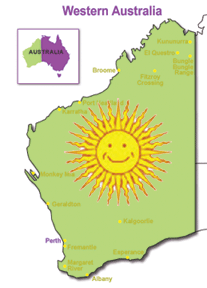 Renewable energy could have a major impact on Western Australia http://www.hydrogenfuelnews.com/renewable-energy-could-have-a-major-impact-on-
 western-australia/859050/ BY
– FEBRUARY 21, 2013
State could reach 100% energy sustainability through solar and windWestern Australia is one of the largest energy consumers in the world. The state relies heavily on fossil-fuels, such as coal, but has been working to adopt renewable energy in recent years. According to the Greens, the state can meet its energy needs in a variety of ways that do not involve the use of fossil-fuels. The document released by the Greens highlights solar thermal and storage technologies as an adequate way for the South West Interconnected System. Western Australia’s expansive energy utility, to break away from fossil-fuels. Another option is to use photovoltaic solar energy systems and wind energy.
Costs of renewable energy considered viableThe cost for solar and wind energy has dropped significantly over the past two years. The Greens suggest that no major advances in technology are required for Western Australia to reap the economic benefits of adopting renewable energy. According to the political party, renewable energy in the region can range from $208 to $221 per megawatt-hour. This estimation represents a $60 billion upfront cost for the state to expand its use of solar and wind energy. The cost may be high, but the Greens suggest that it is significantly lower than the costs associated with a continued focus on fossil-fuels.
Politics likely to dictate future of renewable powerAs Australia’s smallest political party, the Greens have limited influence over the adoption of renewable energy throughout the country. This is particularly problematic because renewable energy is often made into a political issue rather than one of sustainability or economics. The Greens study of renewable energy and its potential to help Western Australia reach 100% energy sustainability has, nonetheless, generated a fair amount of hype in the political space.
A win win situation – carbon economy enables conservation, with early fire practices in Australia’s Northern Territory
There is little doubt that the new carbon economy is transforming fire and biodiversity management across northern Australia. Many areas managed for biodiversity conservation can now generate a substantial income beyond the public purse. This will surely allow the further privatisation of biodiversity conservation, at a time when non-government organisations are already playing an increasingly central, and indeed successful, role in conservation in northern Australia.
Implementing biodiversity-friendly fire regimes remains an enormous management challenge in the north. Although the carbon economy is unlikely to be a panacea, it certainly provides a much-needed income stream for sustainable land management, especially for the vast lands outside of the traditional conservation estate.
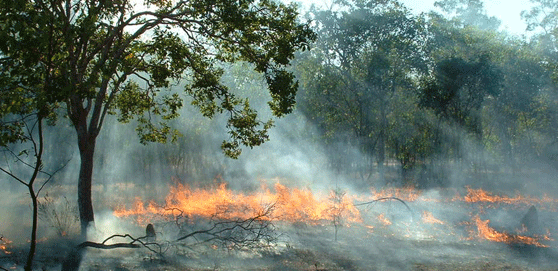
 Savanna burning: carbon pays for conservation in northern Australia http://theconversation.edu.au/savanna-burning-carbon-pays-for-conservation-in-northern-australia-12185 22 Feb 13, Fire and biodiversity have a complex relationship in northern Australia. Tim Flannery and others blame the current northern biodiversity crisis, at least in part, on changed fire regimes. Improving fire management is critical to conserving savanna landscapes – but who pays for it? A new funding model, tapping into the carbon economy, has emerged in the far north and is rapidly transforming fire management and biodiversity conservation.
A new funding model for fire management
The idea that land management could be funded by carbon credits emerged from Aboriginal-owned Arnhem Land in the Northern Territory. By the 1990s it was clear that the region’s enormous biodiversity values were being eroded by frequent, intense late dry season fires.
To address this problem, a trailblazing group of Western scientists and land managers, and Aboriginal Traditional Owners developed a program of prescribed burning early in the dry season to pre-empt large, intense wildfires late in the dry season.
The most innovative part of their work was to link improvements in fire management to reductions in greenhouse gas emissions. They also realised that this emissions reduction (or abatement) could be used to secure resources for land management. The abatement occurs because early dry season fires tend to be patchier and less intense than late season fires, and therefore burn less fuel. Because less fuel is burnt, fewer emissions are produced.
The project that resulted from this early work – the 28,000 km²West Arnhem Land Fire Abatement project – has operated since 2005 and is funded by one of the world’s largest energy companies, ConocoPhillips. They provide $1 million annually in return for an abatement of greenhouse gases equivalent to 100,000 t of CO₂. Continue reading
The human and financial costs of extreme weather events – $188 Billion in USA in past 2 years
$188 Billion Price Tag: Extreme Weather From 2011 To 2012 The Energy Collective, By Daniel J. Weiss and Jackie Weidman
 The United States was subjected to many severe climate-related extreme weather over the past two years. In 2011 there were 14 extreme weather events — floods, drought, storms, and wildfires — that each caused at least $1 billion in damage. There were another 11 such disasters in 2012. Most of these extreme weather events reflect part of the unpaid bill from climate change — a tab that will only grow over time.
 CAP recently documented the human and economic toll from these devastating events in our November 2012 report “Heavy Weather: How Climate Destruction Harms Middle- and Lower- Income Americans.” Since the release of that report, the National Oceanic and Atmospheric Administration, or NOAA, has updated its list of “billion-dollar”-damage weather events for 2012, bringing the two-year total to 25 incidents.
From 2011 to 2012 these 25 “billion-dollar damage” weather events in the United States are estimated to have caused up to $188 billion in total damage. [1] The two costliest events were the September 2012 drought — the worst drought in half a century, which baked nearly two-thirds of the continental United States — and superstorm Sandy, which battered the northeast coast in late October 2012. The four recently added disastrous weather events were severe tornadoes and thunderstorms. Here is an update of vital extreme weather event data after the addition of these four events: Continue reading
Deep and stubborn silence by Australian and Israeli governments about Ben Zygier’s death
Ben Zygier: the silence surrounding Prisoner X The Conversation, Felix Patrikeeff 22 February 2013, When Melbourne man Ben Zygier, an alleged agent of Mossad, or perhaps a double agent, died in December 2010, his end was barely perceptible.
He had been held anonymously in solitary confinement at a high-security prison in Israel. A notice of his death appeared on the Internet, and then promptly disappeared. His name was not made known at the time.
It had to be secured by Australian investigative journalists. Continue reading
Arnhem Land traditional owner opposes fracking on his land
“In many ways, it’s an uncontrolled experiment on the Australian environment”
The meeting was told that about 80 per cent of Territory land and 90 per cent of its coastline are subject to mining exploration applications of some kind.
Shale gas ‘fracking’ fractures views in Top END By Andrew Thompson | ABC , 22 Feb 13, The head of an anti-fracking community group based in the eastern states has warned against the development of the shale gas industry in the Northern Territory.Farming, fishing, pastoral and environmental groups were among those represented at a Darwin meeting to discuss the controversial underground mining technique known as hydraulic fracturing, or fracking. Continue reading
Renewable energy yes! including household rooftop solar – says University of Queensland
Renewable energy critical for competitive Australian power system- University of Queensland, 22 Feb 13, An immediate investment in multiple energy technologies is vital for meeting carbon abatement targets and building a robust power system, a new study from the Global Change Institute at The University of Queensland has found.
• The resilience of Australia’s power system is currently poor (better only than India and South Africa) and is not compensated by low electricity costs.
• Even with a high carbon price, the power system is not on-track to cut emissions by 80%, in line Australia’s 2050 emissions targets*.
• There is no cost premium associated with shifting from ‘business-as-usual’ to renewable, distributed generation and carbon capture and storage. There is, however, evidence of a cost premium for shifting away from coal.
• Australia will benefit from investment in large-scale renewable energy projects to operate alongside coal in the foreseeable future and eventually replace the role of coal.
• Consumer action must not be overlooked and will be an integral part of any successful model, however an in-depth study into the effect of distributed generation (eg household rooftop solar panels) on the distribution network is urgent and overdue. ….. http://www.uq.edu.au/news/?article=25857
1 This month

of the week – Australians for War Powers Reform (AWPR)
To see nuclear-related stories in greater depth and intensity
 Antinuclear