The ABC does it again! South Australia, as world’s nuclear waste dump
 The ABC does it again!. ABC Radio National’s Ockham’s Razor chose March 11 to give a platform to the nuclear lobby. The anniversary of the Fukushima nuclear disaster.What timing!
 No such uncertainty for Terry Krieg, ABC Radio’s favourite nuclear spruiker. Here are a couple of thoughts from Krieg about nuclear waste:
Mirarr welcome close scrutiny for Kakadu uranium mine
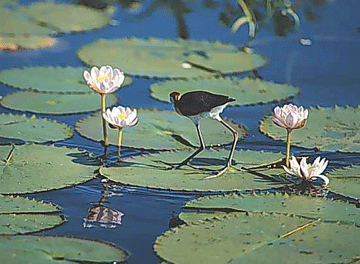 Gundjeihmi Aboriginal Corporation (GAC) has today welcomed Environment Minister Tony Burke’s announcement that Energy Resources of Australia’s proposal to build an underground uranium mine, the so-called Ranger 3 Deeps, will be subject to a full Federal Environmental Impact Statement (EIS).
GAC – the organisation established and run by the Mirarr Traditional Owners of the Ranger uranium mine site, where the underground operations are planned, as well as much of Kakadu National Park – called for this level of assessment. The proposal affects a number of Matters of National Environmental Significance as it is a Nuclear Action occurring within a World Heritage listed Wetland of National Significance.
Kakadu experiences high rainfall and insufficient research has been done to be to predict the effect that underground operations will have on the surrounding wetlands.
“The Mirarr welcome the Minister’s decision. The Ranger 3 Deeps proposal is an entirely new method of mining within the bounds of Kakadu National Park and must therefore be subject to a high level of scrutiny. Energy Resources of Australia (ERA) has no experience with underground mining and the potential for water management or other environmental issues within the World Heritage area demand close examination,” said Justin O’Brien, Executive Officer of Gundjeihmi Aboriginal Corporation.
ERA currently has approval to mine on the Ranger Project Area until 2021 and has not publicly confirmed if it intends to seek a new mining approval beyond that date.
For further information or comment contact Justin O’Brien: 0427 008 765
Japanese in Canberrra call on Australian politicians to stop export of uranium
Mr Kawasaki said because Australia supplied uranium to Japan, the issue was “our common problem”.
Not only was uranium from Australia present in affected Japanese reactors, but low levels of radioactive xenon were picked up by air monitoring stations in Australia, including in Darwin, after the accident.
Kenichi Hasegawa and his wife Hanako were prominent dairy farmers in the Japanese district of Fukushima when disaster struck two years ago. They watched as, one after another, three nuclear reactors only kilometres away, exploded.
Although they did not know it at time, it was the end of their lives as they knew them. They and their neighbours were forced to kill all their beloved cows. In a video, Mr Hasegawa relates how the women sobbed and ran after their animals as they were led away to be killed.
The pair lost their farm and are still in temporary housing two years later. On Wednesday they travelled with a delegation of Japanese people sponsored by environmental groups, trade unions and public health groups to Canberra, as part of a whistlestop tour of Australia.
We have to work collectively to stop this happening again,” he said through an interpreter. Continue reading
No optimism for the nuclear industry on any side of Australian politics
 Ludlam accuses the nuclear industry of “indestructible optimism”. He says the industry will “go off a cliff” as ageing reactors reach the end of their design lives..
Opposition energy spokesman Ian Macfarlane says the Coalition’s previous nuclear power policies have “all been shelved as a result of Fukushima”
Long and cold dawn of the nuclear age, by: CHERYL JONES, The Australian, March 09, 2013 Cheryl Jones is a science journalist and author. She has previously worked at ANSTO. “…….There are still no plans for a nuclear power plant in Australia.
Labor has long opposed the deployment of nuclear power here, but Resources and Energy Minister Martin Ferguson says the issue might be on the agenda of a future government by the end of the decade as Australia continues to cut greenhouse gas emissions. He stresses that Australia will meet its immediate target under the Kyoto Protocol, however.
The Coalition, once open to the idea of domestic nuclear power because of its near-zero carbon emissions, reversed its position in the wake of the Fukushima nuclear disaster two years ago. The Australian Greens remains vehemently anti-nuclear…….
The Fukushima Daiichi plant is being decommissioned. Japan shut down its other reactors after the accident and two have since been restarted, he says. Continue reading
Brief rally in uranium market grinds to a halt
A delay in the resumption of nuclear plants would be a blow for uranium producers from Australia toNamibia
Uranium Rally Falters on Japanese Nuclear Delays: Energy Markets, Bloomberg, By Ben Sharples –12 Mar 13, Uranium’s rally from a three-year low is stalling amid signs Japan, once the world’s third-biggest nuclear power producer, will keep all but a handful of its reactors offline this year.
The atomic fuel has slipped 6.8 percent to $42.40 a pound since the Liberal Democratic Party won Dec. 16 elections, erasing most of the 12 percent gain in the six weeks before the vote. Continue reading
Australian map of nuclear and uranium sites
 Chernobyl in Australia, http://googlemapsmania.blogspot.com/2013/03/chernobyl-in-australia.html by Keir Clarke March 12, 2013

The Australian Map of Nuclear and Uranium Sites is a Google Map displaying the locations of more than 50 of Australia’s nuclear sites including uranium mines, proposed reactor and dump sites, and British nuclear test sites.
As well as the map of nuclear reactor and test sites you can can also view an interactive Google Map that overlays the nuclear fallout zones caused by the 1986 Chernobyl accident applied to proposed nuclear power sites in Australia.
Users can select any of the proposed nuclear sites and see the Chernobyl fallout zones overlaid on a map of that location. Users can also adjust the wind direction to see how the fallout zones would be effected by different wind directions.
Japanese call on Queensland “Leave uranium in the ground”
Don’t mine uranium in QLD: Fukushima survivor, Australian Mining, 13 March, 2013 Vicky Validakis A survivor of the Fukushima nuclear accident wants the QLD government to reinstate its ban on uranium mining.
Visiting Brisbane as part of a delegation from the Japanese disaster relief organisation Peace Boat, dairy farmer Hasegawa Kenichi said mining uranium was too dangerous.
“Uranium is something the human body cannot handle, cannot cope with. It’s like opening Pandora’s box,” he told AAP.
“This government, all governments, must stop using this substance.
“It must be left underground.”…..
Peace Boat spokesman Akira Kawasaki urged the government to think about the nuclear accident and its devastating affects.
“Think about all those people, all those lives this substance destroyed, before making your decision,” he told AAP.
“Don’t make the mistake we did.”……http://www.miningaustralia.com.au/news/don-t-mine-uranium-in-qld-fukushima-survivor
Peace Boast spokesman Akira Kawasaki urged the government to think about the nuclear accident and its devastating affects.
“Think about all those people, all those lives this substance destroyed, before making your decision,” he told AAP.
“Don’t make the mistake we did.”……http://www.miningaustralia.com.au/news/don-t-mine-uranium-in-qld-fukushima-survivor
Peace Boast spokesman Akira Kawasaki urged the government to think about the nuclear accident and its devastating affects.
“Think about all those people, all those lives this substance destroyed, before making your decision,” he told AAP.
“Don’t make the mistake we did.”……http://www.miningaustralia.com.au/news/don-t-mine-uranium-in-qld-fukushima-survivor
Anti nuclear protest in Tokyo – “I do this for my children”
Thousands in Japan anti-nuclear protest two years after FukushimaDate:ie Knight 11-Mar-13 Mari Saito and Soph Thousands of protesters marched in the Japanese capital on Sunday calling on the government to shun nuclear power, a day before the second anniversary of an earthquake and tsunami that triggered the world’s worst atomic disaster in 25 years.
Japan is still coming to terms with the disaster that ravaged its northeastern region two years ago – the earthquake and tsunami killed more than 15,000 people. Several thousand people are still unaccounted for.
“It’s becoming more and more important for us to protest. I do this for my children, we can’t leave the mess of nuclear power behind to them,” said a 32-year old mother of two marching in front of the Ministry of Economy, Trade and Industry, chanting “Stop nuclear! Protect our children!”.
“People and the media are starting to forget Fukushima and what happened there,” said the woman.
The nuclear meltdown at Tokyo Electric Power’s (Tepco) Fukushima Daiichi plant forced 160,000 people from their homes and many of them will never return. It also sparked an unprecedented protest movement against nuclear power.
Tepco faces a decades-long effort to decontaminate and decommission the wrecked nuclear plant after the worst atomic disaster since Chernobyl in 1986……http://planetark.org/enviro-news/item/6811924
Ancient Aboriginal art treasures threatened by uranium mining
After years of drilling, Canadian-based mining company Cameco has reported the find in the Wellington Range, where the thousands of Aboriginal artworks adorning cliffs and caves include a painting of the extinct dog-like creature, the thylacine, made in a style that is at least 15,000 years old.
“The importance of this art site is that it’s like a library,” Ronald Lamilami, a traditional Aboriginal landowner in western Arnhem Land and a custodian for the art, told The Global Mail, which on Friday published a detailed feature and map of the rock-art sites at risk nationwide. Lamilami said he fears if mining goes ahead, the works of his ancestors will be damaged…….
The rainbow serpent, fish, kangaroos and other creatures are painted in traditional “X-ray” style and the world’s only known indigenous rock-art stencils depicting whole birds are silhouetted on a cave wall, ……http://www.guardian.co.uk/environment/2013/mar/08/australian-uranium-discovery-art
1 This month

of the week – Australians for War Powers Reform (AWPR)
To see nuclear-related stories in greater depth and intensity
 Antinuclear