Earth Hour Saturday March 23 – energy conservation and a call for renewables
 On Saturday; Australians are being asked to turn off their lights for one hour from 8.30pm to make a statement against climate change and as a showing of support for renewables.
Originally a one-city initiative in Sydney in 2007 involving two million individuals and 2,000 businesses, Earth Hour now occurs in more than 6,950 cities and towns in 152 countries and territories around the world.
A Renewable Energy Focus For Earth Hour 2013 http://www.energymatters.com.au/index.php?main_page=news_article&article_id=3646 20 March 13, This year’s Earth Hour falls on Saturday 23 March and the event’s main theme calls on Australians to “switch off for good and switch over to renewable energy”.
A related national survey of 1,283 Australians commissioned by WWF-Australia for Earth Hour shows 87% want more action by all sectors, including government, to make Australia a top ten producer of renewable energy.
Currently, Australia is ranked no. 31 – and two-thirds of those surveyed believe the nation would be ranked better.
It seems the Aussie public’s spirit is certainly willing to see Australia become a renewables powerhouse, but political will is still a little weak. The survey revealed participants believe renewable energy should account for 27% of our total energy mix by 2020; 35% more than the current national target of 20%.
Ms. Caught says it’s time Australia’s political leaders set ambitious targets and expand renewables, not hold them back. Continue reading
AREVA was not able to bribe Jeffrey Lee, and Koongarra is safe from uranium minng
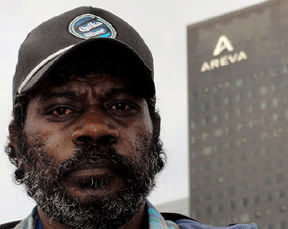 Australia: Koongarra is now permanently protected from uranium companies INTERCONTINENTAL CRY, BY JOHN AHNI SCHERTOW • MAR 18, 2013 The Australian government finally made good on its word. On 6 February, 2013, Environment Minister Tony Burke introduced the “Completion of Kakadu National Park (Koongarra Project Area Repeal) Bill” signalling an end to one of three long standing struggles against uranium mining within the Alligator Rivers Region of Australia’s Northern Territory.
Just a few short days ago, Australia’s senate passed the Bill, ensuring once and for all that Koongarra is permanently protected.
“This is a great day for me, my country and my culture. My mind is at peace now that I know that there will be no mining at Koongarra and that Djok lands will be protected forever in Kakadu National Park,” said Jeffrey Lee, Djok Senior Traditional Owner and the Custodian of Koongarra, in a written statement. Continue reading
GREENS ACT TO SAVE REEF FROM URANIUM AND WORLD HERITAGE IN-DANGER LISTING
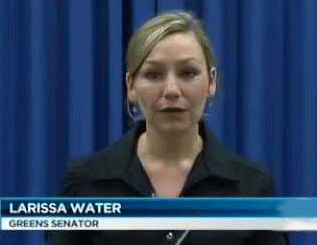 Larissa Waters, 19 March 13, The Australian Greens will introduce a bill to Parliament tomorrow to save the Great Barrier Reef from uranium shipping and being added to the World Heritage list of sites in danger.
“Premier Newman is considering shipping uranium through the reef and the World Heritage committee is warning the reef is being overrun with development,” Senator Larissa Waters, the Australian Greens Great Barrier Reef spokesperson, said.
“The government is not acting to save the reef from these threats – it has ticked off on what would be one of the world’s largest coal ports in the reef and hasn’t ruled out giving Campbell Newman its federal responsibilities to protect the reef.
“I am introducing a bill to adopt key recommendations made by the World Heritage committee on the reef’s management, which would prevent uranium shipping through new or expanded ports. Continue reading
More USA navy men in legal action over radiation exposure at Fukushima
 The plaintiffs say they are suffering a range of disorders related to radiation exposure, from headaches and difficulty concentrating to rectal bleeding, thyroid problems, cancer and gynecological bleeding.
“At all times relevant herein, the Japanese government kept representing that there was no danger of radiation contamination to the USS Reagan (CVN-76) and/or its crew, that ‘everything is under control,’ ‘all is OK, you can trust us,’ and there is ‘no immediate danger’ or threat to human life, all the while lying through their teeth about the reactor meltdowns at FNPP,” lawyers stated in the complaint.
 More U.S. military join lawsuit over Fukushima exposure By Peter Shadbolt, CNN March 19, 2013 — Tokyo Electric Power Company (TEPCO) faces mounting damages from the 2011 Fukushima nuclear disaster as more U.S. servicemembers joined a lawsuit accusing the Japanese national utility of lying about the risks involved in an aid effort to the stricken area in 2011.
Attorneys said the number of plaintiffs had grown to 26 from an initial eight, who filed their original lawsuit in December, and that 100 more were ready to join the lawsuit which is now seeking more than $2 billion, the Stars and Stripes newspaper reported late last week.
READ: TEPCO accused of lying over Fukushima
TEPCO confirmed that more plaintiffs had been added to the court petition filed with the U.S. District Court in California in December but did not give details…..
The amended lawsuit increases the amount of damages lawyers are seeking for crew aboard the USS Ronald Reagan aircraft carrier and other service vessels in the area who say they are suffering continuing health problems from the rescue effort that followed the devastating earthquake and tsunami that struck eastern Japan on March 11, 2011, crippling reactors at the Fukushima Dai-ichi nuclear power plant. Continue reading
Darwin a “soft touch” for Queensland & Western Australia’s uranium export hub
ACF fears push to make Darwin uranium export hub ABC News 20 March 13, “….ACF spokesman Dave Sweeney says the Northern Territory is perceived as an easy target.
“(They) are seeing Darwin as a soft touch,” he said.
“State governments in Queensland and Western Australia know uranium is controversial, know its transport raises concerns and know that people have real issues about its movements.
“They are seeing Darwin as the politically easy solution.”
A Queensland government Uranium Mining Implementation Committee report on uranium mining in the state has made 40 recommendations, including using interstate ports for shipping.
Darwin and Adelaide are the only ports in Australia now permitted to be used for the export of uranium oxide. … http://www.abc.net.au/news/2013-03-19/uranium-exports-darwin-port-qld-govt-acf/4581592
Northern Territory’s uranium industry in the doldrums
 Time the NT got resourceful, ABC Rural By Caddie Brain , 19 March 2013 “……..Uranium exploration projects seem to be struggling to raise capital more than any other resource, with investment down by 70 per cent.Oil, gas and petroleum on the other hand is booming, with an unprecedented 9 per cent of the Territory now subject to petroleum licences or licence applications…..
the Northern Territory Government says it’s concerned that so few projects have made the transition from exploration to mining over the past decade. The last mine was opened in 2006, and there’s been no major greenfield sites developed in the last 20 years.
In his opening remarks, Mines and Energy Minister Willem Westra Van Holthe said while it will support further minerals and petroleum exploration, it’s likely that major projects will rely on foreign investment to get off the ground….. http://www.abc.net.au/rural/content/2013/s3719273.htm
Australians’ Earth Hour pledge for renewable energy
Earth Hour this month http://www.stmarysstar.com.au/story/1370881/earth-hour-this-month/?cs=12 March 18, 2013, Earth Hour, the global phenomenon that started in Australia and spread to 152 countries around the world, will return at 8.30pm this Saturday, March 23.
This year Australians won’t just be switching off their lights for Earth Hour. They will also pledge to switch over to renewable energy for good.
By pledging to switch at earthhour.org.au, thousands of Australians will be committing themselves to a better future for our planet. Continue reading
Vancouver the global Earth Hour capital
Vancouver crowned Earth Hour Capital 2013 WWF Global 19 March 2013 WWF’s Earth Hour City Challenge (EHCC) has recognised the City of Vancouver, Canada, for its innovative actions on climate change and dedication to create a sustainable, pleasant urban environment for current and future residents. After carefully reviewing the merits of the six finalists, the EHCC jury of experts unanimously cast their votes for Vancouver as the first ever Global Earth Hour Capital. Also in the running for the title were finalists Forlì in Italy; New Delhi, India; Oslo, Norway; Uppsala, Sweden; and San Francisco, USA. Vancouver has been recognised by the jury for its ambition to be global leader on climate-smart urban development in spite of low national ambitions.
The city’s overall holistic and strategic approach to climate action – specifically its impressive transportation strategy, solid actions on the impact of food and progressive neighbourhood energy plan – were seen as evidence of how Vancouver aims to play an active role in the global transition towards a 100% renewable future within the next few decades….. http://wwf.panda.org/wwf_news/?207945/Vancouver-crowned-Earth-Hour-Capital-2013
Ranger and Jabiluka – the continuing fight against uranium mining
 Australia: Koongarra is now permanently protected from uranium companies INTERCONTINENTAL CRY, BY JOHN AHNI SCHERTOW • MAR 18, 2013 “……..Koongarra wasn’t the only area that was excluded from the National Park. The government also left out the “Ranger” and “Jabiluka” sites, both of which are owned by another mining giant, Rio Tinto. Currently, only the Ranger site is being actively exploited.
The Ranger mine is a massive controversy onto itself. Ever since the mining operation began, there have been more than 100 environmental errors and breaches leading to the unintentional release of approximately 12 million liters of contaminated water, as Mirarr Elder Yvonne Margarula explained in a 2011 letter to UN Secretary-General Ban ki-Moon. Despite the concerns, Rio Tinto–through its subsidiary, Energy Resources of Australia (ERA)–wants to expand the Ranger mine.
The Jabiluka site is a very different story. Exploitation of this deposit was halted in 1998, following an eight-month blockade that involved thousands of indigenous and non-indigenous protesters. As a result of that effort, Rio Tinto eventually came to sign the “Jabiluka Long-Term Care and Maintenance Agreement” which guaranteed that the Mirarr would have veto rights over any future ‘development’ at Jabiluka.
However, that’s just not good enough for the Mirarr. Like with the Koongarra site, they want to bring Jabiluka and Ranger into the National Park. Continue reading
Australia’s politicians cool on solar power, but public enthusiastic
 Solar-loving Australians want more action on renewables: survey http://reneweconomy.com.au/2013/solar-loving-australians-want-more-action-on-renewables-survey-30990 By Sophie Vorrath 19 March 2013 Where does Australia – with its abundant solar resource and expanses of and suitable for wind farms – rank in the global renewable energy production stakes? The answer: 31st. Surprising? Well, it was to the majority of respondents to a new national survey on renewable energy, two-thirds of whom had assumed their country would be ranked better than that.
The survey of 1,283 Australians – commissioned by WWF-Australia for Earth Hour, conducted by AMR Research and released today – has found that 87% of Australians want more action by all sectors, including government, to make Australia a top-10 global producer of renewable energy.
Rather less surprisingly, the survey also found that the average Australian is, by and large, more positive about renewable energy than the nation’s politicians – believing that renewable energy should account for 27 per cent of Australia’s total energy mix by 2020, rather than the current national target of 20 per cent renewables by 2020. Continue reading
Earth Hour in Moscow
 Moscow to run on pedal power for Earth Hour http://themoscownews.com/local/20130319/191356994/Moscow-to-run-on-pedal-power-for-Earth-Hour.html by Joe West for The Moscow News 19/03/2013 A bike run between Moscow’s Filevsky and Gorky parks is to be held this year on Saturday, March 23, in conjunction with the World Wildlife Fund’s (WWF) annual initiative “Earth Hour,” the head of the city’s department for nature management and environmental protection Anton Kulbachevsky announced on Tuesday.
The goal of the worldwide campaign is to draw attention to saving energy, but on a more local level Kulbachevsky believes the cycle run can also raise the profile of environmentally friendly transportation use in the city.“Participants will be using one of the green cycle routes due to open in Moscow this year. It’s a very important campaign for both our residents and for cycling.”
This will be the sixth time that Moscow has been involved in Earth Hour, a project which was conceived in 2007 and has previously seen cities across the globe turning off their lights in support.
1 This month
7 April – WEBINAR – Australia and the Doomsday Clock – Preventing nuclear war through NoFirstUse and other policies
Online | Tuesday April 7, 4:00-5:30pm, Australian Eastern Time / 8:00-9:30am Central Europe Time
– Access the registration link
15 April – Zoom –Nuclear Power is Not the Solution
Apr 15, 2026 01:00 AM in Canberra, Melbourne, Sydney

Join the International Physicians for the Prevention of Nuclear War (IPPNW) on Tuesday, April 14th for a timely webinar exploring the risks associated with nuclear power and challenging the myth that it offers a simple, safe, carbon-free solution to the climate crisis

21 April Webinar: No Nuclear Weapons in Australia
Start: 2026-04-21 18:00:00 UTC Canberra, Melbourne, Sydney (GMT+10:00)
End: 2026-04-21 19:30:00 UTC Canberra, Melbourne, Sydney (GMT+10:00)
Event Type: Virtual
A virtual link will be communicated before the event.
Host Contact Info: australia@icanw.org

of the week – Australians for War Powers Reform (AWPR)
To see nuclear-related stories in greater depth and intensity
 Antinuclear