Recent nuclear news – Australia
 Over the past two weeks there have been many events across Australia, in recognition of the two year anniversary of the Fukushima nuclear disaster. This included the visit of Japanese from Fukushima. I regret that I have been away in USA over this time, and consequently have been out of touch with the Australian efforts.
Meanwhile I did attend the New York symposium – The Medical and Ecological Consequences of the Fukushima Nuclear Accident. A prestigious gathering of scientists, doctors, engineers gave memorable and up to date lectures – focussing on the situation in Fukushima, but also examining America’s critical problem of nuclear wastes. The full coverage can be seen and heard at http://www.totalwebcasting.com/view/?id=hcf# . While this symposium was in itself a great experience for those attending, its wider effect will go on in video, film, and a forthcoming book.
Australia this week – EARTH HOUR Saturday 23 March at 8.30 p.m – still a fine reminder of the power of energy conservation, and this year with a focus on renewable energy http://earthhour.org.au/
Renewable Energy Target to be maintained by the Australian government, though there are warnings that the Coalition may later muck it up.
Queensland. The Newman government won’t rule out the option of exporting uranium through the Great Barrier Reef. Senator Larissa Waters (Greens) bringing in a Bill to prevent this. A Queensland state governmnet committee reports that the Mary Kathleen uranium mine, (closed 30 years ago) is still leaking radioactive water.
Why Earth Hour is still relevant, Climate Spectator, Kellie Caught, 21 March 13, “……..This year for Earth Hour we are asking Australians to make a change, by switching off fossil fuels ‘for good’, and switching on to renewable energy. We are also asking people to sign our petition calling on the federal government to increase the RET to 50 per cent by 2030.
We are using Earth Hour this year to raise awareness about renewables, provide information on how households can make the switch, and even bust a few myths about the carbon price. The online community have been very receptive with more likes and shares than previous Earth Hours.
Rather than wearing out its use, from its humble beginnings 7 years ago in Sydney, Earth Hour has become a global phenomenon that successfully captures the attention of hundreds of millions of people across the planet.

In 2012, 7001 cities and towns participated across 152 countries and territories.
Last year, the Russian parliament passed a long-awaited law to protect the country’s seas from oil pollution, after the voices of 120,000 Russians were presented to the government during the Earth Hour campaign.
This year, in Africa a 500,000 indigenous tree Earth Hour Forest has been inspired in the nation of Uganda. And in Botswana, former President Festus Mogae has made a four-year commitment to plant one million indigenous trees.
But meanwhile, we are heading for a 4 degree world, where the window to avert catastrophe and stop warming beyond 2 degrees Celsius from pre-industrial levels is fast shutting. So the need for Earth Hour to continue to raise awareness of the issue and to symbolise our desire for action has never been greater.
The beauty of Earth Hour is that it is very easy to participate, and the grass roots enthusiasm and positive feedback that we get here at WWF every year reinforces to us the value of the event.
For the other 364 days a year WWF will continue to raise awareness, encourage behaviour change, work with business to reduce their emissions, and lobby governments for policies that will facilitate the transition to a low carbon clean economy and avoid dangerous climate change.
Kellie Caught, National Manager Climate Change, WWF. http://www.businessspectator.com.au/article/2013/3/21/science-environment/why-earth-hour-still-relevant#ixzz2ODmyCnCg
30 years after closing, Queensland’s Mary Kathleen uranium mine still leaks radioactive water
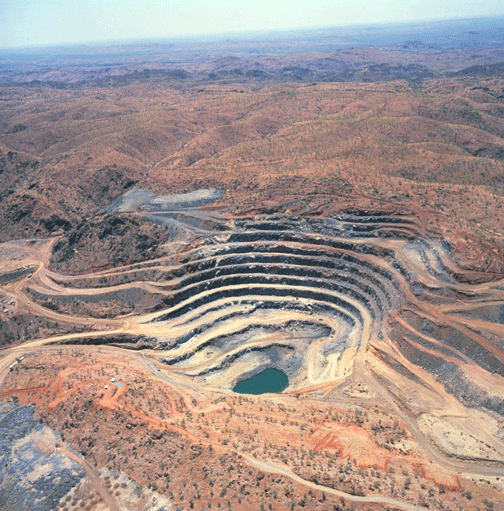 Queensland’s last uranium mine still leaking radioactive water 30 years after production stopped John McCarthy The Courier-Mail March 21, 2013 THE state’s last uranium mine at Mary Kathleen – in the Selwyn Range between Mount Isa and Cloncurry – is still leaking radioactive water from the site 30 years after production stopped. But, according to a committee report handed to the State Government this week, the return of uranium mining to Queensland is “risky but manageable”.
“The uranium mining industry has a number of inherent environmental risks,” the report said….. The report says the Mary Kathleen mine’s pit is still full of highly contaminated water to a depth of about 50m, and since the mine closed in 1982, several other studies have found “ongoing environmental legacy issues”.
Those include the seepage of acidic, metal-rich, radioactive waters from the base of the tailings dam into the former evaporation ponds and local drainage system.
Australian Conservation Foundation spokesman Dave Sweeney said there was no evidence that uranium mining was safe because not one former mine had been rehabilitated properly.
“In the Northern Territory there is a range of old mines, maybe a dozen or more, that are still being cleaned up 50 years after the event,” Mr Sweeney said…… http://www.couriermail.com.au/news/queensland/queenslands-last-uranium-mine-still-leaking-radioactive-water-30-years-after-production-stopped/story-e6freoof-1226601866129
How the legal system betrayed nuclear test veterans
 Chris Busby: Nuclear Test Veterans betrayal http://www.youtube.com/watch?feature=player_embedded&v=ll11ZXpbDKg#! 20 March 13, Prof Busby talks about the Test veterans radiation Pensions Appeals Tribunals cases. He explains how the veterans have been betrayed by their solicitors through a complex series of changes in the nature of the hearings and the sudden withdrawal of one solicitor firm Rosenblatts and its curious replacement by another, Hogan Lovells, culminating in the removal of all the critical evidence from the cases and the exclusion of Busby’s evidence collected over three years, without the knowledge of the individual litigants.
Mainstream media downplays Fukushima disaster”- repeats IAEA propaganda
The IAEA was created by the UN Security Council, and its five permanent nuclear powers, to “”[assist] its Member States, in the context of social and economic goals, in planning for and using nuclear science and technology for various peaceful purposes, including the generation of electricity”” In other words, the purpose of the IAEA is to promote the nuclear power industry on behalf of the most powerful nuclear states on the planet.
 The Truth About Radiation Joe Giambrone OpEdNews 3/20/2013 I’m afraid I’ve got some bad news, and I’m going to have to point out some widespread — let’s say — untruths going around concerning the health impacts of radiation poisoning from the Fukushima meltdowns. Yes, that’s “meltdowns,” plural. It’s actually quite a bit more catastrophic than your mainstream media will tell you, and your government officials, of course, have only ever had one message on the subject: “It’s reaaaaaaally not so bad, so don’t you worry your pretty little head about it.‘ They were saying this on day one, before they knew how bad it was. They were saying it ever since, even as the numbers skyrocketed up into uncharted territory. How can they get away with blatantly lying to the public, you might ask? That is a complex question, and requires a complex answer.
Ask yourself this, next time you come upon a “don’t worry be happy” take on a nuclear meltdown in the media: are any doctors, the people directly treating the children who live in the radioactive contamination zones, ever included in their reporting?
Short answer is no. They are not. Are these doctors far too busy and/or isolated to be interviewed? Is that the reason for their absence across the mainstream news-tainment complex?
A typical radiation news report includes an IAEA spokesman, a government official, and a factoid from the latest study that has come out, all of which bolsters the idea that nuclear meltdowns aren’t so bad. One might assume that the IAEA, or International Atomic Energy Agency, is some kind of skeptical party, a watchdog perhaps. This is false. Continue reading
Loss of power to Fukushima Daichi nuclear plant caused by a rat
 The Fukushima Daichi blackout was caused by a mouse/rat or lemming In this photo released by Tokyo Electric Power Co., the carcass of a small animal lies inside a temporary electric switchboard at the Fukushima Dai-ichi plant in Okuma town, Fukushima Prefecture, northeastern Japan Wednesday, March 20, 2013. Masayuki Ono, spokesman for Tokyo Electric Power Co., the utility that runs the nuclear plant, said a 15-centimeter (6-inch) rat was found dead Wednesday near the switchboard. He said the rat may be linked to this week’s power failure, but that more investigation is needed to be sure. (AP Photo/Tokyo Electric Power Co.) EDITORIAL USE ONLYhttp://www.breitbart.com/system/wire/app-471bb9fd-5dbf-44f3-b95a-f65d142633c8 Posted by Mochizuki on March 20th, 2013…….More at http://nuclear-news.net/2013/03/20/the-fukushima-daichi-blackout-was-caused-by-a-mouse/
Ausltralia’s opposition party still a risk to the country’s renewable energy future
 Breaking: Canberra endorses status quo on renewables target REneweconomy By Giles Parkinson on 21 March 2013The “…….Australian Greens, who argue Australia should have no less than 50 per cent renewable energy by 2030, have welcomed the government’s RET endorsement, but warn there is still a “big black cloud of uncertainty hanging over the industry,” which they name as Tony Abbott and Greg Hunt.
“(Abbott and Hunt) must come out and rule out reducing the 41,000 gigawatt hour target for large-scale renewables or accept responsibility for killing off major projects,” Greens leader Christine Milne said today.
“Ducking and weaving and refusing to answer the question by constantly saying that the Coailtion supports the 20 per cent renewable energy target is dishonest. Is it 41,000 gigawatt or not? …They need to be upfront and admit that what they want to do… is cave in to the vested interests in coal and gas and in so doing destroy renewable energy.” Continue reading
Queensland Government apparently willing to export uranium through Great Barrier Reef
Uranium export through Reef not ruled out 9 News, March 18, 2013 The Queensland government won’t rule out exporting uranium through the Great Barrier Reef, after receiving a report advocating a return to mining the radioactive material.Natural Resources and Mines Minister Andrew Cripps made the concession on Monday after receiving 40 recommendations from a committee tasked with examining the resurrection of the uranium mining industry.
Uranium mining was banned in Queensland in 1989 and the material hasn’t actually been mined since 1982. The Uranium Mining Implementation Committee’s report has recommended uranium be exported from ports in Adelaide and Darwin, given they already have the appropriate environmental licences.
However, committee chairman Paul Bell says the option is open for a port to be opened up in Queensland if demand warrants it. Talks have already been held with the Port of Townsville, he says.
Mr Cripps has not ruled out shipping uranium through the reef…. green groups remain unimpressed and have hit out at the government for lifting the ban despite saying before the election that it had no plans to do so.
An anti-uranium mining alliance of key environmental groups produced its own report on Monday, labelling the industry “high risk, low return”. “Premier (Campbell) Newman was elected with a no-mines position and then broke this commitment without evidence, independent assessment or consultation,” alliance spokeswoman Robin Taubenfield said in a statement.
Unsafety of India’s nuclear industry: Australia could be fuelling a nuclear disaster
 Aust could fuel India ‘nuclear accident’ THE AUSTRALIAN AAP March 20, 2013 ANTI-NUCLEAR campaigners have raised concerns Australian uranium could fuel a nuclear accident in India similar to the Fukushima and Chernobyl disasters.
Negotiations are under way in New Delhi to establish nuclear safeguards before Australia begins selling uranium to India.
 Last year India’s auditor-general warned that lax safety standards could lead to a nuclear disaster.
It is a concern backed up by the Indian-based Coalition for Nuclear Disarmament and Peace (CNDP).
“A major catastrophic accident like Fukushima could happen in any of our 20 reactors,” CNDP spokesman Praful Bidwai told ABC television. Workers in the reactors said they could not be relied upon to raise the alarm on an impending disaster because they were not kept informed by management.
“We can be out there all day in the reactor and we wouldn’t know if we’ve been exposed to danger or not,” said Gulab Singh who works in a Rajasthan reactor.
“They know that if they don’t do the job they won’t have work, so they accept all levels of radiation and keep on working,” he said……..http://www.theaustralian.com.au/news/breaking-news/aust-could-fuel-india-nuclear-accident/story-fn3dxiwe-1226602027160
Australian government is keeping the Renewable Energy Target unchanged
Breaking: Canberra endorses status quo on renewables target REneweconomy By Giles Parkinson 21 March 2013 The Australian government has announced it endorses the Climate Change Authority’s recommendation that the fixed target of 41,000GWh be retained for the country’s Renewable Energy Target.
The decision was a crucial one for the renewables industry, which said that $18 billion of investment in wind and solar farms would be under threat if the government acceded to a push by some major generators and energy utilities to dilute the target. The generators, and utilities such as Origin Energy and EnergyAustralia, fear reduced earnings from their coal and gas fired generation if more renewables are deployed.
However, federal climate change minister Greg Combet said the CCA review had concluded there would be no benefit to consumers in reducing the target, and had argued that in the interests of investment certainty the target should be retained. Continue reading
General Electric’s chief warns on the great cost factors that are stalling nuclear power
Jeff Immelt backs free market on gas GLENDA KORPORAAL The Australian March 21, 2013 GE chief executive and global chairman Jeff Immelt has rejected suggestions that Australia should follow the US policy of restricting its natural gas exports to provide cheaper domestic energy……..
GE chief executive and global chairman Jeff Immelt has rejected suggestions that Australia should follow the US policy of restricting its natural gas exports to provide cheaper domestic energy.
He said he felt the future of the nuclear power industry would depend on whether governments were prepared to support it.
He said cost factors were so great that new nuclear plants would not go ahead unless governments backed them.
The Australian, in association with GE, is in coming weeks launching the Path to Prosperity series, a landmark project exploring the opportunities ahead for key industries across the nation. http://www.theaustralian.com.au/business/mining-energy/jeff-immelt-backs-free-market-on-gas/story-e6frg9df-1226601983356
Don’t fall for the media blather about “background radiation”
 The Truth About Radiation Joe Giambrone OpEdNews 3/20/2013 “…….What you will be told by your televised talking heads is that there is such a thing as “background radiation” and that any and all radiation problems you may encounter are of no more concern to you than eating a banana or flying in a plane at high altitude. Are you really going to fall for that one?
They type this stuff with a straight face. The US Academy of Sciences studied the effects of low-level ionizing radiation in a massive report called BEIR-VII: Health Risks From Exposure to Low Levels of Ionizing Radiation (2006). Well, the very first paragraph tells us, “A comprehensive review of available biological and biophysical data supports a “linear-no-threshold” (LNT) risk model–that the risk of cancer proceeds in a linear fashion at lower doses without a threshold and that the smallest dose has the potential to cause a small increase in risk to humans.”
So think about that. How then can the news media and government officials proclaim that doses are so small that they are “safe” and of no concern? Their own best available scientific data tells us that there is no “safe” dose at all, and that all radiation is bad and to be avoided. Continue reading
Corporations exert their power in secret deals in the Trans Pacific Partnership (TPP)
The TPP will give big business additional leverage through regulatory ceilings and dispute resolution tribunals.
The chilling effect on regulation is greater in poorer countries that can be cowed by the panels…..
On the chilling effect on regulation, Wallach said there is “no limit to the amount of money tribunals can order governments to pay corporations.” ….
The majority of those in power are under overwhelming pressure from moneyed interests to pass the deal …
there is substantial evidence – not least, the enthusiasm among corporate lobbyists, their intense lobbying efforts…..to suggest that the TPP is going to contain deregulatory initiatives and measures that usher in the privatization of publicly owned enterprises and the fencing off of the creative commons.
Corporate-Backed Trans-Pacific Partnership Shrouded in Secrecy, 19 March 2013 By Sam Knight, Truthout | News Analysis The Trans-Pacific Partnership (TPP), a multilateral trade deal currently being hammered out by the United States and ten other countries, could end up affecting every human being and dollar of wealth on the planet. The extent to which it will is clear to no one, apart from negotiators.
But the deal, in its current form, has been in the works since 2010, involves Australia, Brunei, Canada, Chile, Malaysia, Mexico, New Zealand, Peru, Singapore, the United States and Vietnam, and is open to all 21 countries in the Asia Pacific Economic Cooperation (APEC) region. Continue reading
1 This month
7 April – WEBINAR – Australia and the Doomsday Clock – Preventing nuclear war through NoFirstUse and other policies
Online | Tuesday April 7, 4:00-5:30pm, Australian Eastern Time / 8:00-9:30am Central Europe Time
– Access the registration link
15 April – Zoom –Nuclear Power is Not the Solution
Apr 15, 2026 01:00 AM in Canberra, Melbourne, Sydney

Join the International Physicians for the Prevention of Nuclear War (IPPNW) on Tuesday, April 14th for a timely webinar exploring the risks associated with nuclear power and challenging the myth that it offers a simple, safe, carbon-free solution to the climate crisis

21 April Webinar: No Nuclear Weapons in Australia
Start: 2026-04-21 18:00:00 UTC Canberra, Melbourne, Sydney (GMT+10:00)
End: 2026-04-21 19:30:00 UTC Canberra, Melbourne, Sydney (GMT+10:00)
Event Type: Virtual
A virtual link will be communicated before the event.
Host Contact Info: australia@icanw.org

of the week – Australians for War Powers Reform (AWPR)
To see nuclear-related stories in greater depth and intensity
 Antinuclear