Uranium lobby’s King is Dead: Long Live the King
 ” I am, and always have been an enthusiast for the uranium industry.”
” if the industry is to be embraced by the Australian public, it must continue to work hard to pursue public  education.”
“the Australian uranium industry has a positive future ahead of it.”
Christina Macpherson 28 March 13. There was brief jubilation as Prime Minister Julia Gillard sacked
Martin Ferguson from the Resources and Energy Ministry. After all, who could be more dismissive and insensitive to Australia’s Aboriginal people than Ferguson, in his fervour to place a nuclear waste dump on their land?
And perhaps, perhaps, the new Minister, Gary Gray, will be more willing to consider their rights.
However, does the new man sees his portfolio as really about Australia’s energy resources – including solar, wind, tidal? Martin Ferguson certainly didn’t.
Furthermore, Gray has Tourism lumped into his portfolio. Can we hope that he will stick up for the rights of Australia’s tourism industry – say – concerning the Great Barrier Reef – and the plan to export uranium through it?
I don’t think so. Read Gary Gray’s response to the Fukushima nuclear disaster- an all out push for uranium mining!
Gary Gray’s speech to Australian Uranium Conference 2011 Perth 21 July 2011
Introduction
It’s my pleasure to be here today speaking in the place of the Minister for Resources and Energy at this important event for the uranium sector.
Martin and I are staunch supporters of your industry and I know he would have welcomed the opportunity to address this gathering.
Now in its seventh year this conference brings industry together again to engage on the latest business, technical and policy developments.
Unquestionably, it has been a difficult year for uranium.
But despite this we believe in uranium mining and in its future. Continue reading
Japan’s post Fukushima cancer timebomb
 “The potential effects of radiation from Fukushima have beenshamelessly down played. It could be many years before we discover the real impact and some of the risks are being ignored.” According to the organisation, radiation “hotspots” have been found in school playgrounds outside the evacuation zones. “We are most concerned about vulnerable people, including children and pregnant women,” says Dr Teule. “The likelihood is that thousands of people are at risk of cancer from the Fukushima disaster.”….
FARMERS face ruin……
Two years after the Fukushima nuclear disaster is Japan facing a cancer time bomb? Express UK, by Adrian Lee, 26 March 13, TWO years after the Fukushima nuclear disaster local children are showing signs of cancer, prompting cries of a cover-up. “…… Officially the mass evacuation was a success and the prompt action of a heroic band of workers at the crippled plant averted a nuclear catastrophe. No one has so far died as a result of radiation from Fukushima, insist the authorities. However there are growing concerns that the full scale of the disaster has yet to be seen. There are claims of complacency and a cover-up. It’s not the Japanese way to stage protests but there has been a series of anti-nuclear rallies in Tokyo, 160 miles south.
While it’s true that people living very close by were evacuated within the first few days, damage may already have been done to their health. Many more, living up to 25 miles away, were not moved away until six weeks after the radiation escaped.
It’s also feared that the food chain has been contaminated. Radioactive material has been detected in a range of produce, including spinach, tea leaves, milk and beef, up to 200 miles distant. Fish caught near the plant this month were more than 5,000 times over safe radiation limits, according to Japan’s state broadcaster NHK. Continue reading
Thousands petition NSW Parliament to oppose uranium exploration and mining
 27 March 13, NSW Parliament today received a petition of over 2,000 people opposing uranium exploration and mining in NSW and calling on the government to maintain the ban on uranium mining and to hold an open and transparent inquiry into uranium mining in NSW. Greens MP and uranium spokesperson Jamie Parker said:
 “The petitioners have told the Liberal government loud and clear: uranium exploration and mining must not be allowed in NSW.
“This is a hugely damaging industry with a long and well-documented history of safety breaches, dangerous leaks and failed attempts at rehabilitation.
“Labor and Liberal governments in Australia are legislating to allow uranium exploration and mining, placing local communities at risk while increasing the threat of nuclear proliferation and disasters overseas.
“This is even more alarming considering Federal Labor’s decision to export uranium to India, a country which has not signed the nuclear non-proliferation treaty.
“Exploration inevitably leads to mining and all the dangers and health hazards that involves – we must stop this damaging industry now, before it expands even further.
“We should be working toward a clean energy future and investing in renewables, instead of fostering this dangerous and unnecessary industry which will leave a lasting radioactive legacy for future generations.” Mr Parker said.
The facts on Australia’s potential for rooftop solar energy
 Rooftop Solar Could Supply 134% Of Australian Residential
 Power Needs (includes excellent table illustrating Australia’s rooftop potential and costs) http://www.energymatters.com.au/index.php?main_page=news_article&article_id=3660 27 March 2013: Australians feeling the pinch from high electricity prices have an economical alternative, and if every suitable rooftop in Australia was turned into a solar power station, the amount of energy generated would supply more than 134.8% of the country’s residential electricity needs.
Not only would the installation of solar on every roof be a boon for jobs, the cost of the electricity being generated would be reduced to a mere 7 cents per kWh. This potential new pricing point is in total contrast to what Australians are currently paying; up to 40 cents per kilowatt-hour (kWh)1 in some parts of the country, which is predicted to continue climbing. Continue reading
Commercial solar panel leasing takes off in South Australia
 Energy Matters’ Australian First For Commercial Solar Leasing http://www.energymatters.com.au/index.php?main_page=news_article&article_id=3657 28 March 13 National solar solutions provider Energy Matter has announced a commercial solar leasing program offering South Australian businesses the opportunity to install a solar power system with zero up front costs.
The announcement was made at the recent formal unveiling of Ullrich Aluminium’s latest solar installation; a 30kW commercial system at their Pooraka, South Australia facility. Continue reading
Nuclear power phaseout already happening in USA
….Thus, even without events that might accelerate nuclear phase-out, as the Fukushima disaster did in Germany, shifting competitive conditions have begun to drive a gradual US nuclear phase-out….…..In the United States, which trades three-fifths of its electricity in competitive markets, the prohibitive capital cost of new nuclear power plants ensures that only a handful will be built. ……….. But the generating costs of ageing reactors have been rising, while competitors, including modern renewable s, show rapidly falling total costs—and those opposed cost curves have begun to intersect….
 March 25, 2013
Japan already has storage systems – well suited to solar power
A Solar Powered Tokyo? http://www.energymatters.com.au/index.php?main_page=news_article&article_id=3661 28 March 13 Much of Tokyo’s power needs once supplied by nuclear power could be met by rooftop solar along with energy storage systems already in place. Nuclear is still a dirty word to many in Japan following the Fukushima crisis, a disaster that will continue to negatively affect a large area for many years to come.
While solar power offers an attractive alternative; the issue remains of continual supply – particularly at night and during heavily overcast days.
A recent study examining the potential for rooftop photovoltaics in Tokyo to replace nuclear capacity reveals some of the answer is already in place – pumped hydroelectric storage.
“Japan is in the unique position of already possessing the largest capacity of pumped hydroelectric storage in the world, a total of 24.6 GW… Continue reading
Australian’s especially vulnerable to UV radiation
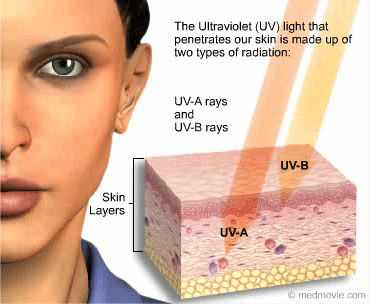 How does the ozone layer protect Earth from radiation? The Coversation by Stuart Henderson, and Peter GiesThis is bad, but it would be a lot worse without the ozone layer. garth.kennedy/Flickr
SAVING THE OZONE: Part three in our series exploring on the Montreal Protocol on Substances that Deplete the Ozone Layer – dubbed “the world’s most successful environmental agreement” – explains why we need an ozone layer.
The ozone layer acts as a filter for the shorter wavelength and highly hazardous ultraviolet radiation (UVR) from the sun, protecting life on Earth from its potentially harmful effects. When the sky is clear, there is an inverse relationship between stratospheric ozone and solar UVR measured at the Earth’s surface. That is,the lower the ozone levels, the higher the solar UVR.
The level of UVR from the sun measured at the Earth’s surface varies linearly with latitude. There are higher UVR levels nearer the equator and lower UVR nearer the poles (see Figure 1).
Australia has high levels of solar UVR, due mainly to its geographical position. We have capital cities at latitudes ranging from 12°30’S (Darwin) close to the equator down to 42°52’S (Hobart). Continue reading
Kevin Buzzacott supports Scotland’s Scrap Trident Coalition
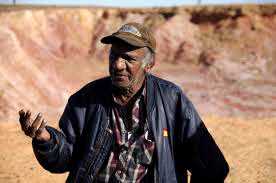 Sadly, the scandalous devastation and exploitation of land which carries great spiritual significance for the Aboriginal people did not end there. Almost 50% of the world’s estimated stocks of Uranium ore occur in Australia, the vast majority of which are to be found on Aboriginal land. These are minerals which are much coveted by large mining companies who wish to remove them despite the costs to workers, the natural landscape and the safety of the globe. Despite the fact that Aboriginal Australians continue to endure standards of living and health far below those of non-indigenous Australians, the indigenous communities in general remain steadfastly opposed to the exploitation of their traditional lands for these poisons.
Scrap Trident – A message from the Arabunna Nation for the people of Scotland http://scraptrident.org/scrap-trident-a-message-from-the-arabunna-nation-for-the-people-of-scotland/ 19 March, 2013 We here at the Scrap Trident Coalition are immensely proud to have received the message of support from Arabunna Nation elder Kevin Buzzacott. Continue reading
1 This month
7 April – WEBINAR – Australia and the Doomsday Clock – Preventing nuclear war through NoFirstUse and other policies
Online | Tuesday April 7, 4:00-5:30pm, Australian Eastern Time / 8:00-9:30am Central Europe Time
– Access the registration link
15 April – Zoom –Nuclear Power is Not the Solution
Apr 15, 2026 01:00 AM in Canberra, Melbourne, Sydney

Join the International Physicians for the Prevention of Nuclear War (IPPNW) on Tuesday, April 14th for a timely webinar exploring the risks associated with nuclear power and challenging the myth that it offers a simple, safe, carbon-free solution to the climate crisis

21 April Webinar: No Nuclear Weapons in Australia
Start: 2026-04-21 18:00:00 UTC Canberra, Melbourne, Sydney (GMT+10:00)
End: 2026-04-21 19:30:00 UTC Canberra, Melbourne, Sydney (GMT+10:00)
Event Type: Virtual
A virtual link will be communicated before the event.
Host Contact Info: australia@icanw.org

of the week – Australians for War Powers Reform (AWPR)
To see nuclear-related stories in greater depth and intensity
 Antinuclear