Australian’s especially vulnerable to UV radiation
 How does the ozone layer protect Earth from radiation? The Coversation by Stuart Henderson, and Peter GiesThis is bad, but it would be a lot worse without the ozone layer. garth.kennedy/Flickr
SAVING THE OZONE: Part three in our series exploring on the Montreal Protocol on Substances that Deplete the Ozone Layer – dubbed “the world’s most successful environmental agreement” – explains why we need an ozone layer.
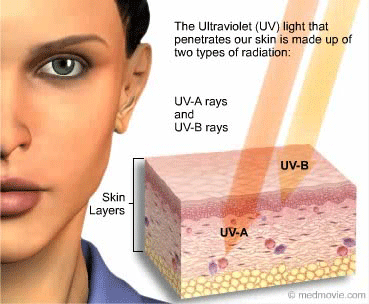
The ozone layer acts as a filter for the shorter wavelength and highly hazardous ultraviolet radiation (UVR) from the sun, protecting life on Earth from its potentially harmful effects. When the sky is clear, there is an inverse relationship between stratospheric ozone and solar UVR measured at the Earth’s surface. That is,the lower the ozone levels, the higher the solar UVR.
The level of UVR from the sun measured at the Earth’s surface varies linearly with latitude. There are higher UVR levels nearer the equator and lower UVR nearer the poles (see Figure 1).
Australia has high levels of solar UVR, due mainly to its geographical position. We have capital cities at latitudes ranging from 12°30’S (Darwin) close to the equator down to 42°52’S (Hobart).
For comparison with some Northern Hemisphere locations, the south of France is 43°N and London is 51°32’N, while Melbourne at 37°46’S is as far from the equator as the coast of North Africa (37°16’N).
The southern hemisphere generally has higher levels of solar UVR than the northern hemisphere, because the Earth is approximately 1.7% closer to the sun in January (summer) than at the equinox and 1.7% further away in July (northern hemisphere summer). The intensity of solar UVR is proportional to the square of the distance, so this means solar UVR levels are already 3.4% higher in the southern Hemisphere than at equinox and 3.4% lower for an equivalent location in the northern hemisphere. However as the atmosphere in the southern hemisphere is cleaner than that in the northern and transmits UVR more readily, these differences are even larger for similar latitudes, approaching ~15%.
Australians are predominantly descended from fair-skinned individuals used to European conditions, so exposure to these high levels of solar UVR has resulted in very high rates of skin cancer within the population. Deaths are now more than 1800 per year with a cost to the health system of more than $300M annually….. If not for the success of the Montreal Protocol it is very likely that the more densely populated areas of the globe would be subject to increased solar UVR with potentially severe consequences for (human) health.
No comments yet.
1 This month
7 April – WEBINAR – Australia and the Doomsday Clock – Preventing nuclear war through NoFirstUse and other policies
Online | Tuesday April 7, 4:00-5:30pm, Australian Eastern Time / 8:00-9:30am Central Europe Time
– Access the registration link
15 April – Zoom –Nuclear Power is Not the Solution
Apr 15, 2026 01:00 AM in Canberra, Melbourne, Sydney

Join the International Physicians for the Prevention of Nuclear War (IPPNW) on Tuesday, April 14th for a timely webinar exploring the risks associated with nuclear power and challenging the myth that it offers a simple, safe, carbon-free solution to the climate crisis

21 April Webinar: No Nuclear Weapons in Australia
Start: 2026-04-21 18:00:00 UTC Canberra, Melbourne, Sydney (GMT+10:00)
End: 2026-04-21 19:30:00 UTC Canberra, Melbourne, Sydney (GMT+10:00)
Event Type: Virtual
A virtual link will be communicated before the event.
Host Contact Info: australia@icanw.org

of the week – Australians for War Powers Reform (AWPR)
To see nuclear-related stories in greater depth and intensity
 Antinuclear
Leave a comment