Shakeups in the Assange legal case
 to publicly discuss the case.
 “If an Australian High Court judge came out and spoke on a case the court expected or was likely to judge, it would be regarded as absolutely outrageous,” he told Fairfax media.
WikiLeaks characterized the judge’s lecture as part of the Swedish government campaign against Assange, following Swedish Foreign Minister Carl Bildt’s recent visit to Australia.
“The head of Swedish Supreme Court campaigning on a case they expect to judge with $ from the embassy in the run up to an election,” the group wrote on Twitter.
Assange legal shakeup: Prosecutor walks, Supreme Court judge to speak out on case RT March 28, 2013 The lead Swedish prosecutor pursuing sexual assault charges against WikiLeaks founder Julian Assange is no longer handling the case, media reports revealed. Her departure comes as a top Swedish judge is set to speak publicly on the ‘Assange affair.’ Continue reading
New Energy Minister Gray – dubious credentials on climate change
Political moves in Australia’s renewable energy landscape, PV Magazine 25 MARCH 2013 BY: JONATHAN GIFFORD, A cabinet reshuffle in Australia results in the Department of Climate Change merging with Industry and a new Energy Minister. In the states of Queensland and Western Australia, electricity price policies remain a subject for debate.
 With renewable energy becoming an increasingly contentious issue in Australian politics, former oil and gas industry advisor Gary Gray has been appointed Australia’s new Energy Minister in a cabinet reshuffle. As a part of the changes, the Climate Change Department will be merged with the Industry Department, however minister Greg Combet will remain in charge of the portfolio.
Australian green business website Climate Spectator observed earlier today that not bringing the energy and climate change portfolios together represented a missed opportunity. It also pointed out that new energy minister Gray has dubious credentials when it comes to climate change.
“Gary Gray was one of the founders of the Lavoisier Institute, a group that has probably done more than any to spread misinformation about the science of global warming in Australia. According to The Age (newspaper), in 1993 Gray said the evidence linking human activity to climate change was ‘pop science’.”…..
The government has shown support for renewables in other ways and last week it committed to maintaining its Renewable Energy Target (RET) for 2020, a move that was welcomed by the photovoltaic and renewable energy industries…… http://www.pv-magazine.com/news/details/beitrag/political-moves-in-australias-renewable-energy-landscape_100010677/#ixzz2OxVmPPeE
USA nuclear energy production falls, wind energy races ahead
 BAD NEWS FOR HOMER SIMPSON HTTP://QZ.COM/68344/US-RENEWABLE-ENERGY-PRODUCTION-NOW-TOPS-NUCLEAR-POWER/ US renewable energy production now tops nuclear power By Todd Woody — March 28, 2013
US president Barack Obama has pursued an energy policy he describes as “all of the above,” a bit of Bill Clinton-style triangulation that seeks to boost production from carbon-intensive oil and gas drilling while promoting clean technologies like solar and wind.
So how’s he doing?
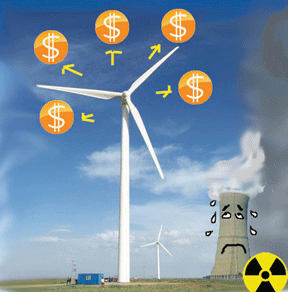 New data released yesterday from the US Energy Information Administration offers a snapshot of the energy landscape in Obama’s first term. Energy production from natural gas grew 16% while coal-fired power fell more than 4%, thanks to a glut of cheap natural gas from the fracking boom. It’s a trend likely to continue as shale gas reserves are tapped and new emissions regulations effectively bar the construction of new coal-fired power plants.
Renewable energy production jumped nearly 24% but remains only 11% of the US’ total energy production. But the trend lines tell the story: Wind energy, for instance, grew 89% while electricity production from nuclear power plants fell 4%.
And this factoid should warm the hearts of anti-nuke activists: The US now gets more energy from renewable sources—wind, solar, hydro, geothermal, and biomass—than it does from nuclear power plants.
While there are new nuclear projects winding their way through the regulatory process, don’t expect a nuke boom. Multibillion-dollar price tags, waste disposal issues and growing water shortages are likely to limit nuclear power’s contribution to the nation’s energy mix in the coming decades.
Mr. Burns just might want to start looking for another job, perhaps as a wind farm magnate.
Murwillumbah flm screening, and talk by Christine Assange – April 6th
 Julian Assange’s mother to speak at Murwillumbah http://www.mydailynews.com.au/news/julian-assanges-mother-to-speak-at-murwillumbah/1804982/ Luke Mortimer 26th Mar 2013 The mother of WikiLeaks founder,Christine Assange, will be conducting an information session at Murwillumbah’s Regent Cinema on April 6.
This will coincide with the National Film and Sound Archive of Australia’s Big Screen Film Festival screening of Underground:  The Julian Assange Story.
Ms Assange will be there to answer any queries relating to the film and her son’s chequered past.
“It is wonderful to bring writer/director Robert Connolly and his new thriller, Underground: The Julian Assange Story, to Murwillumbah,” Big Screen Co-ordinator Jacqui North said.
“We previously worked with Robert to bring his award-winning 2009 film Balibo to Broken Hill, where he met a very appreciative regional audience. We hope everyone in Murwillumbah will enjoy this unique night.”
The movie is a dramatization of Assange’s teenage years growing up as a hacker in Melbourne and has received rave reviews from many critics.
These days he is well known as the founder of not-for-profit media organisation WikiLeaks, which has released thousands of documents directly leaked by the public.
Their work has been met with controversial Government reactions worldwide, but other organisations view WikiLeaks as promoting freedom of information.
Tickets are $12 for adult admission and those looking for more information can visitwww.cinemaregent.com.
Squirrels, rats, snakes, birds can cause havoc at nuclear power plants
Wildlife vs U.S. nuclear plants: Flies short-out transformer — Pelican starts emergency generator — Snake causes fire — Bird shuts down reactor… more http://enenews.com/wildlife-incidents-at-u-s-nuclear-plants-flies-short-out-power-transformer-pelican-starts-emergency-generator-snake-causes-fire-fish-block-water-intake-more
March 27th, 2013
Title: Fission Stories #133: Mayflies, and Squirrels, and Rats
Source: All Things Nuclear (Union of Concerned Scientists)
Author: Dave Lochbaum, director, Nuclear Safety Project
Date: March 26, 2013
[…] one wonders about the havoc that an individual saboteur or a team of bad guys might be able to cause by malicious intent. Could well-trained and heavily armed attackers cause more devastation than a furry little squirrel or a pesky rat? […]
Selected incidents at U.S. nuclear plants:
Pelican started an emergency diesel generator
Bird caused […] shut down […] after it landed in the switchyard containing electrical cables connecting the plant to its offsite electrical power grid
Snake slithering onto an overhead power cable […] caused a short that caught the wooden pole holding the cable on fire
“A large number of small forage fish” blocked the screens at the intake structure
Squirrel caused an electrical short in the main power transformer.
Bunch of jellyfish blocked the screens at the intake station
Mayflies caused a power transformer to short out
Full report here
See also: Tepco: Animal caused extended power outage at Fukushima Daiichi — Nearly a foot long (PHOTO)
Indigenous and environmental lobbying pays off, as Quebec calls a halt to uranium development
 “It’s a little bit like asbestos — people have come to the conclusion that there are certain minerals that are so dangerous that they’re not worth mining, they’re better to leave underground,” Edwards said. “One is asbestos, and one is uranium
Quebec imposes moratorium on uranium development, Montreal Gazette, By Kevin Dougherty and Monique Beaudin, March 28, 2013
QUEBEC — No permits for the exploration or mining of uranium in Quebec will be issued until an independent study on the environmental impact and social acceptance of extracting uranium has been completed, Environment Minister Yves- François Blanchet announced Thursday.
Blanchet has asked Quebec’s Bureau d’audiences publiques sur l’environnement to examine the issue of uranium development and uranium waste in general, with hearings throughout the province……Blanchet said he realizes the northern Quebec Crees of  Eeyou Istchee have called for a permanent moratorium on uranium development and he hopes the Crees and other aboriginals participate in the process.
In a statement, the Crees welcomed the “moratorium,” while expressing reserves……..
Christian Simard, of the environmental groups Nature Québec and Québec meilleure mine, applauded Blanchet’s announcement, while adding that environmentalists wanted a complete halt to uranium exploration.
But Simard noted uranium prices are very low and the number of active exploration sites in Quebec now stands at about 10. Continue reading
All new homes must have solar energy systems – a Californian City Council rules
 CALIFORNIA CITY TO REQUIRE SOLAR ENERGY SYSTEMS ON ALL NEW HOMES HTTP://E360.YALE.EDU/DIGEST/LANCASTER_CALIFORNIA_TO_REQUIRE_SOLAR_ENERGY_SYSTEMS_ON_NEW_HOMES/3804/ 28 MAR 2013: A city in southern California this week passed a zoning regulation that requires developers to install solar power systems on every new house they build. Beginning next year, all new homes built on lots at at least 7,000 square feet in size in Lancaster, Calif. will be required to produce at least one kilowatt of solar electricity. Developers also have the option of purchasing solar energy credits from other developments within the city limits. The new zoning rules are the latest initiative in Mayor Rex Parris’s quest to make Lancaster, which has a population of 150,000 and abundant sunshine, the “solar capital of the universe.” Since 2008, the city has also introduced an initiative to attract utility-scale solar developers to the city, proposed a transmission project to deliver solar-generated power to other communities, and created an affordable solar financing program for homeowners, businesses, and nonprofits. “To truly establish ourselves as the alternative energy capital of the world, we must continue to take a progressive approach,” Parris, a Republican, said in a statement.
International Monetary Fund calls for scrapping of fossil fuel subsidies
 IMF Urges Reining In Of Fossil Fuel Subsidies http://www.energymatters.com.au/index.php?main_page=news_article&article_id=3662 29 March 13, A new report from the International Monetary Fund (IMF) estimates that energy subsidies total $1.9 trillion worldwide – the equivalent of 2.5 percent of global GDP. Earlier this month, Earth Policy Institute (EPI) pegged the number at USD$620 billion; however the IMF’s figures are based on a post-tax basis that also factors in a range of negative externalities from energy consumption.
The IMF’s paper shows for some countries the burden of energy subsidies is becoming so great that it threatens the stability of those economies.
Instead of supporting the poor, IMF First Deputy Managing Director David Lipton says energy subsidies reinforce inequality as they mainly benefit upper-income groups given they tend to be the largest consumers of energy.
“On average, the richest 20 percent of households in low- and middle-income countries capture 43 percent of fuel subsidies,” said Mr. Lipton.
Eliminating energy tax subsidies would deliver massive emissions reductions, slashing carbon dioxide emissions by 4.5 billion tons, a 13 percent reduction. Doing so would also strengthen incentives for research and development in energy-efficiency and alternative technologies.
Mr. Lipton says in some countries, low energy prices also mean little investment in essential infrastructure occurs and other critical areas.
“More is spent on subsidies than on public health and education, undermining the development of human capital.”
While fossil fuel subsidies have substantial adverse effects on public finances, economic growth, equity and the environment, Mr. Lipton cautions a weaning-off of subsidisation needs to be done carefully to avoid impacting those who require support the most; stating :it is better to do it the right way, than to do it right away.
The International Energy Agency has also repeatedly called for fossil fuel subsidies to be scrapped in an effort to reduce carbon emissions.
The IMF’s paper provides estimate of energy subsidies in 176 countries and insights as to how to go about energy subsidy reform based on 22 country case studies. The paper can be viewed in full here (PDF).
Queensland’s way of slowing down solar rooftop energy
 Political moves in Australia’s renewable energy landscape, PV Magazine 25 MARCH 2013 BY: JONATHAN GIFFORD, “……….In the state of Queensland, where over 1 GW of photovoltaics is expected to have been installed when its Feed In Tariff expires on July 10, a report into the electricity market has suggested new pricing structures for households installing a photovoltaic array……
The report recommended that a price of AUD0.0755/kWh be paid for electricity fed back into the grid from photovoltaic arrays, in south east Queensland, in 2013/14. It also found that compulsory minimum FITs were not required, and left the possibility of “gross FITs” open. Gross Feed In Tariffs have been vigorously opposed by the solar and renewable energy industry as they essentially prevent the self-consumption of electricity from a rooftop array.
In areas outside of the major population centers in the state, the Competition Authority report recommends the monopoly utility pay between AUD0.08 – AUD0.14/kWh for solar electricity from households.
The report has been criticized by supporters of renewable energy, because it does not take into account the advantages and savings that additional photovoltaic capacity adds, but rather assesses it only as a cost. These advantages include the reduction of wholesale electricity prices – the “merit order effect” – and a reduction of demand in peak times.
The report was also illustrative of some of the potential obstacles the solar industry may face in the future in Australia. The Queensland Department of Energy Supply and Water proposed to the Competition Authority that a limit be introduced to the amount of electricity that could quality for a FIT from each household and even the right of utilities to refuse solar connections http://www.pv-magazine.com/news/details/beitrag/political-moves-in-australias-renewable-energy-landscape_100010677/#ixzz2OxVmPPeE
1 This month
7 April – WEBINAR – Australia and the Doomsday Clock – Preventing nuclear war through NoFirstUse and other policies
Online | Tuesday April 7, 4:00-5:30pm, Australian Eastern Time / 8:00-9:30am Central Europe Time
– Access the registration link
15 April – Zoom –Nuclear Power is Not the Solution
Apr 15, 2026 01:00 AM in Canberra, Melbourne, Sydney

Join the International Physicians for the Prevention of Nuclear War (IPPNW) on Tuesday, April 14th for a timely webinar exploring the risks associated with nuclear power and challenging the myth that it offers a simple, safe, carbon-free solution to the climate crisis

21 April Webinar: No Nuclear Weapons in Australia
Start: 2026-04-21 18:00:00 UTC Canberra, Melbourne, Sydney (GMT+10:00)
End: 2026-04-21 19:30:00 UTC Canberra, Melbourne, Sydney (GMT+10:00)
Event Type: Virtual
A virtual link will be communicated before the event.
Host Contact Info: australia@icanw.org

of the week – Australians for War Powers Reform (AWPR)
To see nuclear-related stories in greater depth and intensity
 Antinuclear