Very little economic benefit to Queensland, in uranium mining
 NGOs release alternative report to Uranium Implementation Committee
Queensland Nuclear Free Alliance March 18, 2013
High Risk – Low Returns: the case against uranium mining in Queensland is the NGO and civil society response to the LNPs undemocratic decision to go ahead with uranium mining in our state.
Read the report http://qnfa.files.wordpress.com/2013/03/180313highcost-lowreturn-uinqld.pdf
In October 2012 the LNP government broke its clear commitment not to allow uranium mining in Queensland. This commitment was the position of the LNP at the March 2012 state election and was reaffirmed after they took office. In the absence of open, inclusive and evidence based policy making the Newman LNP government has set up the Uranium Implementation Committee. The Committee has not sought broad community input and has not been asked to assess the arguments for and against uranium mining in Queensland. The Committee’s mandate is the far narrower task of recommending how uranium mining should be managed, not whether it should occur.
Why should Queensland forego the economic benefits of uranium mining when some other states permit uranium mines? In a nutshell, it is because the economic benefits are grossly overstated and are outweighed by the wide-ranging environmental, public health and weapons proliferation problems and risks.
Uranium accounted for 0.19 per cent of Australia’s export revenue in 2011/12 (the last available figures). By the most generous estimate, uranium accounts for 0.015% of all jobs in Australia. For Queensland, there is the additional limitation that the state has around just 2% of Australia’s uranium resources. Clearly, the industry has no capacity to deliver significant economic or employment benefits.
Instead of acknowledging the extremely limited economic potential of uranium mining in Queensland the LNP state government, the Australian Uranium Association and the Queensland Resources Council have continued a pattern of extravagant and unsubstantiated claims regarding jobs, revenue and royalties. Enthusiasm is no substitute for evidence and limited sectoral self-interest is not the same as the public interest. Continue reading
No scientific basis for “ailments caused by wind energy”
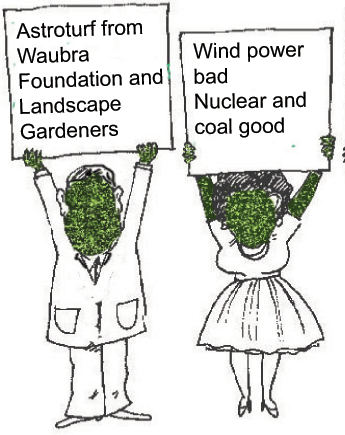 A University of Sydney study released this month concluded wind farm-associated health problems were “communicated” diseases of a psychogenic origin, based on non-physical causes such as fear and anxiety.
The study drew its data on the number of people complaining about health problems from wind farm developers, submissions to government public inquiries and news media articles.
Flannery derides wind farm sickness Weekly Times Now, 28 March 13
CLIMATE commissioner Tim Flannery has dismissed concerns about possible health effects from wind farm noise.
In Thursday’s The Australian, he says illness may be caused by stress or residents being “sick with envy” at not getting payment for turbines on their properties.
Speaking at a nurses’ forum yesterday about the relationship between climate change and health, Professor Flannery fended off a question from a regional Victorian nurse who said she supported wind energy but was seeing many patients with health problems attributed to a nearby wind farm.
”What I’ve read and experienced is that there are no proven health impacts directly from wind-related noise,” Professor Flannery said. “What we do see is people who are adversely affected by it through perhaps stress or tension or worry.” Continue reading
An explanation of the connection between global warming and harsh winters
Global warming cause of harsher winters? http://main.omanobserver.om/node/158846, 30 March 2013 By Richard Ingham and Claire Snegaroff — Millions of people in northern Europe are still battling snow and ice, wondering why they are being punished with bitter cold when — officially — spring has arrived and Earth is in the grip of global warming. Yet some scientists, eyeing the fourth year in a row of exceptionally harsh late-winter weather in parts of Europe and North America, suggest warming is precisely the problem. Continue reading
Physicians refute World Health Organisation’s disinformation on Fukushima radiation
 In contrast to WHO disinformation and what may only be described as pro-nuclear propaganda, a report from the International Physicians for the Prevention of Nuclear War (IPPNW) has analyzed some of the available data from Japan and found “[t]he initial health consequences of the nuclear catastrophe are now, two years after the incident, scientifically verifiable” (9).
Depending on which demographic group is included in the survey and the radiation level that is considered a risk, the IPPNW estimated that upwards to 136,872 cancer cases or serious illnesses, apparently not including precancerous tumors on children, could occur.
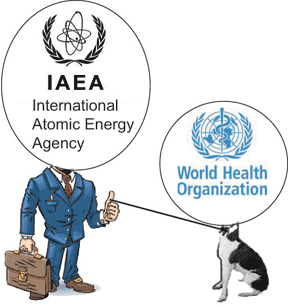 World Health Organisation lies Refuted: Physicians Group predicts 100,000+ Fukushima Cancer Incidences/Deaths, rense.com, By Richard Wilcox, PhD, 14 March 2013“………WHOM Do You Trust?
The WHO published their Fukushima report just before the two-year anniversary of the March 11, 2011 nuclear disaster, and – incredibly – announced that there will be practically no ill health effects to the public despite documented evidence to the contrary. A typical “mainstream media” headline reads that thyroid radiation doses in Fukushima infants are well within safe limits (2). Imagine that, the world’s “premiere” health organization and supposedly top medical “watchdog” stating for the record that the most vulnerable population within the most radiated zone is somehow magically “within safe limits.”
The continuing and endlessly repeated message from the media based on WHO’s report is that health damage from the Fukushima nuclear disaster is more psychological than actual (3). If you are worried about radiation you are probably paranoid, and that victims “should smile often” to reduce the negative health impacts of radiation. These depraved assertions are indicative of the specious and insidious lengths WHO and their media lackeys are prepared to go in order to obfuscate and cover-up what is one of the most severe threats to human health in modern history.
Even though the global media is controlled by just a handful of mega-corporations (4; 5), some people (perhaps too few of them) – to their credit – do not instantly accept the WHO’s findings and are now becoming more vocal in their demands for accurate information. Continue reading
Governments raise “acceptable” levels of ionising radiation
 Governments Worldwide Raise Acceptable Radiation Levels Based Upon Politics … Not Sciencehttp://www.washingtonsblog.com/2012/01/governments-worldwide-raise-acceptable-radiation-levels-based-upon-politics-not-science.html
Instead of Protecting People, Governments Cover Up by Raising “Safe” Radiation Levels
American and Canadian authorities have virtually stopped monitoring airborne radiation.
Neither American nor Canadian authorities are testing fish for radioactivity.
Does that mean that we don’t have to worry about radiation from Fukushima?
It is a little hard to know, given that what is deemed a “safe level” of radiation is determined by politics … rather than science. For example, current safety standards are based on the ridiculous assumption that everyone exposed is a healthy man in his 20s – and that radioactive particles ingested into the body cause no more damage than radiation hitting the outside of the body.
And one of the main advisors to the Japanese government on Fukushima announced: If you smile, the radiation will not affect you.
In the real world, however, even low doses of radiation can cause cancer. Moreover, small particles of radiation – called “internal emitters” – which get inside the body are much more dangerous than general exposures to radiation. See this and this. And radiation affects small children much more than full-grown adults. Continue reading
Is the Gillard government now downgrading climate change?
 The Climate Change Department’s staff once numbered above 1,000. It is now down to “approximately 620 with 50 contract staff” and, according to Senate Estimates from October last year, “employee staff numbers are steadily declining”… with no more Climate Change Department, there will no longer be a Climate Change secretary.
“how can the minister overseeing the big mining companies turn around and manage renewable energy?”
New-look Climate Change Department: What’s ahead? ABC News, By environment reporter Sarah Clarke, Mar 27, 2013
After last week’s spill that never happened and in a week described by the Prime Minister as “appalling”, it was on the cards that those who stuck by Julia Gillard would be rewarded.
But with the new ministries unveiled and extra portfolios being taken on by some, you have to ask, are they being rewarded or overloaded?
Climate Change Minister Greg Combet has been a staunch supporter of the Prime Minister and that has now translated to a number of extra titles and a huge portfolio.
As Fairfax’s Tony Wright put it, imagine the letterhead on that one; the “Department of Industry, Innovation, Climate Change, Science, Research and Tertiary Education”. It is a mouthful by any standards.
And what does this mean for what was the Department of Climate Change and Energy Efficiency? It is now being squeezed under the umbrella of the Industry Department, while the Energy Efficiency component is being shifted to the Department of Resources, Energy and Tourism. Continue reading
China’s solar industry – the birthpangs of a new capitalist industry
 There is still a chance for Australian firms to get involved in the production and export of next-generation solar technology – and capitalise on the fact that the technology was actually invented here (at University of NSW). But it needs strong and determined support for this to happen – on a scale that would match the support that is already being offered in China.
What’s going on with Chinese solar? The Conversation, John Mathews, 27 March 2013 “….. The birth pangs of  a capitalist industry What we’re seeing is the birth pangs of a new, capitalist industry. We should be rejoicing that some companies are going bankrupt – it shows that the industry really is competitive, and not subject to arbitrary state control.
There have been comparable episodes at the birth of every major industry. Detroit boasted hundreds of auto companies in the 1910s and 1920s before bankruptcies and consolidation led to the creation of the Big Three – Ford, General Motors and Chrysler. Likewise in electronics and computers. Now it is the turn of solar photovoltaics.
China has created an astonishingly successful solar photovoltaic industry, far beyond the imaginings of commentators even ten years ago. A decision was taken at the highest levels that China needed to promote renewable energy industries to complement and offset its rapid escalation of coal-burning and fossil fuel driven industrialisation. Continue reading
American schools will now teach children about climate change
Teach Your Children Well – About Climate Change http://www.enn.com/climate/article/45772 JENNIFER LUDDEN,  NPR
NPR
March 27, 2013
 By the time today’s K-12 students grow up, the challenges posed by climate change are expected to be severe and sweeping. Now, for the first time, new federal science standards due out this month will recommend that U.S. public school students learn about this climatic shift taking place.
“Only 1 in 5 [students] feel like they’ve got a good handle on climate change from what they’ve learned in school,” he says, adding that surveys show two-thirds of students say they’re not learning much at all about it. “So the state of climate change education in the U.S. is abysmal.”
We all learn the water cycle. But how many can draw a picture of the carbon cycle? It would include plants taking in carbon to grow, then dying, and eventually turning into fossil fuels like coal and oil, which then put carbon back into the atmosphere when burned.
Even when this is taught, McCaffrey says, climate is often sidelined. Why take Earth science, when what you need to get into college is biology and chemistry? A recent report on climate literacy recommends sweeping changes to address such issues.
On top of this, there’s the political battle over how climate change is taught. Last month, Colorado became the 18th state in recent years — including seven this year — to consider an “Academic Freedom Act.”
Climate change blackboard image via Shutterstock.
Read more at NPR.
A note of optimism: Australia’s renewable energy initiatives are being kept.
 New-look Climate Change Department: What’s ahead? ABC News,
By environment reporter Sarah Clarke Mar 27, 2013 “………Which agencies are safe? A spokesman from Mr Combet’s office says the “Clean Energy Regulator, Clean Energy Finance Corporation and the Australian Renewable Energy Agency (ARENA)” are all clear.
The Clean Energy Regulator will remain independent with the newly-merged Climate Change Industry, Innovation, Science, Research and Tertiary Education portfolio.
The Clean Energy Finance Corporation is an independent agency within Treasury. That too won’t change.
ARENA is independent within the Resources, Energy and Tourism portfolio. That too continues as is.
But can Climate Change and Industry work together? The Climate Institute thinks so.
“It’s not illogical to have Climate Change, Industry and Innovation under one umbrella,” chief executive John Connor said.
Mr Connor says what matters is that climate change is taken seriously across all of government and across all portfolios.http://www.abc.net.au/news/2013-03-27/climate-marriage3a-will-it-work3f/4595794
New York is taking climate change seriously
NY cites climate change as a risk in Sandy’s wake, SMH, March 27 2013 New York is listing climate change as a risk for bondholders after Hurricane Sandy caused more than $US40 billion ($38 billion) in damage in the state and Governor Andrew Cuomo said better preparations are needed.
The state may be the first US state to inform investors of the danger posed by rising sea levels, flooding and erosion tied to climate change, said Rich Azzopardi, a Cuomo spokesman. The citation first appeared in budget documents in January and has since been included among fiscal risks mentioned in bond offering statements, Azzopardi said. Continue reading
1 This month
7 April – WEBINAR – Australia and the Doomsday Clock – Preventing nuclear war through NoFirstUse and other policies
Online | Tuesday April 7, 4:00-5:30pm, Australian Eastern Time / 8:00-9:30am Central Europe Time
– Access the registration link
15 April – Zoom –Nuclear Power is Not the Solution
Apr 15, 2026 01:00 AM in Canberra, Melbourne, Sydney

Join the International Physicians for the Prevention of Nuclear War (IPPNW) on Tuesday, April 14th for a timely webinar exploring the risks associated with nuclear power and challenging the myth that it offers a simple, safe, carbon-free solution to the climate crisis

21 April Webinar: No Nuclear Weapons in Australia
Start: 2026-04-21 18:00:00 UTC Canberra, Melbourne, Sydney (GMT+10:00)
End: 2026-04-21 19:30:00 UTC Canberra, Melbourne, Sydney (GMT+10:00)
Event Type: Virtual
A virtual link will be communicated before the event.
Host Contact Info: australia@icanw.org

of the week – Australians for War Powers Reform (AWPR)
To see nuclear-related stories in greater depth and intensity
 Antinuclear