Friends of the Earth tours, showing the nuclear impact on South Australia’s outback
 Green group stages uranium mining tour http://www.abc.net.au/news/2013-04-05/green-group-stages-uranium-mining-tour/4611798?§ion=news Apr 5, 2013 An environmental group is touring the South Australian outback this week to observe the impact of uranium mining on the environment. Friends of the Earth has been making the trip around mine sites almost every year since 1983.
Nuclear campaigner Jim Green says the group appreciates being shown mine sites such as Olympic Dam and Beverley, despite its presence causing tension. Dr Green says it is important to regularly observe what happens around a mine.
“Over the years we’ve taken many, many people out to the South Australian desert to see first-hand the impacts of the uranium mining industry,” he said.
“So it’s really important and of course with a long-term project like this one, going over 30 years, you get to witness long-term impacts that you otherwise wouldn’t.”
He says tours in recent years have included a presentation by a Maralinga veteran about nuclear weapons testing.
“There are those social impacts on the veterans of the nuclear bomb tests and we’ll also be speaking to Aboriginal traditional owners who are involved in debates about uranium mining, that’s at Roxby Downs and also at the Beverley mine,” he said.http://www.abc.net.au/news/2013-04-05/green-group-stages-uranium-mining-tour/4611798?§ion=news
Larissa Waters busts the deceptions in the coal seam gas advertising
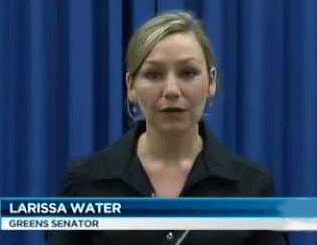
The old parties at both levels of government are so wedded to the mining industry that they are approving coal seam gas projects as quickly as possible with gaping holes of data left missing.
No state or federal government has ever knocked back a coal seam gas project.
What we need is a moratorium on coal seam gas mining until we fully understand its impacts on groundwater, the climate and food production. All indications are that those impacts will be unmanageable, and when we have clean energy alternatives that don’t threaten food production, it’s a no brainer.
Buying time, but not buying hearts http://www.abc.net.au/environment/articles/2013/04/05/3729905.htm LARISSA WATERS ABC t5 APR 2013 The risk to Australian farmland from CSG is not worth taking, says Larissa Waters.
Full-page advertisements by mining companies do nothing to persuade ordinary Australians that drilling for coal seam gas is completely safe. HAVE YOU COME ACROSS the full-page newspaper ads that Santos has taken out this week? They’re in response to the Four Corners expose of the dangers of the coal seam gas industry – that same program which Santos refused to speak to.
The advertising spree by the coal seam gas company is a desperate and obvious attempt to try and buy a social licence, which the community has so far refused because of the risks this industry poses to our water, farmland and climate.
But even with its massive advertising budget, Santos can’t get past the weight of serious public and scientific concern about this high-risk industry.
Three quarters of New South Wales voters oppose CSG exploration on agricultural land, as shown in a Fairfax surveythis week. As a Queensland senator and the Greens coal seam gas spokesperson, I constantly hear that same opposition loud and clear in my home state. And I hear it from our expert scientific bodies, who say we don’t understand the long term impacts of coal seam gas on our water resources, and could be doing damage to the water table which will take hundreds of years to fix, if it’s fixable at all.
Australians aren’t buying the big-mining spin because the facts are simply not on the industry’s side. Here are a few facts that were conveniently left out of Santos’ ad. Continue reading
Julian Assange brings fresh vision into Australia’s threatened democracy
 That Assange’s Wikileaks movement is growing a political arm in
Australia is a logical step. There is no party in this country which
unambiguously believes that we need to roll back the surveillance
state. Greens Senator Scott Ludlam from Western Australia has been a
champion of this issue but he is too often a lone voice in the Senate.
The Wikileaks Party and Julian Assange are filling a gap in the
political ideas marketplace in Australia. Its fresh approach to
policy making and to democratic values is compelling.
Running the Assange Senate campaign like racing into cold surf on hot
day https://australiansforhonestpolitics.wordpress.com/2013/04/05/running-the-assange-senate-campaign-like-racing-into-cold-surf-on-hot-day/
Greg Barns April 5, 2013
Julian Assange has been treated appallingly by the Gillard government,
and the Tony Abbott led Opposition for that matter. But Mr Assange’ s
Wikileaks and its underpinning philosophies of both blowing open the
world of secrecy that permeates bureaucracies and the political
masters they serve – and reducing the footprint of the state in the
lives of individuals in a democracy – are highly attractive. Continue reading
VIDEO: Danger of escalating crisis in North Korea
 VIDEO North Korea’s nuclear threats could lead to dangerous escalation of crisis, warns U.N. Secretary General Australian Broadcasting Corporation http://www.abc.net.au/lateline/content/2013/s3731193.htm Broadcast: 05/04/2013 Reporter: Emma Alberici
The U.N. Secretary General, Ban Ki-Moon has warned that North Korea’s nuclear threats could lead to an escalation of the crisis on the Korean peninsula.
Transcript
EMMA ALBERICI, PRESENTER: The UN Secretary General has warned North Korea’s nuclear threats to lead to an escalation of the crisis on the Korean Peninsula.
Ban Ki Moon says he’s concerned the North’s rhetoric might cause a miscalculation on the part of South Korea.
North Korea watchers believe the rogue regime doesn’t want a full scale war, they argue that Pyongyang is working toward as a small scale military provocation similar to its sinking of a South Korean ship in 2010.
ANDREA BERGER, NUCLEAR WEAPONS ANALYST: The difference this time around will be that South Korea has already made very clear that it will respond in kind to any such provocation and will not tolerate a death of South Korean citizens.
EMMA ALBERICI: South Korea is closely watching its northern neighbour’s missile movements with reports an intermediate range rocket has been moved to a launch site in the country’s east which is closer to US bases in the Pacific.
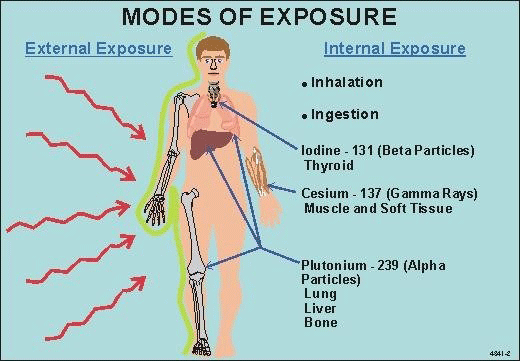
Cesium 137 and iodine 131 – internal radiation emitters are far more dangerous than external
Risk from internal exposure is 200-600 times greater than risk from external exposure. See this, this, this and this.
cesium-137 and radioactive iodine – the two main radioactive substances being spewed by the leaking Japanese nuclear plants – are not naturally-occurring substances, and can become powerful internal emitters which can cause tremendous damage to the health of people who are unfortunate enough to breathe in even a particle of the substances, or ingest them in food or water.
Fake Science Alert: Fukushima Radiation Can’t Be Compared to Bananas or X-Rays http://www.zerohedge.com/contributed/2013-04-01/fake-science-alert-fukushima-radiation-can%E2%80%99t-be-compared-bananas-or-x-rays George Washington 04/01/2013
“….Mixing Apples (External) and Oranges (Internal) Moreover, radioactive particles which end up inside of our lungs or gastrointestinal track, as opposed to radiation which comes to us from outside of our skin are much more dangerous than general exposures to radiation.
The National Research Council’s Committee to Assess the Scientific Information for the Radiation Exposure Screening and Education Program explains:
Radioactivity generates radiation by emitting particles. Radioactive materials outside the the body are called external emitters, and radioactive materials located within the body are called internal emitters.
Internal emitters are much more dangerous than external emitters. Specifically, one is only exposed to radiation as long as he or she is near the external emitter.
For example, when you get an x-ray, an external emitter is turned on for an instant, and then switched back off.
But internal emitters steadily and continuously emit radiation for as long as the particle remains radioactive, or until the person dies – whichever occurs first. As such, they are much more dangerous. Continue reading
The toxic and secretive trail of radioactive waste to Murmansk, then Mayak, in Russia
 After unloaded in Murmansk, the containers with nuclear fuel is sent by rail to Mayak, Russia’s reprocessing plant just north of Chelyabinsk in the South Urals.
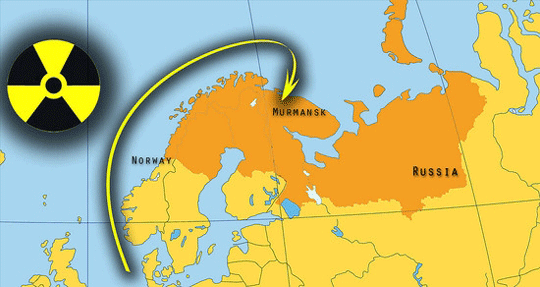
Norwegian Radiation Protection Authorities had no knowledge about the nuclear voyage before being asked by BarentsObserver to give a comment. Then, the vessel “Mikhail Dudin” had sailed along Norway’s long coastline for nearly five days and had already delivered its cargo in Murmansk.
“We have no information about any shipment of nuclear waste outside the coast of Norway last week,” NRPA Director Ole Harbitz said. In Murmansk, information about the nuclear waste arrival was first made public by the non-governmental organization Kola Ecological Center. The group is highly concerned about the radiation safety risk such cargo poses to the city’s 300,000 inhabitants. Maybe for good reasons; similar cargo is expected to arrive again. Continue reading
Uranium industry casting around for ways to save itself, in declining market
 HOW TO CURB DECLINING URANIUM PRICES http://www.namibian.com.na/letters/full-story/archive/2013/april/article/how-to-curb-declining-uranium-prices/ Martin Harris
URANIUM prices have suffered a significant decline since the Fukushima nuclear disaster in Japan.
The drop in prices has had a global affect on operations for many companies. In Namibia this can be seen from the pending retrenchment of workers at Rössing Uranium Mine and the upcoming temporal closure of Trekkopje Uranium Mine.
Namibia is ranked among the top five producers of uranium in the world, alongside Kazakhstan, Canada, Niger and Australia. Together the above mentioned countries account for more than 50 percent of world production. To get the best out of our uranium reserves, an OPEC-style trading block should be considered. Russia and South Africa, the world’s two major platinum producers are in the process of implementing such a block. Creating such a market regulatory body similar to OPEC will curb the over-supply of uranium and hence increase direct price control.
Namibia can take the initial step and spearhead the formation of such a block. This would allow top uranium producing countries to influence the market and hence prevent future retrenchments, mine closures and will result in Namibia getting the best out of its resource.
The rat risk again leads to failure of Fukushima cooling system
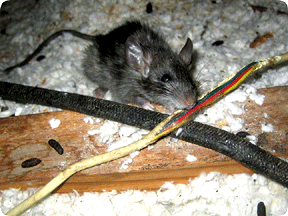
“We were installing wire nets to keep the rats out. But the end of one of the wires may have momentarily come into contact with a live terminal,” said Masayuki Ono, general manager at Tepco’s Nuclear Power and Plant Siting Division. “The next moment, there were sirens.”
Rat Chase Again Bedevils Fukushima Nuclear Plant http://www.nytimes.com/2013/04/06/world/asia/rat-chase-again-bedevils-fukushima-nuclear-plant.html?_r=0 By HIROKO TABUCHI April 5, 2013 TOKYO — Workers at the stricken Fukushima nuclear power plant who were installing wire nets Friday to keep rats away from a vital cooling system instead tripped up that system, causing it to fail for the second time in weeks. The spent-fuel pool at the site’s No. 3 reactor went without fresh cooling water for almost three hours on Friday afternoon, said the plant’s operator, the Tokyo Electric Power Company, or Tepco. Continue reading
Kevin Rudd called on China to quell North Korean aggression
Kevin Rudd says China must use its influence to quell North Korean aggression, news.com.au: AAP March 30, Rudd says world looking to China to influence North Korea FORMER prime minister and foreign minister Kevin Rudd has told officers of Beijing’s main defence academy that the world is looking to China to use its influence to quell the aggression of North Korea.
In a speech this week to China’s National Defence University, reported by The Australian today, Mr Rudd said North Korea’s nuclear program poses a serious threat to China’s relations with its neighbours.
The speech was made two days before North Korea announced that it had formally entered into a “state of war” with South Korea…….
1 This month

of the week – Australians for War Powers Reform (AWPR)
To see nuclear-related stories in greater depth and intensity
 Antinuclear