Analysing the motives of anti wind power campaigners
5. Nuclear Advocates
These people may or may not believe that global warming is real, but they are invested heavily in nuclear energy as the answer to almost all of our energy needs and often have a poor understanding of grid management. They tend to be smart but ignore human dynamics of problems, and have a blind spot about the effort and time required to develop nuclear engineers and maintenance workers. Their greatest challenge to renewables campaigns is that their arguments are leveraged by others who are just against wind energy…….
If countered, the average nuclear advocate will drag out more and more factoids about nuclear energy’s value and wind power’s lack of value. They will likely reference amateur and professional studies which look good until you dig in and realize the biases. Generally a time suck, so avoid digging into their arguments in too much depth…… . Talk past them to those listening.
Examples: Willem Post (USA), James Lovelock (sadly, UK), Barry Brook (Australia)
 NOT JUST NIMBYS: UNDERSTANDING ANTI-WIND ENERGYCAMPAIGNERS Barnard on Wind, by Mike Barnard 8 April 13, NIMBY is a nice crisp acronym, but it is completely inadequate as a categorization of the various people fighting against broader penetration of renewables in energy grids world wide and their motivations…..
1. NIMBY – Not In My Back Yard Continue reading
Financial failure of Britain’s nuclear reprocessing plant hits Japan’s utilities
“Britain plans to shut down its reprocessing plant after the last shipment of radioactive waste to Japan is finished,” Sawai said. “Japan should abandon the planned reprocessing activity and rather ponder how to restore and manage spent nuclear fuel.”
April 08, 2013 By SHIN MATSUURA/ Staff Writer Source : The Asahi Shimbun http://ajw.asahi.com/article/0311disaster/fukushima/AJ201304080007
The cost for overseas reprocessing of spent nuclear fuel from Japanese nuclear power stations has nearly tripled since 1995 because of problems at a contracted British plant, which is likely to further hurt utilities and be passed along in rate hikes for electricity users.
The cost surged apparently because the plant is plagued with a slew of problems, including leakage of waste liquid.
The current cost at the plant that Japanese utilities commissioned for reprocessing is 122 million yen ($1.28 million) per container of vitrified high-level radioactive waste. That compares with 44 million yen in 1995, when the shipment of such waste from France back to Japan started.
The overall cost for reprocessing spent nuclear fuel into 790 more containers of waste that are scheduled to be returned to Japan is expected to be around 100 billion yen. Continue reading
France’s nuclear industry in big trouble, Britain’s new nuclear program in doubt
 EDF ‘in big trouble’ says French nuclear expert http://www.telegraph.co.uk/finance/newsbysector/energy/9978548/EDF-in-big-trouble-says-French-nuclear-expert.html 9 Apr 13,
Financial problems facing EDF could force the French energy giant to pull out of the £14bn project to build the first of a new generation of nuclear power plants in Britain, a French expert has warned. Mycle Schneider, a former energy adviser to the French government, questioned whether EDF could finance the investment.
 “EDF is in big trouble. The whole of the nuclear power industry in France is in big trouble,” he told BBC Radio 4’s Today programme.
David Cameron was due to have raised the issue with the president of France, Francios Hollande, during his lightning tour to try to win support for EU reforms. However, he cut short his visit after the death of Margaret Thatcher.
President Hollande is seen as a pivotal figure because he wants state controlled EDF to curb its nuclear power ambitions and invest heavily in improving safety at plants in France as well as giving a higher priority to renewable energy.
Negotiations on a deal between EDF and the Government over the construction of a massive plant at Hinkley Point in Somerset are deadlocked because the two sides have failed to agree on a price for electricity and a range of other guarantees. EDF is also trying to find a partner to fill the gap left by Centrica which has abandoned nuclear power.
Lord Deighton, Treasury Commercial Secretary and former chief executive of the London Olympic organising committee, has been given the task of hammering out an agreement the Government regards as crucial to meet its nuclear power ambitions to reinforce the electricity generating network and avoid the “lights going out.”
Mr Schneider said that EDF with debts of €39bn (£33.3bn) might not have the cash to put into Hinkley and added: “It’s not certain it will go ahead.
“There are a long list of issues that need to be agreed, not only the strike price. Even if there is an agreement the financing package has to be put together. It’s a very long-term investment of very uncertain levels of realisation.”
Exposing Sarah Laurie’s deceptive anti wind farm propaganda
 Sarah Laurie’s windfarm fearmongering enough to make you sick, Independent Australia, 9 Apr 13 In spite of 17 reviews and a new landmark study, Sarah Laurie defiantly continues her propaganda campaign against wind farms. Mike Barnard reports. A LANDMARK STUDY by Fiona Crichton at the University of Auckland recently showed that propaganda linking the low levels of noise from wind to sickness is a strong cause of anxiety related symptoms. The control group, which hadn’t watched the video of health fears from anti-wind campaigners, had no symptoms.
The findings backed up previous reports in Australia showing “unwarranted fear-mongering might cause greater health impacts than the presence of any actual ‘Wind Turbine Syndrome’”.
 Sarah Laurie, head of the Waubra Foundation, an offshoot of the anti-wind, astroturfer, the Landscape Guardians, is the source of a great deal of the anti-wind propaganda which is harming people’s health.
To date, Sarah Laurie’s work has been largely constrained to south-eastern Australia, however she has begun to spread her wings. We can expect a related spread of so called ‘Wind Turbine Syndrome’, an illness that Professor Simon Chapman has famously dubbed a ‘communicated disease’. (Due to her active spreading of disinformation, she’s up for the Australian Skeptics’ annual Bent Spoon award for 2013.)….. Continue reading
1 This month
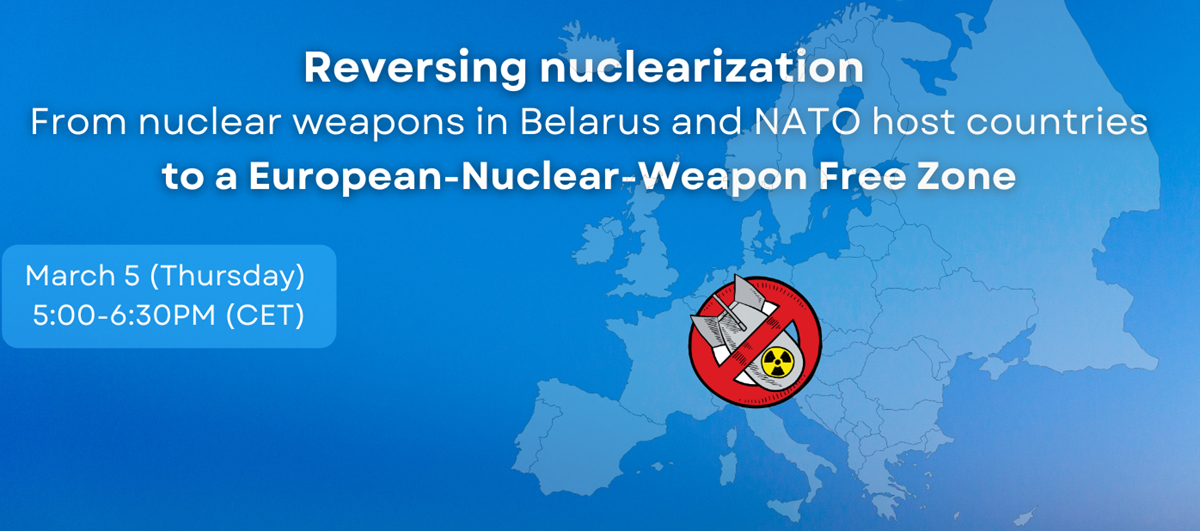
6 March -Online – Reversing nuclearization:
From nuclear weapons in Belarus and NATO host countries to a European-Nuclear-Weapon Free Zone
Mar 6, 2026 03:00 AM in Canberra, Melbourne, Sydney

of the week – Australians for War Powers Reform (AWPR)
To see nuclear-related stories in greater depth and intensity
 Antinuclear