Don’t let Australia’s uranium lobby remove safeguards – say doctors
It is essential that appropriate environmental and human safeguards remain, and that uranium mining and milling remains within the definition of “nuclear actions” for the purposes of the EPBC Act. There is a clear need for federal oversight to ensure clear and consistent implementation of these measures
Medical Assocation for the Prevention of War (MAPW) SUBMISSION ON FEDERAL REGULATION OF URANIUM MINING, by Dr Margaret Beavis April 2013 The uranium mining industry is attempting to remove federal overview of uranium mining. MAPW Vice-President Dr Margaret Beavis has prepared this submission to the Productivity Commission arguing that federal oversight should remain, and noting that as risks to health and the environment become more apparent, radiation regulation is increasing internationally.:
 It is concerning that the uranium industry has used the expression “mild radiation” to describe its radiological environmental impacts, when there is no regulatory basis or definition to use this term, potentially giving the impression that the levels of radiation in the uranium mining industry are without risk to the environment. The evidence is clear and unassailable that this is not correct. Furthermore, it is appropriate that uranium mining continue to be considered a ‘nuclear action’ as specified by the EPBC Act as the radioactivity derives specifically from nuclear decay processes. Tailings from uranium mining are radioactive for millennia, resulting in unique environmental considerations for every uranium mine.
The International Commission on Radiological Protection has determined that the dose coefficient for radon gas, one of the sources of radioactivity from uranium mining, needs to be doubled, indicating that it is actually thought to be double the previously estimated carcinogenic hazard.1. ARPANSA is currently in the process of revising dose estimates to workers. It follows that risks to others is doubled and makes it even more essential appropriate mitigation strategies are introduced. It also follows that the environmental risk is also increased. Continue reading
Mainstream media ignores USA government’s weakening of radiation safety standards
 Shocking raise in nuclear radiation ‘safety levels’ announced Digital Journal By R. C. Camphausen Apr 17, 2013 – Washington – Shocking is not only that the White House is significantly raising so-termed ‘safety levels’ for nuclear radiation in drinking water and soil, but also that mainstream media are all too quiet about this assault on people’s health.
increase a longstanding 1 in 10,000 person cancer rate to a rate of 1 in 23 persons exposed over a 30-year period.
Remembering Australia’s wars – what about the one against the Aborigines?
 on the 97.8 per cent of human affairs conducted in this place before colonisation, on the 2000 generations who made their lives where Hyde Park now stands, on what happened in our obtaining of it, and on what became of the ‘dispossessed’, not a word or stone is spent.
It’s time we started talking about how Anzac Day can embrace difficult realities of war and nation, and still do the other things it needs to
The Australian wars that Anzac Day neglects, EUREKA STREET, DEAN ASHENDEN APRIL 21, 2013 For more than 30 years the Australian War Memorial in the nation’s capital has refused to consider any recognition of the long and often violent conflict between black and white.
The proposal that the memorial might commemorate the ‘frontier wars’ first came in 1979 from Geoffrey Blainey. It has since been repeated by commentators and scholars including the then-principal historian at the memorial, Dr Peter Stanley, and a former army chief of staff, Lieut-General John Coates. To no avail.
The memorial is not alone in its silence. Sydney’s Hyde Park, just a few hundred metres from where it all began, has almost as many monuments, memorial gardens and commemorative fountains as trees, most to do with our loss, sacrifice and valour in war, the struggles of our explorers and pioneers, or the sagacity of our civic leaders. Continue reading
Plutonium in the continuing leakage of high level radiation in water from Fukushima nuclear reactors
 The most recent report on the leakage problem said that about 22 liters of radioactive water had leaked from gaps between the pipes used to transfer it from underground water storage tank into an another tank, and that the level of radioactivity in the water was 290,000Bq/m3.
  The underground tanks were meant to store low level of radioactive water after being filtered through ALPS. But they have been using them to store high level of radioactive water (including the β (beta)emitting nuclide, Strontium and the α (alpha)emitting nuclide, Plutonium).
 Fukushima report: Plutonium should be in the leakage! 汚染水問題に関する小出先生のコメント、報道するラジオより。 追加報告:プルトニウムも汚染水に混じっているはず! by Mia (JANUK) 18 April 2013
…..The last one was plutonium 241, which had radiation dose about 50 times as much as the total of the other three(PU238, PU239 & PU240)…..
….The underground tanks were meant to store low level of radioactive water after being filtered through ALPS. But they have been using them to store high level of radioactive water (including β (beta) emitting nuclide, Strontium and α (alpha) emitting nuclide, Plutonium)….. Continue reading
70% of Portugal’s electricity comes from renewable energy
Portugal Provides 70% of Electricity Using Renewable Energy , Design Build, 19 April 13, By Marc Howe Figures from Portugal’s electricity network operator indicate that 70 per cent of all electricity consumed in the country during the first quarter of this year was derived from renewable energy sources, leading to a marked decline in the usage of conventional fossil fuels for power generation purposes. Continue reading
Hear Radioactive Show podcast about the Radioactive Exposure Tour 2013
 http://www.3cr.org.au/radioactive/podcast/radioactive-show-13042013 Radioactive Show 13.04.2013
What Happens on Rad Tour… Doesn’t stay on Rad Tour. The Radioactive Exposure Tour 2013, organised by Friends of the Earth, ventured into the nuclear heartlands of South Australia and back. This weeks show is an audio reportback of the trip, and the inspirations and challenges of learning about the nuclear industry. Bhargavi Dilipkumar, an Indian anti-nuclear activist gives a talk on the shore of Lake Eyre, and a salty poem is shared.
Doctors make powerful statement on protection of animals from uranium mining radiation
 Medical Assocation for the Prevention of War (MAPW) SUBMISSION ON FEDERAL REGULATION OF URANIUM MINING, by Dr Margaret Beavis April 2013 “…..With regard to non-human species, the 2010 ARPANSA Technical Report No. 154 entitled
Height of waves is increasing due to climate change
 VIDEO Climate change increasing wave height ABC News http://www.abc.net.au/news/2013-04-18/climate-
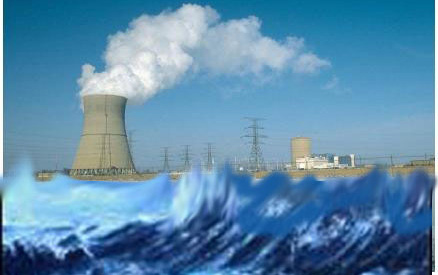 change-predicted-to-increase-wave-height/4637624 By Fiona Blackwood Apr 19, 2013 Scientists are beginning to predict how climate change will influence the height of waves.
The impact on wave height has been a neglected area of research until now.
CSIRO research scientist Mark Hemer says buoys and satellites around the world have been modelling how changes in atmospheric circulation will influence sea swells. “We see an increase in wave heights in the Southern Ocean and we see decreases in a lot of the rest of the global oceans,” he said.
Waves in the Southern Ocean could increase by half a metre over the next century.
Dr John Hunter, from the Antarctic Climate and Ecosystems CRC, says wave height will have a similar impact on coastal areas as sea level rise.”So changing waves and sea level can cause recession probably of order in some places say 100 metres this century,” he said.
“That’s quite likely a lot of houses are within 100 metres of the shoreline.” For the first time wave height will be included in a new report by the International Panel on Climate Change.
1 This month
Chernobyl: The Lost Tapes – A good documentary on Chernobyl on SBS available On Demand for the next 3 weeks– https://www.sbs.com.au/ondemand/tv-program/chernobyl-the-lost-tapes/2352741955560
15 April – Zoom –Nuclear Power is Not the Solution
Apr 15, 2026 01:00 AM in Canberra, Melbourne, Sydney

Join the International Physicians for the Prevention of Nuclear War (IPPNW) on Tuesday, April 14th for a timely webinar exploring the risks associated with nuclear power and challenging the myth that it offers a simple, safe, carbon-free solution to the climate crisis

21 April Webinar: No Nuclear Weapons in Australia
Start: 2026-04-21 18:00:00 UTC Canberra, Melbourne, Sydney (GMT+10:00)
End: 2026-04-21 19:30:00 UTC Canberra, Melbourne, Sydney (GMT+10:00)
Event Type: Virtual
A virtual link will be communicated before the event.
Host Contact Info: australia@icanw.org

of the week – Australians for War Powers Reform (AWPR)
To see nuclear-related stories in greater depth and intensity
 Antinuclear